
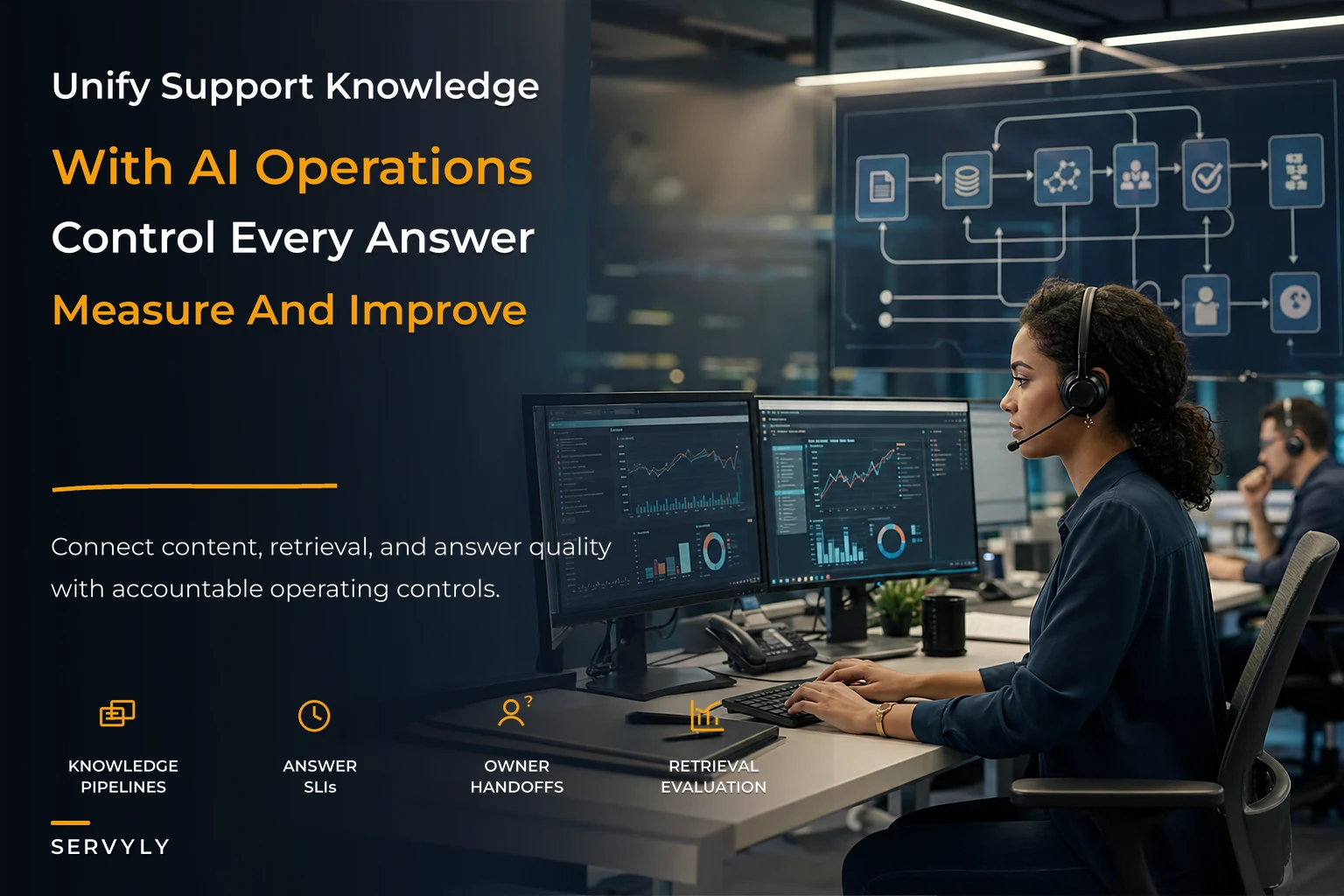

Most support teams don't have an AI problem. They have a wiring problem.
The knowledge base lives in one tool. The ticketing system lives in another. Someone exported a bunch of articles into a vector database six months ago and nobody's touched it since. The AI assist feature is pulling answers from embeddings that no longer match what's actually published. And when a customer gets a wrong answer, there's no clean way to trace it back to the article, the chunk, or the retrieval step that caused it.
The pieces exist. They're just not running as one loop with defined handoffs. That's the gap this article is about—treating your support knowledge AI operating model as a connected production system with contracts between stages, not a collection of features bolted onto each other.
Below is the full operating model: the pipeline stages and who owns them, the contracts that keep stages honest, the metrics that tell you it's working, the gates that keep it safe, and the executive controls that keep it from quietly rotting.
The loop that actually has to run
Forget the architecture diagram for a second. The thing you're running is a loop, and the loop either closes or it doesn't.
A ticket comes in. The resolution contains knowledge—a fix, a workaround, a clarification. That knowledge should become (or update) an article. The article should get chunked and embedded into whatever your retrieval layer uses. Retrieval should surface it when a similar question shows up—either to an agent as assist, or to a customer as a deflected answer. And the quality of that answer should feed back into whether the article was good, whether retrieval found the right thing, and whether the whole thing needs correcting.
Visualizing this loop helps teams align owners and handoffs.
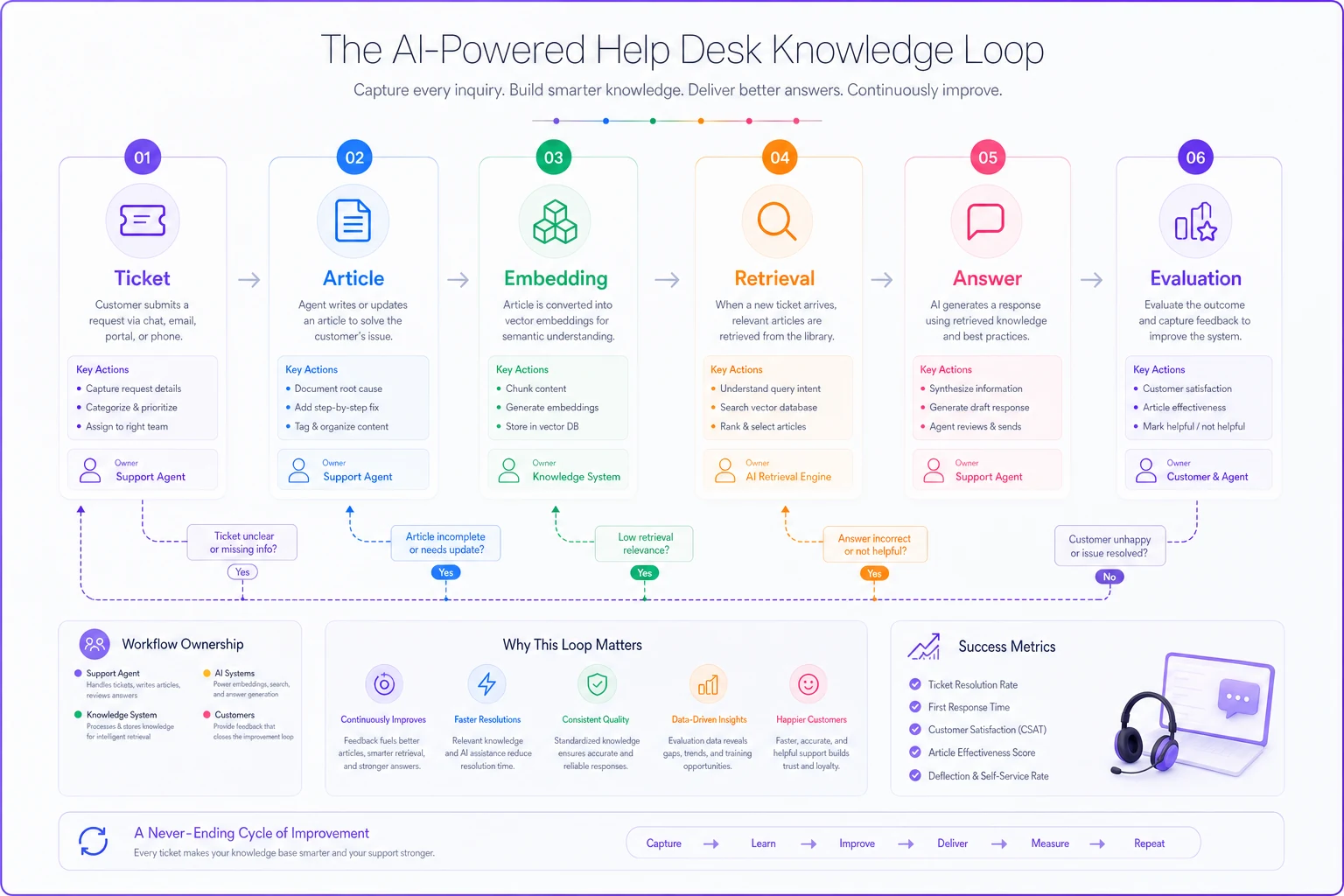
Most teams only build half the loop. They build ticket→article (capture) or they build retrieval→answer (deployment), but the two halves don't talk. Articles get written that retrieval never surfaces, and retrieval keeps surfacing stale content that nobody's maintaining.
When the loop is broken, you get a very specific symptom. Your help center looks healthy—hundreds of articles, decent search—but AI answer quality is stuck and nobody can explain why. Almost always, the deployment half is drawing from a snapshot of the capture half taken months ago.
So the first principle of the operating model: every stage has an input contract and an output contract, and a named owner who's accountable for both.
The pipeline stages and their contracts
A contract here just means: what this stage promises to deliver downstream, in a format the next stage can rely on. When a contract breaks, you know exactly which handoff failed instead of debugging the whole system.
Never lose track of a customer request again.
Servyly helps you track, assign, and resolve every ticket quickly and efficiently.
- Centralized ticket management
- Automated response workflows
- Team collaboration tools
No credit card required
| Stage | Input contract | Output contract | Owner |
|---|---|---|---|
| Ticket capture | Resolved ticket with tagged resolution | Structured "knowledge candidate" (problem, cause, fix, scope) | Support lead / QA |
| Article authoring | Knowledge candidate | Published article with metadata, versioning, review date | KB manager |
| Embedding pipeline | Published article (versioned) | Chunked, embedded, indexed content with source IDs | Data / platform owner |
| Retrieval | User query + index | Ranked candidate passages with confidence scores | Platform owner |
| Answer generation | Retrieved passages + query | Answer with citations + confidence + abstain option | AI/automation owner |
| Evaluation | Answer + outcome | Quality signals routed back to article + retrieval | Analytics / QA |
The column people skip is the last one. Evaluation isn't a report you generate quarterly—it's a stage in the pipeline that routes signals back to earlier stages. If a bad answer can't be traced to "article #4412, chunk 3, retrieval rank 2, confidence 0.71," your loop isn't closed. It's just a pipeline that runs in one direction.
Teams tend to over-invest in the embedding stage—fancy chunking, model swaps—and under-invest in capture. Garbage capture produces garbage answers no matter how good your retrieval is. The quality of the ticket→article handoff caps everything downstream. If you only fix one stage, fix that one.
The flow from ticket to answer—and back
Understanding which stage hands off to what helps clarify where contracts break. Here's the sequence as it actually runs:
-
A ticket resolves and gets tagged with a structured knowledge candidate (problem, cause, fix, scope)
-
KB manager authors or updates an article from that candidate, with metadata and a review date
-
The embedding pipeline chunks and indexes the published article within a defined freshness window
-
Retrieval scores incoming queries against the index and returns ranked passages with confidence
-
Answer generation uses those passages to produce a cited response—or abstains if confidence is too low
-
Evaluation samples the answers, grades them, and routes failure signals back to the article, retrieval layer, or generation config that caused them
The loop closes at step 6. Without that routing step, you're measuring failures without fixing them—which mostly just generates anxiety.
Retrieval contracts: the part everyone underspecifies
Retrieval is where most "mystery" answer failures actually live, and it's the stage with the weakest contracts in most orgs.
-
Freshness guarantee. How long after an article is published or updated does it appear in retrieval? If the answer is "whenever the next batch job runs," you have a stale-answer problem waiting to happen. A real contract looks like: published articles are indexed within 30 minutes; a reconciliation job verifies index-to-source parity nightly.
-
Source parity. Every chunk in the index must map to a live, published article. Orphaned chunks—embeddings whose source article was deleted or unpublished—are a top cause of confidently wrong answers. The contract: zero orphaned chunks tolerated; nightly job flags and removes them.
-
Confidence surfacing. Retrieval must return a score the answer stage can act on. Without it, generation can't decide when to abstain, and you lose your single most important safety lever.
-
Coverage visibility. You need to know which incoming queries retrieval couldn't answer well—low top-score queries. This is your content gap list, and it's the most actionable artifact the whole system produces.
Enforce a short freshness window for top-traffic articles to reduce high-impact stale answers.
That last point deserves emphasis. The highest-ROI output of a retrieval layer isn't the answers it gives—it's the map of questions it can't answer. One mid-market SaaS team ran their last 60 days of chat queries through retrieval scoring and found roughly a quarter had no passage above their confidence threshold. Those queries clustered into about a dozen themes. Writing those dozen articles moved their deflectable coverage noticeably within a single sprint—far more efficient than rewriting content that was already working.
If you're still figuring out how to sequence knowledge work against retrieval design, the phased approach in Avoid Costly AI Mistakes in Support pairs well here—it covers the sequencing mistakes that make retrieval contracts impossible to enforce later.
Answer SLIs and SLOs: measuring the thing customers actually experience
Uptime and latency are easy. Answer quality is the hard part, and it's what actually determines whether this system earns trust or burns it.
Here are the SLIs worth tracking, and they're not interchangeable:
-
Answer accuracy rate — of answers given, what share were factually correct (sampled and graded). This is your north star.
-
Citation faithfulness — does the answer actually match the sources it cites, or did generation drift? A faithful-but-wrong answer and an accurate-but-ungrounded answer are different failures with different fixes.
-
Abstain rate — how often the system correctly declines to answer. A near-zero abstain rate is a red flag, not a win. It means the system is guessing.
-
Deflection rate (confirmed) — not "customer didn't reply," but customer confirmed resolution or didn't reopen within a defined window.
-
Escalation-after-answer rate — customer got an AI answer, then escalated anyway. High numbers here mean answers are plausible but useless.
The mistake is collapsing these into one "satisfaction" number. Accuracy, faithfulness, and abstain behavior pull in different directions, and a single metric hides the tradeoff you're actually making.
A reasonable starting SLO set for a team past the experiment stage:
-
Sampled answer accuracy ≥ 92%
-
Citation faithfulness ≥ 95%
-
Confirmed deflection without reopen within 72h ≥ 40%
-
Escalation-after-answer ≤ 15%
Those are starting points, not gospel. The number that matters is the one you hold yourself to and act on when it breaks. An SLO you don't enforce is just a slide deck.
A measurement approach you can actually run
Measuring accuracy sounds expensive. It doesn't have to be:
-
Each week, pull a random sample of 50–80 answered queries, stratified across your top intent categories so rare-but-critical topics still get represented.
-
Have two reviewers independently grade each on accuracy and faithfulness using a fixed rubric. Track inter-rater agreement—if reviewers consistently disagree, the rubric is the problem, not the AI.
-
Log every failure with its trace
article ID, retrieved chunks, confidence score, and failure type (wrong retrieval / faithful-but-wrong-source / generation drift / genuine content gap).
-
Route each failure type to the owner who can fix it. Content gaps go to the KB manager. Retrieval failures go to the platform owner. Drift goes to the AI owner.
That last step is what makes this worth doing. A measured failure that nobody owns is just anxiety. The process isn't about the grading—it's about the routing.
Safety gates: where humans stay in the loop
Not every answer should flow straight to a customer. The operating model needs gates—rules that decide when an answer ships automatically, when it goes to an agent first, and when the system refuses to answer at all.
The cleanest structure uses confidence and blast radius together:
-
High confidence + low risk → auto-answer (e.g., "how do I reset my password")
-
High confidence + high risk → agent review before send (anything touching billing, cancellations, security, legal)
-
Low confidence, any risk → abstain and route to human, with the retrieved context attached so the agent isn't starting cold
The subtle failure here is defining "risk" too narrowly. Risk isn't just regulatory—it's reputational and irreversible-action risk. An AI confidently telling a customer the wrong refund policy isn't a compliance issue, but it's exactly the kind of wrong answer that ends up screenshotted on social media.
Gates also need rollback criteria. A rollback isn't a vague "turn it off if it's bad." It's a pre-agreed threshold: if sampled accuracy drops below 85% for two consecutive days, or citation faithfulness drops below 90%, auto-answer is disabled and everything routes to agents until the cause is found. Deciding this in advance is the difference between a controlled rollback and a panic at 4pm on a Friday.
The thresholds, human-in-the-loop logic, and rollback mechanics deserve their own treatment—Automation Governance for Support covers how to set those gates without strangling the automation that's actually helping.
Executive controls: keeping the system from rotting quietly
Here's what breaks at scale, and it breaks silently. The system works at launch, everyone celebrates, attention moves on, and eighteen months later the answers are subtly wrong and nobody noticed the drift.
AI-powered knowledge systems don't fail loudly. They degrade. Articles go stale, the product changes, embeddings keep pointing at outdated chunks, and accuracy erodes a percentage point at a time until a customer complaint finally forces someone to look.
Executive controls exist to make degradation visible before it's expensive. At the leadership level, you need a small, stable set of indicators reviewed on a consistent cadence:
-
Trend lines (not single points) on answer accuracy and deflection
-
Coverage gap count—and whether it's growing or shrinking
-
Stale-article count (articles past their review date still live in retrieval)
-
Rollback events and their causes
-
Cost-per-answered-query trend
Teams that keep these systems healthy over time treat the knowledge base and the AI layer as one governed asset with a budget and an owner, not two separate initiatives. The governance mindset in Why a Governance-First Knowledge Strategy Keeps Your Help Center Healthy is the foundation this whole operating model sits on—without it, every pipeline below eventually drifts.
Owner roles and cadences
A system with no named owners is a system that decays. Here's the role split that works, and the rhythm each role runs on.
| Role | Owns | Cadence |
|---|---|---|
| KB Manager | Article quality, review dates, gap backlog | Weekly gap review, monthly stale-article prune |
| Platform Owner | Embedding pipeline, retrieval freshness & parity | Daily index health check, weekly retrieval scoring |
| AI/Automation Owner | Answer generation, gates, confidence tuning | Weekly SLI review, rollback decisions |
| Analytics/QA | Answer sampling, grading, failure routing | Weekly sample grade, monthly rubric calibration |
| Support Director | SLO enforcement, budget, cross-team conflicts | Monthly trend review, quarterly target reset |
The cadences matter as much as the roles. Daily for index health (because freshness fails fast), weekly for quality signals (because you need enough volume to be meaningful), monthly for pruning and trends (because content rot is slow). Run everything at the same cadence and you'll either over-react to noise or miss slow drift entirely.
One honest note: on small teams, one person wears three of these hats. That's fine—as long as the responsibilities are explicit. The failure mode isn't too few people; it's responsibilities that live nowhere because everyone assumed someone else had them.
When this full model makes sense—and when it doesn't
This is a real operating model, and real operating models have overhead. Worth being honest about fit.
When it makes sense:
-
You're handling more than a few hundred repeat-pattern questions a week
-
Wrong answers carry real cost (churn, compliance, escalations)
-
You have at least part-time ownership to assign to the roles above
-
Your content is already decent—AI amplifies whatever's underneath it
When it's a bad idea:
-
Your knowledge base is thin or chaotic. Fix the content first. Retrieval over bad content just makes bad answers faster.
-
Your ticket volume is genuinely low and varied. The loop needs repeat patterns to pay for itself.
-
Nobody can own it. An unowned AI answer system is worse than no system—it fails invisibly.
Who should hold off for now: teams still fighting tag chaos and inconsistent resolution capture. The ticket→article handoff is the foundation of the whole loop. If resolutions aren't being captured cleanly, every downstream stage inherits the mess.
A real scenario
A B2B software company, roughly 25 agents, was running an AI assist feature on top of about 900 help articles. On paper it looked fine. In practice, agents had quietly stopped using the suggestions because "half of them were wrong."
When they finally logged failures properly, the trace was obvious. A large chunk of wrong suggestions were pulling from articles that had been updated in the help center but never re-embedded. The index was running off a snapshot from a product version two releases back. Retrieval was doing its job perfectly—on stale data.
They didn't rebuild anything. They added a freshness contract (articles re-indexed within the hour of publishing), a nightly parity job to remove orphaned chunks, and a weekly 60-answer grading sample routed by failure type. Within roughly two months, sampled accuracy climbed from the low 70s to the low 90s—and more tellingly, agents started using suggestions again because they'd learned to trust them.
The lesson wasn't "we needed better AI." The pieces were all there. What was missing was the wiring between stages and the contracts that would have caught the drift months earlier.
Running it as one system
The teams that get durable value from AI in support aren't the ones with the fanciest retrieval or the newest model. They're the ones who stopped treating capture, embedding, retrieval, and answering as separate projects and started running them as a single loop—with contracts at every handoff, owners for every stage, and gates that fail safe.
Everything in this operating model—the retrieval contracts, the answer SLOs, the measurement approach, the rollback thresholds, the executive trend review—exists to do one thing: make invisible failures visible before a customer finds them for you.
Start with the weakest handoff in your org right now. For most teams, that's either ticket→article capture or article→embedding freshness. Fix that contract, assign its owner, give it a cadence, and then move to the next weakest link. You don't need the whole system live on day one. You need the loop to close—and then you need to keep it closed.
Ready to transform your support operations?
Join 500+ support teams using Servyly to reduce resolution times, improve customer satisfaction, and boost team productivity.