


Most support orgs don't have a talent model. They have a salary spreadsheet, a vague sense of who's "senior," and a promotion process that kicks in whenever someone threatens to quit. That's not a system — that's reactive damage control dressed up as HR.
The problem usually isn't that managers don't care. It's that pay, leveling, and performance live in three separate worlds — finance owns comp, HR owns titles, and support managers own the actual work. Nobody owns the connection between them. So you end up with a Tier 2 agent making less than a Tier 1 hire from last quarter, a "senior" title that means nothing operationally, and a retention problem nobody can explain because the data to explain it simply doesn't exist.
This piece is about wiring those worlds together into one runnable operating model. Not a philosophy — actual artifacts you can use: competency ladders that map to real work, pay-band formulas HR will sign off on, calibration rituals that prevent rating drift, and small experiments that tell you whether your pay decisions are moving retention or just moving money around.
Why the three-worlds split breaks everything
Here's the pattern that keeps showing up across support teams of almost any size. Someone gets hired at a market rate pulled from a job board. Six months later, a new hire comes in at a higher rate because the market moved. Now you have pay compression — experienced people quietly earning less than the newest ones. Nobody notices until someone sees an offer and does the math.
At the same time, promotions happen on vibes. An agent is "clearly ready," so they get bumped. But "ready" was never defined, so the next manager has a different bar, and within a year your Tier 2 pool has people with wildly different actual capability. The title stops predicting anything. Which means the pay attached to it stops predicting anything either.
The deeper issue is that none of this gets measured against outcomes. You can't answer the one question that actually matters — does paying this person more keep them longer and make them more productive? — because comp, leveling, and performance data were never designed to be joined.
In real operations, this usually breaks down when the org grows past the point where one manager held the whole picture in their head. Around 15–25 agents is where it tends to crack. Before that, informal works fine. After that, informal gets expensive.
The operating model, from the ground up
A talent operating model has four parts, and they only work when connected:
Never lose track of a customer request again.
Servyly helps you track, assign, and resolve every ticket quickly and efficiently.
- Centralized ticket management
- Automated response workflows
- Team collaboration tools
No credit card required
-
Competency ladder — what each level actually means, in observable terms
-
Pay bands — a defensible salary range mapped to each ladder level
-
Calibration ritual — a recurring process that keeps ratings and promotions consistent across managers
-
ROI experiments — small, measured tests to validate that your pay and retention assumptions are real
Think of it as a loop. The ladder defines the work. The bands price the work. Calibration keeps the ladder honest. Experiments tell you if the whole thing is paying off. Break any one link and the others start lying to you.
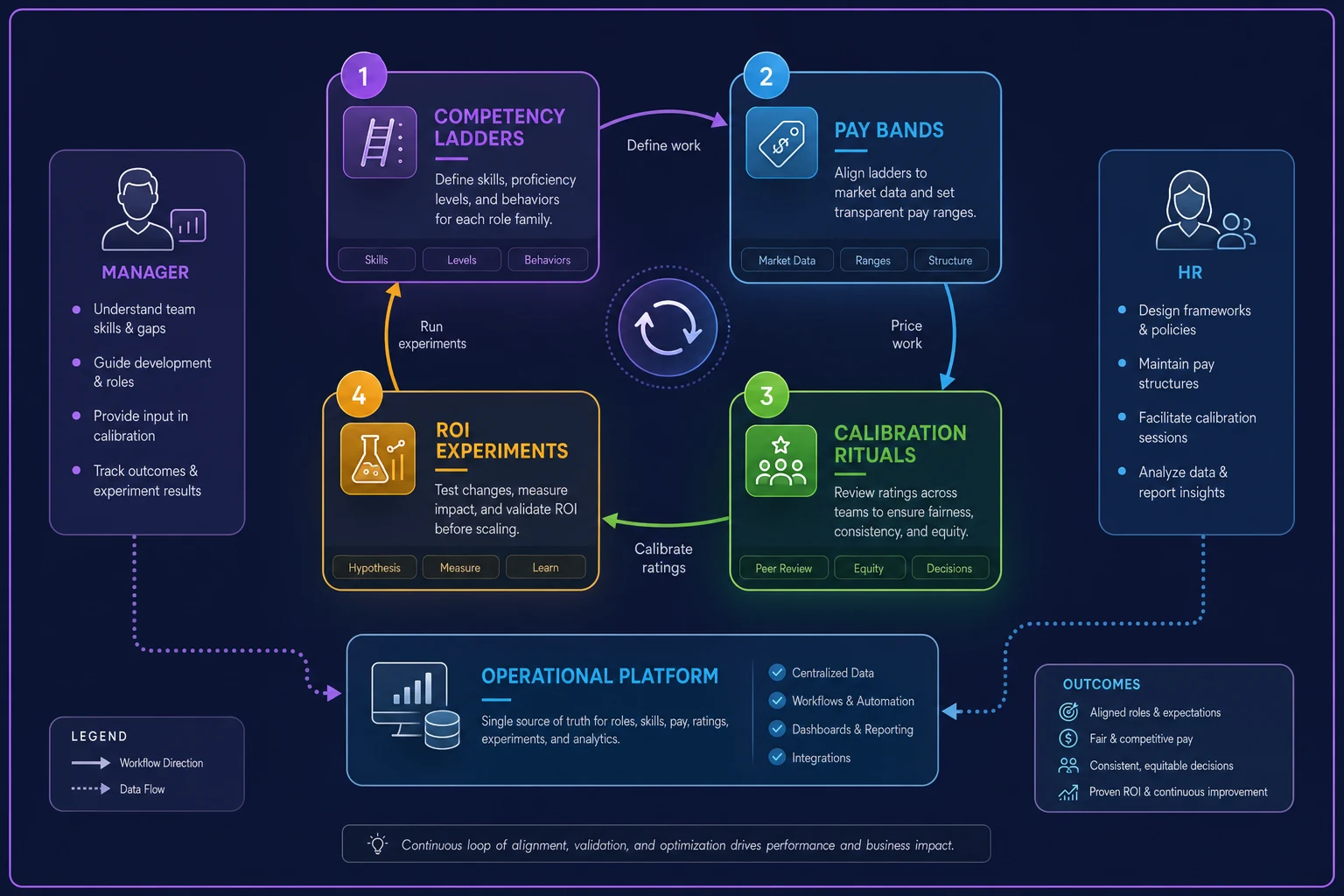
Here's a quick visual of that loop.
Part 1: The competency ladder that isn't theater
Most ladders fail because they're written in adjectives. "Demonstrates strong ownership." "Communicates effectively." You can't calibrate adjectives, and you definitely can't defend a pay decision with them.
A usable ladder describes behaviors you could actually observe in a ticket review. Here's the difference:
| Level | Vague version | Operational version |
|---|---|---|
| Support I | "Handles basic tickets" | Resolves documented, single-issue tickets within SLA; escalates anything off-runbook |
| Support II | "Handles complex tickets" | Owns multi-step issues end to end; writes KB drafts from resolved tickets; mentors I-level on 2+ topics |
| Senior | "Is a go-to person" | Handles ambiguous/undocumented issues; drives root-cause with engineering; owns a knowledge domain |
| Lead | "Shows leadership" | Runs calibration for a pod; sets quality bar; handles the hardest escalations and high-risk accounts |
Every operational row references work you already track — SLA adherence, KB contributions, escalation quality, mentorship. That's intentional. The ladder should sit on top of your existing quality program, not float beside it. If you've already built out rubrics and promotion criteria through something like an operational agent quality program, the ladder is where those rubric scores translate into levels.
One mistake worth avoiding: don't create more than four or five levels in a support function. Every extra level is another band to defend and another boundary to argue about. Most teams need fewer levels than they think.
Part 2: Pay bands HR will actually sign
A pay band is a floor, a midpoint, and a ceiling for each level. The midpoint should reflect the market rate for a fully-performing person at that level. The floor is where someone enters the level; the ceiling is where they max out before they need to level up to earn more.
A clean, defensible formula:
-
Midpoint = market rate for the level (pull from a real comp source, not a job board scrape)
-
Floor = midpoint × 0.85
-
Ceiling = midpoint × 1.15
-
Band overlap = next level's floor should sit around the current level's midpoint
When possible, use multiple verified comp sources rather than a single scrape to set midpoints.
That overlap matters. It's what lets a top-performing Support II earn more than a brand-new Senior — which is correct, because they probably are more valuable than someone two weeks into a new level. Bands with no overlap force awkward jumps and turn every promotion into a budget crisis.
A worked example. Say your Support II midpoint is around $58k:
-
Floor
~$49k
-
Midpoint
$58k
-
Ceiling
~$67k
And Senior midpoint is $72k, so Senior floor lands near $61k — which overlaps the top of the Support II band. A strong Support II at $65k gets promoted to Senior and lands at, say, $66k. Small bump, clean story, no compression.
The HR-friendly part is that every number traces back to a rule. When finance asks why someone earns what they earn, the answer is a formula, not a negotiation.
The placement question — where in the band does a specific person sit? — should come from calibrated performance, not tenure. Which is exactly where the next piece becomes non-negotiable.
Part 3: Calibration rituals that stop rating drift
Left alone, every manager grades differently. One rates generously because they manage closely and feel protective. Another rates harshly because their bar quietly crept up over time. Within two quarters, a "3 out of 5" from one pod means something completely different from a "3 out of 5" in another. Now your pay bands are being applied to inconsistent inputs, and the whole model rots from the inside.
Calibration is the recurring meeting where managers defend their ratings against each other and converge on a shared bar. It's not comfortable, which is exactly why it works.
A workable calibration meeting script:
-
Pre-read (before the meeting) Each manager submits proposed ratings and one piece of evidence per person — a ticket, a KB contribution, an escalation handled.
-
Distribution check (5 min) Look at the spread. If one pod has 80% top-rated and another has 20%, that's the first thing you interrogate.
-
Anchor on examples (20 min) Pick 2–3 people and have managers describe the actual work. The group decides if that work matches the level. This sets the shared anchor.
-
Challenge the outliers (20 min) Any rating more than one step from the pod average gets defended with evidence or adjusted.
-
Lock and record (10 min) Final ratings recorded with a one-line rationale each. The rationale is what you'll reference at review time.
Run it quarterly at minimum. The output isn't just fairer ratings — it's a defensible paper trail for every pay and promotion decision, which is what protects you in an HR dispute.
A subtle thing most teams miss: calibration also surfaces manager coaching problems. When one manager's whole pod rates low consistently, sometimes the agents aren't the issue — the manager isn't developing them. That signal is worth as much as the ratings themselves.
Promotion gates: the bridge between ladder and pay
A promotion gate is the checklist someone must clear to move levels. Gates prevent the two most common failure modes: promoting someone who's good at talking about the next level but not doing it, and blocking someone who's clearly operating above their level but hasn't been formally recognized.
-
[ ] Sustained calibrated rating at or above the level bar for two consecutive quarters
-
[ ] Owns at least one knowledge domain (documented, others actively route to them)
-
[ ] Handles undocumented issues without escalating more than X% of the time
-
[ ] At least two KB articles others actively use
-
[ ] Mentored a newer agent through ramp (ties directly into your onboarding plan)
-
[ ] Clean record on high-risk and escalation handling
Gates are intentionally boring. The boringness is the feature — it removes the "my manager likes me more" dynamic and makes the path visible. Agents who can see the gate tend to self-drive toward it, which quietly reduces the retention problem before you've spent a dollar on raises.
Part 4: Proving pay actually moves retention
This is the part almost nobody does, and it's the whole reason the model earns its keep. You're spending real money on comp. Do you actually know it changes behavior?
Most teams assume higher pay equals better retention and leave it there. Sometimes that's true. Sometimes attrition is being driven by scheduling, a specific manager, or burnout from queue volume — and no raise fixes any of that. You validate the assumption with small, structured experiments. Not lab-grade science. Just structured enough to believe the result.
A sample retention experiment:
-
Hypothesis Moving tenured Support II agents from the bottom third of their band to the midpoint reduces 12-month attrition.
-
Setup Identify the group below midpoint. Adjust roughly half — the ones with the strongest calibrated ratings. (You can't ethically randomize pay cuts, so you adjust up for a subset based on a defensible rule.) Track the rest as your comparison group.
-
Measure Voluntary attrition over the next two to three quarters, plus a secondary signal like internal-transfer requests or eNPS.
-
Guard against noise Watch for confounding events — a reorg, a rough product launch — that would hit both groups.
A realistic outcome looks messy, not clean. You might find the adjusted group's attrition dropped from around 22% to the low teens while the comparison group barely moved. That's a signal worth acting on. Or you might find no difference — in which case you just learned attrition isn't about pay, and you saved yourself from throwing money at the wrong problem. Both results are useful because both replace a guess with evidence.
You can run the inverse experiment on productivity too: does placement in the band correlate with calibrated performance over time, or are you overpaying people who've plateaued?
Pulling these joins together — comp data, calibrated ratings, tenure, attrition — gets painful fast in spreadsheets. It's much easier when the ladder, ratings, and performance signals already live in one place inside an operational platform. Less about buying software and more about not having your talent model trapped across four disconnected tools.
When this makes sense — and when it doesn't
When to build this out: You've passed roughly 15–20 agents, you have more than one manager, and you're seeing compression, inconsistent promotions, or attrition you can't explain. This is also usually the moment the broader org starts straining — the same inflection point where manager ratios and role templates start to matter. The talent model and the org model tend to crack at the same time.
When it's probably overkill: You're under ten people with one manager. At that size, a four-level ladder and quarterly calibration is pure overhead. A simple two-level distinction and honest one-on-ones do the job. Building the full machinery too early just creates process you'll resent maintaining.
Who should not do this: Anyone treating it as a one-time rollout. A talent model that isn't re-calibrated and re-benchmarked every couple of quarters decays fast — markets move, bars drift, and within a year you're back to the salary-spreadsheet chaos you started with. If you can't commit to the recurring rituals, don't bother building the bands; you'll just have outdated numbers that feel official.
A short real scenario
A ~30-person SaaS support team had the classic mess: nine different "senior" agents with no shared definition, three cases of pay compression bad enough that newer hires out-earned two-year veterans, and voluntary attrition running somewhere around 25% annually. Exit conversations kept pointing at "no growth path" and "pay doesn't make sense."
They built a four-level ladder tied to their existing quality rubric, set bands using the 0.85/1.15 formula with real overlap, and started quarterly calibration across their three pods. The first calibration alone exposed that one pod was rating two full steps softer than the others — which explained a chunk of the inconsistent-promotions complaint.
Then they ran the band-adjustment experiment on their below-midpoint tenured group. Over the following three quarters, attrition in that group fell into the mid-teens while the rest of the org stayed flat. Not a dramatic number — but enough to justify the comp spend with actual evidence, and enough to stop the "no path" complaints from showing up in exits.
The quieter win was that promotions stopped being emergencies. People could see the gate, so fewer of them went looking elsewhere just to force the conversation.
The point
A support talent operating model isn't an HR nicety — it's operational infrastructure. The ladder defines the work, the bands price it fairly, calibration keeps the whole thing honest across managers, and experiments tell you whether your money is actually buying retention or just buying resentment somewhere else.
Run them as separate pieces and each one slowly lies to you. Run them as a connected loop and you get something rare in support: pay and promotion decisions you can actually defend, backed by evidence instead of whoever argued hardest in the room.
Start with the ladder. Price it. Calibrate it. Then prove it works — in that order, because every piece downstream depends on the one before it being real.
Start with the ladder. Price it. Calibrate it. Then prove it works — in that order, because every piece downstream depends on the one before it being real.
Ready to transform your support operations?
Join 500+ support teams using Servyly to reduce resolution times, improve customer satisfaction, and boost team productivity.