

Most support orgs don't break because the people are bad. They break because the structure stopped fitting the volume. A team that ran fine at 6 agents and one lead suddenly starts dropping SLAs at 14 agents, and everyone assumes it's a coaching problem or a tooling problem. It's usually neither. It's span of control, unclear role boundaries, and governance rules that were designed for a smaller company that no longer exists.
Good support org design isn't a static chart you draw once. It's a set of ratios, responsibilities, and checkpoints that shift as you grow — and the teams that scale cleanly are the ones that plan those changes before the cracks appear.
Here's how the whole thing fits together, where it tends to fail, and how to build something that bends instead of snaps.
Why org structure breaks in predictable places
The pattern almost every growing support team hits: the org was built around a person, not a role. The early lead knows every product edge case, every difficult customer by name, every undocumented workaround. That works great until they're managing too many people to also be the escalation point, the QA reviewer, the scheduler, and the hiring manager. Suddenly one person is a bottleneck for five different workflows, and nobody notices until three of those workflows are late simultaneously.
-
Escalations pile up because the only person who can approve them is in interviews all afternoon
-
New hires ramp slowly because whoever trains them is also handling live tickets
-
QA slips because "review calibration" is technically nobody's job once volume spikes
-
Two agents give a customer conflicting answers because ownership of that ticket type was never actually assigned
None of these are individual failures. They're structural gaps that were invisible at smaller scale. The reason it happens across so many businesses is that role definitions get inherited, not designed. You hire the second agent to "help out," the third to "cover chat," and by the fifth hire nobody has decided what a Tier 1 agent is not responsible for.
If you want broader context on how these failure points map to growth stages, the 4-Stage Support Maturity Framework breaks down what tends to fall over at each level. This article is the org-structure companion to that — the who-does-what-and-how-many piece.
Roles: define the boundaries, not just the titles
The most useful thing you can do early is write down what each role doesn't do. Titles are cheap. Boundaries are where coordination actually happens.
Never lose track of a customer request again.
Servyly helps you track, assign, and resolve every ticket quickly and efficiently.
- Centralized ticket management
- Automated response workflows
- Team collaboration tools
No credit card required
-
Tier 1 Agent — handles the majority of inbound volume, resolves known issues using documented playbooks, and escalates anything outside their scope. Their job is throughput on solved problems, not investigation.
-
Tier 2 / Specialist — takes escalations requiring deeper product knowledge or account context. They own reproduction, workarounds, and the decision of whether something goes to engineering. This is where escalation packets get built.
-
Team Lead — owns a pod of agents. Coaching, real-time queue health, unblocking, first-line people issues. A lead should not be a full-time ticket handler. If they're carrying a normal queue, they can't actually lead.
-
QA / Quality Owner — owns rubric consistency, calibration sessions, and the feedback loop into coaching. At smaller scale this is a slice of the lead's time; at larger scale it's a dedicated seat.
-
Support Manager — owns staffing, forecasting, cross-team coordination, vendor relationships, and the KPIs the whole org is measured on.
-
Workforce / Ops Coordinator — scheduling, shift coverage, surge routing. This role appears later than people expect, and its absence is why managers end up spending Sunday nights building schedules in a spreadsheet.
Write explicit "doesn't do" bullets for each role during hiring to prevent gradual scope creep.
The mistake I see most often: collapsing QA and coaching into the lead role permanently. It works at 5 agents. At 15, the lead quietly stops doing QA because live queue always wins the priority fight, and quality drifts for two months before anyone catches it in the CSAT numbers.
Manager-to-agent ratios by maturity stage
Span of control is the number that quietly determines whether your managers are actually managing or just firefighting. Too many direct reports and coaching disappears. Too few and you're paying for management overhead you don't need yet. Here's a practical ratio guide based on how these orgs tend to shake out at each stage. Treat these as ranges, not laws — product complexity shifts them.
| Maturity Stage | Team Size | Manager : Agent Ratio | QA Coverage | Notes |
|---|---|---|---|---|
| Stage 1 — Founding | 1–5 agents | 1 : 5 (working lead) | Ad hoc, lead does spot checks | Lead still handles tickets; that's fine here |
| Stage 2 — Growing | 6–15 agents | 1 : 7–8 | ~10% of tickets, part-time QA | First dedicated lead who doesn't carry a full queue |
| Stage 3 — Structured | 16–40 agents | 1 : 8–10 per lead, manager over 3–4 leads | Dedicated QA seat, formal calibration | Pods form; WFM coordinator appears |
| Stage 4 — Scaled | 40+ agents | 1 : 10–12 per lead, layered management | QA team, embedded per pod | Vendor/BPO governance becomes its own function |
The jump that trips people up is Stage 2 to Stage 3. That's where you need to stop having your best agent lead while carrying half a queue. The math is brutal: a lead handling 30 tickets a day and coaching 8 people does neither job well. When you cross roughly 15 agents, protect at least 70% of a lead's time for actual leadership work.
Also notice QA scaling from ad hoc to a real seat. Quality doesn't fail suddenly. It erodes, and the erosion is invisible until you're calibrating a team that's been drifting apart in their scoring for months.
The governance checkpoints that keep it honest
Structure without checkpoints drifts back into chaos. The org chart looks fine on paper while the actual work quietly ignores it.
-
Weekly queue health review — leads and manager look at backlog, aging tickets, and SLA risk. Owner: Support Manager. Trigger for action: any ticket type trending toward breach two weeks running.
-
Monthly calibration session — QA owner runs scoring alignment across leads. Without this, every lead grades differently and your quality data means nothing.
-
Quarterly span-of-control audit — check actual reports-per-manager against your stage targets. If a lead crept up to 13 direct reports because you kept hiring, that's your early warning, not a surprise six months later.
-
Role boundary review — twice a year, confirm that people are doing their defined role and not silently absorbing three others. This is where you catch the lead who became the accidental scheduler.
Tie each checkpoint to a KPI and an owner. A governance checkpoint with no named owner is just a meeting that gets skipped when things get busy.
One pattern worth naming: the checkpoints you skip first are always the preventive ones. Queue reviews survive because the pain is immediate. Calibration and span audits die quietly because their consequences are delayed. The discipline you need most is protecting the checkpoints whose absence you won't feel for a quarter.
When outsourcing makes sense — and when it wrecks you
At some point in Stage 3, the outsourcing question shows up. Usually it's framed as a cost decision. It shouldn't be. It's a governance decision first.
When outsourcing actually makes sense:
-
You have high volumes of repetitive, well-documented ticket types
-
Your knowledge base is genuinely usable by someone outside your company
-
You have the internal capacity to manage a vendor relationship — this is a real job, not a side task
-
Your escalation paths are clean enough that a BPO agent knows exactly when to hand off
When outsourcing is a bad idea:
-
Your product is complex and your docs live in people's heads
-
You're outsourcing because your org is chaotic and you hope a vendor will fix it — they won't, they'll inherit the chaos and add a coordination layer on top
-
Your ticket types require deep account context or judgment on every interaction
-
You don't have anyone who actually owns vendor performance
Early-stage teams under roughly 15 agents with undocumented workflows should not be doing this. If you can't write down how to handle your top 20 ticket types, you can't outsource them. You'll spend more time correcting a vendor than you'd have spent handling the tickets internally.
The core insight: outsourcing amplifies whatever structure you already have. Clean org, documented playbooks, clear escalation rules — outsourcing scales your capacity. Messy internal org — outsourcing multiplies the mess and adds a contract to it.
Vendor selection and the contractual appendix that saves you later
If you do outsource, the contract is where you either protect your KPIs or quietly lose control of them. The parts people underweight are the operational appendices — the SLA schedule, the QA rights, and the offboarding clause.
A usable vendor evaluation checklist:
-
Volume & complexity fit — can they demonstrably handle your ticket mix, not just headcount?
-
Ramp plan — how long to productive, and who trains? Get this in writing with milestones.
-
QA and calibration rights — you must retain the right to score their work against your rubric and require calibration.
-
KPI accountability — SLA targets, CSAT floors, quality thresholds, with defined consequences for sustained misses.
-
Data and access controls — what they can see, log, and retain. Non-negotiable.
-
Offboarding terms — how you get your knowledge, ticket history, and continuity back if the relationship ends.
For the contractual appendix, keep it concrete. A workable structure:
-
Appendix A — SLA Schedule response and resolution targets by priority tier, measurement method, and reporting cadence
-
Appendix B — Quality Standards the rubric, minimum passing scores, calibration frequency, and remediation timelines for underperformance
-
Appendix C — Escalation & Handoff Protocol exactly when and how a vendor agent hands a ticket back, including required escalation packet fields
-
Appendix D — Reporting & Governance what metrics get reported, how often, and the joint review cadence
The handoff protocol in Appendix C is the one that quietly determines success. A vendor agent who doesn't know precisely when to escalate will either dump too much on your internal team or sit on tickets they can't resolve. Define the trigger conditions, the required context fields, and the destination. Ambiguity there is where customer experience goes to die.
A real scenario: the Stage 2-to-3 wall
A B2B software support team hit this wall almost exactly on schedule. They'd grown from 7 to 16 agents in about eight months. One lead — their best original agent — was managing everyone while still carrying roughly a third of a normal ticket load.
The symptoms: SLA attainment slipped from the mid-90s to around 82%. Escalation resolution time nearly doubled because the lead was the only approver and was constantly buried. New hires were taking close to two months to get productive because training kept getting interrupted by live queue fires.
-
Split 16 agents into two pods with two leads, each capped at 8 reports
-
Pulled both leads mostly off the live queue, protecting roughly 75% of their time
-
Carved out a part-time QA/calibration owner from the strongest specialist
-
Added a lightweight weekly span-and-queue checkpoint
Within about a quarter, SLA attainment climbed back into the low 90s, escalation resolution time came down, and ramp time dropped closer to five weeks. Total added cost was one additional lead's salary — far cheaper than the churn and SLA penalties they were bleeding through.
The lesson wasn't "hire more." It was that the structure that got them to 15 wouldn't carry them to 30. They didn't have a people problem. They had a span-of-control problem wearing a people-problem costume.
Tying it all together as a system
The pieces only work when they reinforce each other. Roles define boundaries. Ratios keep managers actually managing. Governance checkpoints catch drift before it becomes a fire. Outsourcing — done only after the internal structure is clean — extends capacity without exporting chaos.
Where teams go wrong is treating these as separate projects. They redraw the org chart but never audit span of control. They hire a QA person but never run calibration. They sign a vendor but skip the handoff protocol. Each gap on its own looks survivable; together they're why orgs that "did everything right" still break at scale.
A useful mental model: every stage transition should force a review of ratios, roles, and checkpoints at the same time. When you cross a headcount threshold, don't just add people — re-ask who owns what, how many report to each manager, and which governance moments now need a dedicated owner. The same discipline applies to adjacent systems like coverage and rotation; if you're scaling on-call alongside your org, the lightweight on-call approach for small teams pairs naturally with the span-of-control principles here.
A quick visual of the process can make it easier to follow.
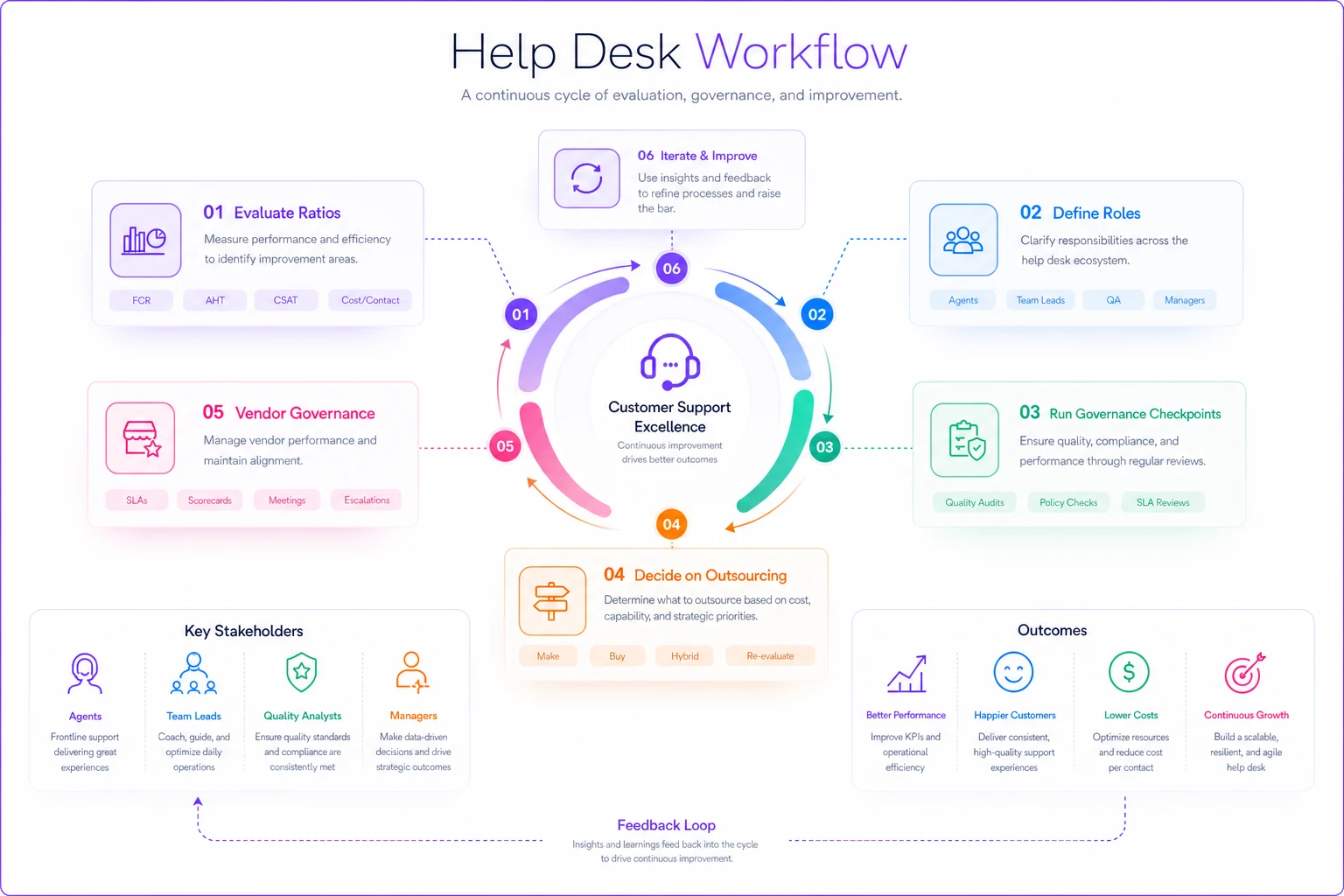
Use this sequence as a checklist when planning stage transitions.
The teams that scale cleanly aren't smarter or better resourced. They treat org structure as something that has to change on a schedule — planned in advance, tied to KPIs, reviewed before volume forces the issue. Build the checkpoints now, while things still feel manageable. That's the version of this you'll be glad you did when you're staring down your next doubling.
Ready to transform your support operations?
Join 500+ support teams using Servyly to reduce resolution times, improve customer satisfaction, and boost team productivity.