

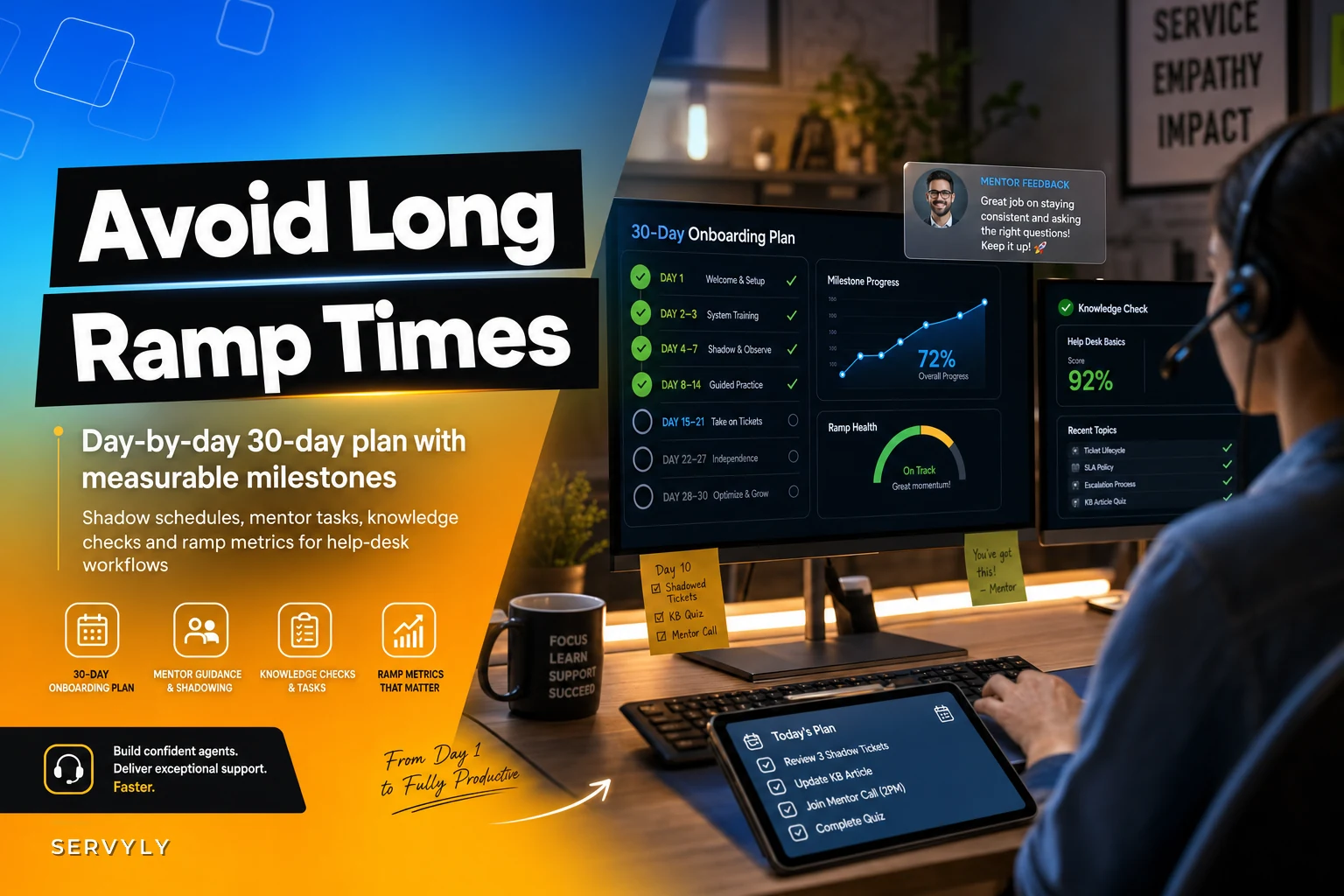

Most remote support onboarding fails in a pretty specific way. It's not that the new hire is bad. It's that week two turns into "just sit in Slack and ask questions if you're stuck," and by day fifteen nobody actually knows whether the agent can handle a live queue. Then someone panics, drops them into tickets, and CSAT dips for a month while the team quietly absorbs the extra work.
The fix isn't more training content. Most teams already have too much of it. What's missing is a schedule that forces a real decision every few days: is this person ready for the next thing, yes or no? Below is a 30‑day onboarding plan for support agents structured around measurable checkpoints instead of vague learning periods. It's built for help‑desk workflows specifically — queues, macros, escalations, SLA timers — not generic "welcome to the company" onboarding.
The day‑by‑day breakdown, the ramp metrics that actually predict success, and the mentor tasks that keep everything from falling apart when the manager gets busy are all here.
The real reason ramp takes 60+ days when it should take 30
The pattern tends to go like this. A team hires a remote agent, gives them a two‑day product overview, a login to the help desk, and a Notion page with 40 articles. Then the new agent starts answering tickets on day four.
Nobody built a ramp with intentional exposure order. So the agent's first ten tickets are random. They might get a simple password reset, then immediately a billing dispute involving a partial refund and a broken integration. No gradient. The person learns in a chaotic, high‑stress order, which means they build confidence slowly and make avoidable mistakes early.
The second issue is invisible progress. A manager can't tell you on day 12 whether the agent is behind or ahead — because there's no expected state for day 12. Without that baseline, "ramp" becomes a feeling instead of a number. And feelings stretch to 60 days because nobody has the data to say "you're ready now."
A solid onboarding plan solves both: it controls the order of exposure, and it makes progress visible through small, frequent checks.
The four‑phase structure at a glance
Before the daily breakdown, here's the shape of the 30 days. Each phase has one job. Don't let them blur together — that's where ramp starts bloating.
Never lose track of a customer request again.
Servyly helps you track, assign, and resolve every ticket quickly and efficiently.
- Centralized ticket management
- Automated response workflows
- Team collaboration tools
No credit card required
| Phase | Days | Primary Goal | Agent Handles | Success Signal |
|---|---|---|---|---|
| Foundation | 1–5 | Tools, product, tone | Nothing live | Passes tooling + tone check |
| Guided Reps | 6–12 | First live tickets, supervised | Tier‑1 only, drafts reviewed | Draft approval rate rising |
| Supervised Solo | 13–21 | Independent handling, spot‑checked | Tier‑1 + easy Tier‑2 | Quality holds without pre‑review |
| Ramp to Target | 22–30 | Volume + speed | Near‑full scope | Hits ~80% of team throughput |
The most common mistake is compressing Foundation to squeeze in early productivity, then paying for it in weeks three and four with quality problems. The gradient exists for a reason.
Days 1–5: Foundation (no live tickets, and that's the point)
The temptation is to get the agent productive fast. Resist it. The goal of week one is to clear out the dumb friction — not knowing where to click, not knowing your product's edge cases, not knowing your voice — so that when they hit live tickets in week two, the only hard part is the actual customer problem.
Day 1 — Environment and orientation
-
Get every tool working
help desk, internal chat, knowledge base, screen share, any VPN. A surprising amount of remote ramp time disappears into access requests that should have been filed a week before start date.
-
Walk the ticket lifecycle end to end
new → assigned → pending → solved → reopened. Use a real, anonymized ticket at each state.
-
Knowledge check
have them describe, in their own words, what happens to a ticket when a customer replies after it's been marked solved.
Day 2 — Product depth, not product tour
-
Focus on the top 10 issue types by volume. Don't try to cover the whole product. In practice, roughly 70–80% of tier‑1 tickets tend to cluster around a handful of recurring issues, so front‑load those.
-
Mentor task
the assigned mentor walks through the three ugliest edge cases they personally get wrong the most. That conversation is worth more than any doc.
Day 3 — Tone and templates
-
Review your macros and canned responses, but spend most of the time on when to break from them. Agents who only learn templates sound robotic. Agents who learn the judgment behind templates sound like people.
-
Exercise
rewrite three stiff canned replies into something that sounds human. Mentor reviews.
Day 4 — Shadowing (reverse)
-
The new agent watches the mentor handle 8–10 live tickets, thinking aloud. Expert does, novice observes and asks questions.
-
Knowledge check
after each ticket, the agent predicts the resolution before the mentor acts, then compares.
Day 5 — First knowledge assessment + gate
-
Short practical test
10 scenario questions ("customer says X, what tier is this, what's your first move?").
-
Gate a score below roughly 70% means an extra Foundation day, not a push into live work.
Honoring this gate is what keeps ramp short overall. Skipping it is usually what makes it long.
Days 6–12: Guided Reps (live tickets, every reply reviewed)
Now the agent touches live tickets, but nothing goes out unreviewed. This phase feels slow, and it should. You're trading speed for a clean feedback loop.
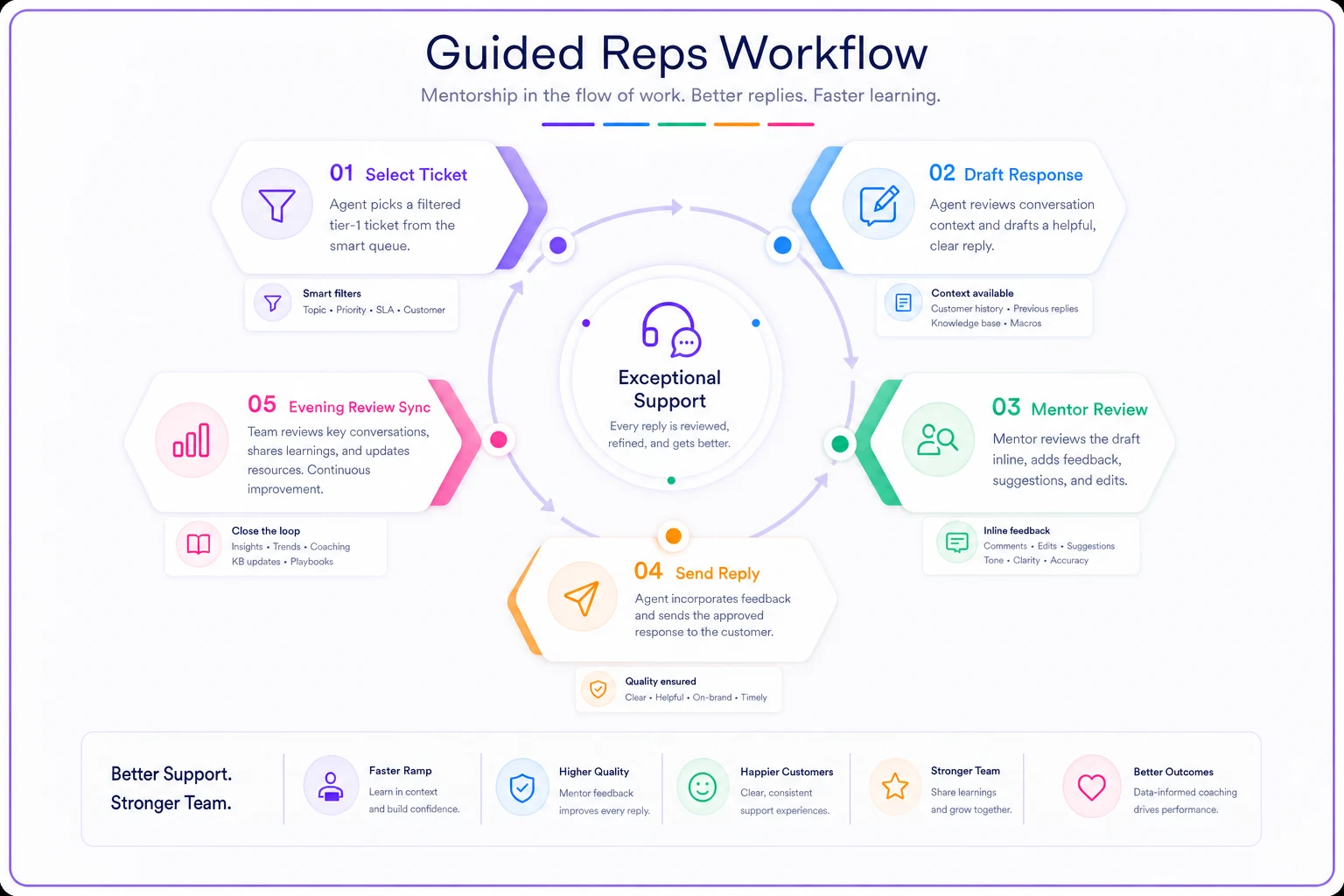
In practice, the workflow looks like this:
-
Agent picks a ticket from a filtered queue — tier‑1 only, tagged for training.
-
Agent drafts a full response but does not send.
-
Mentor reviews the draft, leaves inline notes, approves or requests edits.
-
Agent sends the approved version.
-
Every evening, mentor and agent spend about 15 minutes reviewing the day's five most instructive tickets.
Here's a quick visual of that workflow.
That filtered queue matters more than most teams realize. Drop a trainee into the general queue and they'll grab whatever's on top, including things they have no business touching yet. A dedicated training view — even a simple saved filter on a "tier‑1, non‑urgent" tag — controls the difficulty gradient automatically.
Ramp metric to watch this phase: draft approval rate. Track what percentage of drafts get approved without edits. A typical curve: around 30–40% on day 6, climbing to 70%+ by day 12. If it's flat, the problem is usually a knowledge gap in one specific area, not general slowness. Flat approval rates are diagnostic — go find the category they keep getting wrong.
Mentor task, days 6–12: keep a running "miss log" — a short list of mistakes this agent makes repeatedly. Two or three lines a day is enough. This becomes their personalized study list and, later, useful evidence when you're deciding whether they're ready to advance.
Days 13–21: Supervised Solo (they send, you spot‑check)
This is the phase most plans skip entirely, jumping straight from "every reply reviewed" to "on your own." That jump is exactly why quality craters in week four. Supervised solo is the bridge.
The agent now sends replies without pre‑approval, but you review a sample afterward. Start at 100% on day 13, taper to around 50% by day 17, then down to 20–25% by day 21. The tapering itself is a signal — if you can't comfortably reduce review frequency, they're not ready to advance.
-
Reopen rate — the single best early quality signal. If their tickets keep bouncing back, they're closing prematurely or under‑solving. This matters more than resolution speed right now.
-
CSAT on their solved tickets — noisy at low volume, so treat it as a trend, not a verdict. One frustrated customer on day 14 isn't a pattern.
-
Escalation accuracy — are they escalating the right things? New agents either over‑escalate (dumping easy tickets) or under‑escalate (holding onto things they can't actually fix). Both are coachable, and both show up clearly this week.
Teams that run a real supervised‑solo phase typically see week‑four reopen rates come in noticeably lower than teams that skip it. Often the difference between an agent who's genuinely independent by day 30 and one who's still quietly dependent at day 45.
Days 22–30: Ramp to Target (volume and speed, finally)
Only now do you care about throughput. Chasing speed in week two would've produced a fast agent making expensive mistakes. Chasing it now, on top of a solid quality base, is a different thing entirely.
Set a graduated volume target rather than a hard number on day one. Something like: reach roughly 60% of a tenured agent's daily volume by day 25, and around 80% by day 30. Full parity by day 30 is unrealistic for most help desks, and pushing for it just teaches people to rush closures.
Days 22–26: open the full scope, including the harder categories held back until now. Mentor stays available for tricky situations but no longer reviews routine work.
Days 27–30: the agent runs essentially independent. The mentor's role shifts to reviewing escalations and anything the agent flags themselves. That self‑flagging habit is worth building deliberately — an agent who knows what they don't know is more valuable than one who's confident about everything.
Day 30 graduation review. Sit down with the data collected over the month:
-
Draft approval curve from the Guided phase
-
Reopen rate trend
-
CSAT trend
-
Escalation accuracy
-
Current volume vs. target
-
The mentor's miss log, now mostly resolved
If those numbers are trending right, the agent moves to the standard queue with normal QA. If one metric is lagging, extend that specific area by a few days — not the whole onboarding. Precision here is the whole game.
A short real scenario
A remote SaaS support team of about nine agents kept losing new hires to a slow, murky ramp — somewhere around 55–60 days before anyone felt comfortable cutting them loose. They'd also had two early quits that everyone blamed on "not a culture fit" but were really just people drowning in week two.
They rebuilt onboarding around the phase structure above. The two changes that actually moved things weren't complicated: a filtered training queue so trainees only saw appropriate tickets, and the draft‑approval metric so the mentor could see real progress instead of guessing at it.
New hires started hitting roughly 80% of team volume by end of month one instead of the middle of month two. Week‑four reopen rates dropped to something close to what tenured agents produced. The "are they ready?" conversation stopped being a gut‑feel debate, because the answer was sitting in the data.
Where the right tooling quietly helps
None of this requires special software — a spreadsheet and a disciplined mentor can run the whole plan. But the friction points are predictable, and that's where an operations platform earns its keep.
Save a dedicated training queue as a saved view with the right tags so mentors can control trainee exposure without manual filtering.
The filtered training queue is just a saved view with the right tags. AI‑assisted routing can go a step further and automatically keep complex tickets out of a trainee's queue based on content, not just tags — so a messy refund dispute never lands in front of a day‑8 agent by accident. The draft‑approval loop works better when reviews live inside the ticket rather than a separate doc, and automated capture of reopen and escalation‑accuracy numbers means the mentor isn't hand‑tallying at day 30. The point isn't to automate judgment away — it's to remove the manual tracking that causes managers to quietly abandon a good plan somewhere around week two.
When this plan makes sense — and when it doesn't
This works well when: you're onboarding remote agents into a real queue with tiered complexity, you have at least one experienced person who can mentor, and you have enough ticket volume to fill a training queue. Most SaaS, e‑commerce, and B2B support teams fit this description.
This is overkill when: you're hiring a single agent for a low‑complexity product with maybe 20 tickets a day. At that scale, a lighter three‑phase version over two weeks is plenty — don't build ceremony you can't sustain.
Don't compress Foundation if: you're short‑staffed and tempted to cut it to two days. That's exactly the situation where a rushed ramp bites hardest. A half‑trained agent in a busy queue generates rework that costs more hours than the training would have.
Long ramp times aren't a training‑content problem. They're a visibility and sequencing problem. Control what tickets a new agent sees, in what order, and measure a few things that actually predict readiness — and 30 days is enough. Skip that structure, and you'll keep paying for 60‑day ramps while wondering why onboarding never seems to stick.
Ready to transform your support operations?
Join 500+ support teams using Servyly to reduce resolution times, improve customer satisfaction, and boost team productivity.