


Most support teams measure quality wrong. They count tickets closed, track average handle time, maybe do some random ticket audits. Then they wonder why CSAT stays flat while agents hit every metric.
The disconnect happens because traditional QA programs treat quality like a checkbox exercise. You grade tickets in isolation. Agents game the metrics. Managers struggle to explain why someone with perfect QA scores still generates complaints. Meanwhile, your best performers—the ones customers actually love—might score lower on technical rubrics because they bend rules to solve real problems.
After building quality frameworks across dozens of support operations, one pattern becomes hard to ignore. Teams that link agent development stages to actual customer outcomes see fundamentally different results than those running compliance-based QA. Not marginally better—completely different operational dynamics.
Why Stage-Based Quality Programs Actually Work
Traditional QA treats every agent the same. New hire with three weeks of experience? Same rubric as your five-year veteran. Junior agent handling password resets? Same standards as your technical specialist managing escalations.
This creates two problems. First, you lose agents who could become great because you overwhelm them early. Second, you bore experienced agents with metrics that stopped mattering two years ago.
A stage-based approach recognizes that quality evolves. What matters for a new agent—following processes, hitting basic accuracy—differs from what matters for a senior agent handling judgment calls, complex problem-solving, and mentoring.
Here's what typically breaks when you skip progression stages:
Your QA team spends hours grading tickets that don't move customer satisfaction. Those perfect scores on grammar and greeting format? Customers don't care if an agent actually helps them. Without stages, you weight these equally with actual problem resolution.
Managers can't defend promotion decisions. Someone has great QA scores but customers complain about them. Someone else breaks every formatting rule but customers specifically request them. Without stages that measure different competencies, you're making gut-feel calls that HR will eventually question.
The operational impact compounds. Good agents leave because there's no visible growth path. Mediocre agents stay because they learned to game the rubric. Customer satisfaction plateaus because you're optimizing for compliance instead of outcomes.
Building Your Three-Stage Progression Framework
Most support operations need three distinct stages. Some need four. More than that and you're creating bureaucracy, not development paths.
Never lose track of a customer request again.
Servyly helps you track, assign, and resolve every ticket quickly and efficiently.
- Centralized ticket management
- Automated response workflows
- Team collaboration tools
No credit card required
Stage 1: Foundation (Months 0-6)
New agents need to prove they can handle basics consistently. Not perfection—just reliable baselines.
-
Process adherence (40%)
-
Technical accuracy (30%)
-
Communication clarity (20%)
-
Efficiency metrics (10%)
Efficiency sits lowest on purpose. New agents who rush make expensive mistakes. Get them accurate first, fast later.
Sample Foundation rubric items:
-
Uses correct ticket classification (binary yes/no)
-
Includes all required information fields
-
Follows escalation procedures when needed
-
Maintains professional tone throughout
The key is objectivity. New agents shouldn't have to wonder if they passed. They either classified the ticket correctly or didn't. They either included the case number or didn't.
Stage 2: Proficiency (Months 6-18)
Agents at this level handle standard issues independently. The basics are proven. Now you're measuring judgment and problem-solving.
-
Problem resolution quality (35%)
-
Customer experience indicators (25%)
-
Process adherence (20%)
-
Efficiency with quality (20%)
Now you're measuring things like:
-
Identified root cause, not just symptoms
-
Offered alternatives when the primary solution wasn't available
-
Managed customer expectations realistically
-
Reduced potential for repeat contact
These require evaluator judgment. That's fine—proficient agents should be able to handle ambiguity.
Stage 3: Mastery (18+ months)
Senior agents shape customer experience beyond individual tickets. They handle escalations, mentor others, surface systemic issues.
-
Complex problem resolution (30%)
-
Customer relationship impact (25%)
-
Process improvement contributions (25%)
-
Team development support (20%)
Mastery indicators include:
-
Turned an escalated situation into a positive outcome
-
Identified a pattern that needed a process change
-
Coached a teammate through a difficult scenario
-
Created a solution that prevented future issues
At this stage, you're measuring impact beyond the ticket. Did they spot a bug affecting multiple customers? Did they help a struggling teammate improve? Did they suggest a knowledge base update that reduced incoming volume?
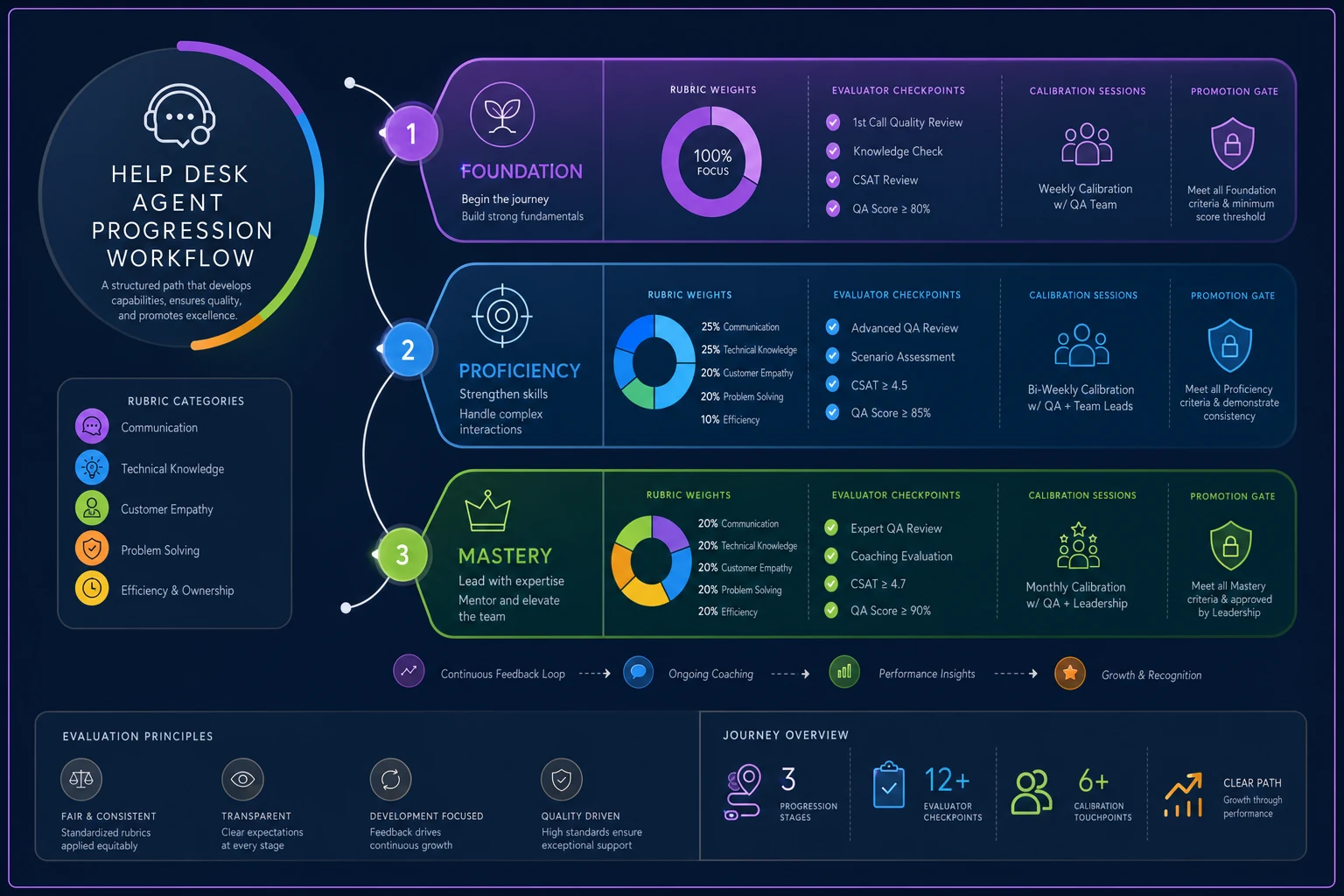
This visual maps progression stages, rubric focus shifts, and the promotion gate workflow.
At this stage, you're measuring impact beyond the ticket. Did they spot a bug affecting multiple customers? Did they help a struggling teammate improve? Did they suggest a knowledge base update that reduced incoming volume?
Calibration Artifacts That Keep Scoring Consistent
Without calibration, the whole program falls apart. One evaluator's "meets expectations" becomes another's "exceeds expectations." Agents figure out which evaluators grade easier. The system loses credibility fast.
Weekly Calibration Sessions
Every evaluator scores the same 3-5 tickets before meeting. You compare scores, discuss differences, align on standards. The goal isn't consensus—it's understanding why scores differed.
Document these in a calibration log:
| Ticket | Evaluator A | Evaluator B | Evaluator C | Variance | Aligned Score | Key Learning |
|---|---|---|---|---|---|---|
| #4521 | 85% | 72% | 78% | 13pts | 78% | Different interpretation of "complete resolution" |
| #4534 | 91% | 89% | 90% | 2pts | 90% | Strong alignment |
| #4547 | 66% | 82% | 74% | 16pts | 74% | Missed context from previous interaction |
Track variance trends over time. If certain evaluators consistently score higher or lower, that's a signal—either additional training is needed or your rubric definitions need tightening.
Dispute Resolution Artifacts
Agents will challenge scores. That's healthy—it means they care. But you need a structured process that doesn't undermine the program.
Create a dispute form that requires:
-
Specific rubric element being challenged
-
Agent's interpretation of the requirement
-
Evidence supporting their interpretation
-
Requested score adjustment
Keep a dispute resolution log:
| Date | Agent | Original Score | Disputed Element | Resolution | Score Adjusted? | Rubric Updated? |
|---|---|---|---|---|---|---|
| 3/15 | Johnson | 76% | Tone appropriateness | Maintained - cultural context considered but response still too casual | No | Yes - added context examples |
| 3/18 | Park | 83% | Technical accuracy | Adjusted - agent correct, KB outdated | Yes - 89% | No |
This creates accountability in both directions. Agents can't dispute everything, but evaluators have to defend their scoring.
Edge Case Documentation
Real customer interactions don't follow scripts. You'll hit scenarios your rubric doesn't cover. Document these as they come up:
-
Scenario description
-
Initial evaluator interpretation
-
Team consensus decision
-
Rubric modification if needed
Build a library of edge cases by stage. New evaluators study these before scoring independently. It's essentially case law for your QA program—precedents that guide future decisions.
Build a library of edge cases by stage for new evaluators to study before scoring independently.
It's essentially case law for your QA program—precedents that guide future decisions.
Linking QA Scores to Customer Metrics
Most programs track QA scores. They track CSAT. They never actually connect them.
The relationship isn't always direct either. An agent might have perfect QA scores this month but affect next month's CSAT through the relationships they're building—or quietly destroying—today.
Creating Your Correlation Framework
Start by mapping QA elements to likely customer outcomes:
| QA Element | Expected CSAT Impact | Expected NPS Impact | Repeat Contact Impact |
|---|---|---|---|
| First contact resolution | High - immediate | Medium - cumulative | High - direct |
| Tone/empathy scores | Medium - immediate | High - relationship | Low |
| Technical accuracy | Low - immediate | Medium - trust | High - if wrong |
| Follow-up completeness | Medium - delayed | High - reliability | High - direct |
Then track actual correlations. Pull three months of data:
-
Agent QA scores by element
-
Same agents' customer satisfaction scores
-
Same agents' contribution to repeat contacts
You'll find surprises. Maybe tone matters less than you assumed for transactional support. Maybe technical accuracy drives NPS more than CSAT. Maybe your fastest agents are generating the most repeat contacts.
Adjust your rubric weights based on actual correlation data, not assumptions.
Building Predictive Indicators
Once you have correlation data, identify leading indicators—which QA elements actually predict future customer satisfaction?
-
Agents who score high on "complete resolution" tend to show noticeably higher CSAT three weeks later
-
Low scores on "expectation setting" often precede NPS drops after 30 days
-
High efficiency paired with low accuracy tends to create repeat contact spikes within 72 hours
Build an early warning system around these. When an agent's predictive indicators drop, you can intervene before customer metrics tank. That's what shifts QA from reactive grading to actual operational value.
HR-Friendly Promotion Criteria
HR needs defensible promotion decisions. "They're really good" doesn't hold up when someone files a complaint about being passed over.
Your stage-based system creates natural promotion gates:
Foundation to Proficiency Requirements:
-
6 months minimum tenure
-
85% average QA score over last quarter
-
No critical errors in last 60 days
-
CSAT at or above team average
-
Completed proficiency skills assessment
-
Manager recommendation with specific examples
Proficiency to Mastery Requirements:
-
18 months minimum tenure (12 at proficiency level)
-
90% average QA score over last quarter
-
CSAT/NPS in top 40% of team
-
Documented process improvement contribution
-
Completed complex scenario assessment
-
Peer recommendation from a mastery-level agent
Document everything in promotion packets:
-
Historical QA scores by element
-
Customer metric trends
-
Specific examples of stage-appropriate performance
-
Growth areas and development plan
When someone asks why they weren't promoted, you show them exactly which criteria they haven't met and what specifically needs to change. That conversation becomes straightforward instead of uncomfortable.
Sample Implementation Timeline
Rolling out a stage-based quality program requires sequencing. Flipping everything overnight creates chaos.
-
Month 1
Foundation
- Define your three stages - Create rubrics for each stage - Map current agents to appropriate stages - Set up calibration schedule -
Month 2
Pilot
- Run parallel scoring (old system and new) - Conduct weekly calibrations - Document edge cases - Gather agent feedback -
Month 3
Refinement
- Adjust rubric weights based on pilot data - Finalize dispute process - Train all evaluators - Create agent communication plan -
Month 4
Rollout
- Launch with clear documentation - Run daily calibrations the first week - Address disputes quickly - Track correlation metrics -
Month 5-6
Optimization
- Analyze customer metric correlations - Adjust rubrics based on data - Identify predictive indicators - Create automated tracking where possible
Rolling out in phases reduces risk and gives you data to iterate on each step.
Common Implementation Failures
Overcomplicating the Rubric
Teams build 50-point rubrics thinking more detail means more accuracy. Instead, agents get confused, evaluators spend hours per ticket, and consistency disappears.
Keep it under 10 elements per stage. If you can't measure something consistently, don't include it.
Ignoring Workload Reality
You design a program requiring 20% of tickets to be evaluated. Your QA team has capacity for 5%. What happens? Random sampling that misses patterns, rushed evaluations that lack depth, or an abandoned program after two months.
Calculate realistic capacity before you commit:
-
Average tickets per agent per month
-
Time to properly evaluate one ticket
-
Available QA hours
-
Buffer for calibration and disputes
Most sustainable programs land between 5-10% of tickets.
Skipping Calibration
"We don't have time for weekly meetings." Three months later, scoring varies by 30 points between evaluators. Agents learn to game the system based on who's grading. The program loses credibility entirely.
Calibration isn't optional overhead—it's a core operational requirement. Without it, you don't have a QA program. You have random opinions affecting people's careers.
How Automation Enhances Quality Programs
Manual QA programs hit scale walls fast. With 50 agents, evaluating even 5% of tickets can overwhelm your QA team. What happens at 100 agents?
AI-powered operational software changes the economics here. Instead of sampling 5% of tickets, you can run basic quality checks across all of them. Not replacing human evaluation—extending its reach.
The operational system you've built gets more useful when enhanced with automation. Flagging potentially incomplete resolutions, unusual handle times, or sentiment shifts that suggest a frustrated customer. Your QA team can then focus their judgment where it actually matters instead of hunting for problems through random sampling.
Some things automated checks catch consistently:
-
Incomplete resolutions likely to generate repeat contact
-
Tone mismatches that humans might skim past when reading quickly
-
Technical inaccuracies where responses contradict the knowledge base
-
Missing follow-up commitments that create problems down the road
This isn't about replacing QA roles. It's about making QA strategic instead of administrative. Evaluators spend less time searching and more time coaching agents through genuinely complex scenarios.
Measuring Program Success
Success isn't higher QA scores alone. That's easy—make the rubric easier or coach agents to hit the right phrases. Real success shows up in operations:
Agent Retention
Track turnover by stage. If Foundation agents leave at 3x the rate of Proficiency agents, your early-stage support probably needs work. If Mastery agents are leaving, you may lack meaningful growth opportunities beyond that level.
Promotion Velocity
How long does it take agents to move between stages? If it's taking 18 months to go from Foundation to Proficiency, either your requirements are too strict or your development support is insufficient. Worth figuring out which.
Customer Metric Correlation
QA scores should predict customer satisfaction. If they don't, you're measuring the wrong things. Track correlation quarterly and adjust rubrics accordingly.
Dispute Rates
Healthy programs see somewhere around 5-10% dispute rates. Lower usually means agents don't feel safe challenging scores. Higher means your rubric lacks clarity or your evaluators aren't aligned.
A midwest retail company went through this transition last year—35 agents, single-rubric QA, CSAT stuck at 72% for six months. After moving to stage-based quality:
-
Foundation agents improved accuracy by about 23% in the first quarter
-
Proficiency agents reduced repeat contacts by roughly 30%
-
Mastery agents identified three process improvements that eliminated around 200 tickets monthly
-
Overall CSAT reached 81% within four months
-
Agent turnover dropped from around 40% annually to about 25%
The rubrics themselves weren't the magic. It was connecting quality measurement to career progression and actual customer outcomes.
Beyond Individual Performance
The best quality programs recognize that support is a team sport. Individual excellence matters, but system performance determines the customer experience.
Consider adding team-based quality elements:
-
Knowledge sharing contributions
-
Peer support effectiveness
-
Systemic issue identification
-
Process improvement participation
Your closure checklists and QA triggers get more powerful when agents are actively improving them based on what quality findings surface. Instead of QA just catching problems, it becomes a mechanism for continuous operational improvement.
One pattern that shows up consistently: teams that share quality insights openly outperform those that treat QA as individual performance management. When agents discuss why certain responses scored well, everyone improves. When they work through why something failed, everyone learns.
Create space for this:
-
Weekly quality roundups highlighting strong responses
-
Monthly edge case discussions
-
Quarterly rubric improvement sessions with agent input
-
Annual quality recognition for different types of excellence
That shift—from quality being something done to agents to something done with them—changes the dynamic entirely.
Starting Your Program Tomorrow
Building a comprehensive quality program takes months. But you can start improving immediately.
Map your current agents to stages first. Don't overthink it—use tenure and existing performance as initial guides. You'll refine as you go.
Then pick your most critical quality elements. What three things, if done consistently well, would most impact customer satisfaction? Start measuring those.
Schedule your first calibration session. Even with your existing rubric, getting evaluators aligned improves consistency right away.
Finally, connect one QA element to one customer metric. Something obvious to start—first contact resolution to repeat contacts, for example. Just start tracking the correlation.
A decent program that links agent development to customer outcomes will outperform a perfect rubric that exists in isolation every time. Start with stages, maintain calibration discipline, and keep tying QA scores to real business metrics.
Your agents want clear growth paths. Your customers want consistent, improving experiences. Your business needs predictable quality at scale.
A properly structured quality program delivers all three—but only if you build it as an operational system, not a compliance exercise.
Ready to transform your support operations?
Join 500+ support teams using Servyly to reduce resolution times, improve customer satisfaction, and boost team productivity.