

Most support teams don't lose customer trust because they made a bad automation call. They lose it because, when the customer or legal asked why the automation did what it did, nobody could produce a clean answer. The decision existed somewhere — in a Slack thread, in a config nobody documented, in the head of the person who set it up — but it wasn't defensible. It wasn't written down in a way you could hand to a lawyer or read to an angry customer.
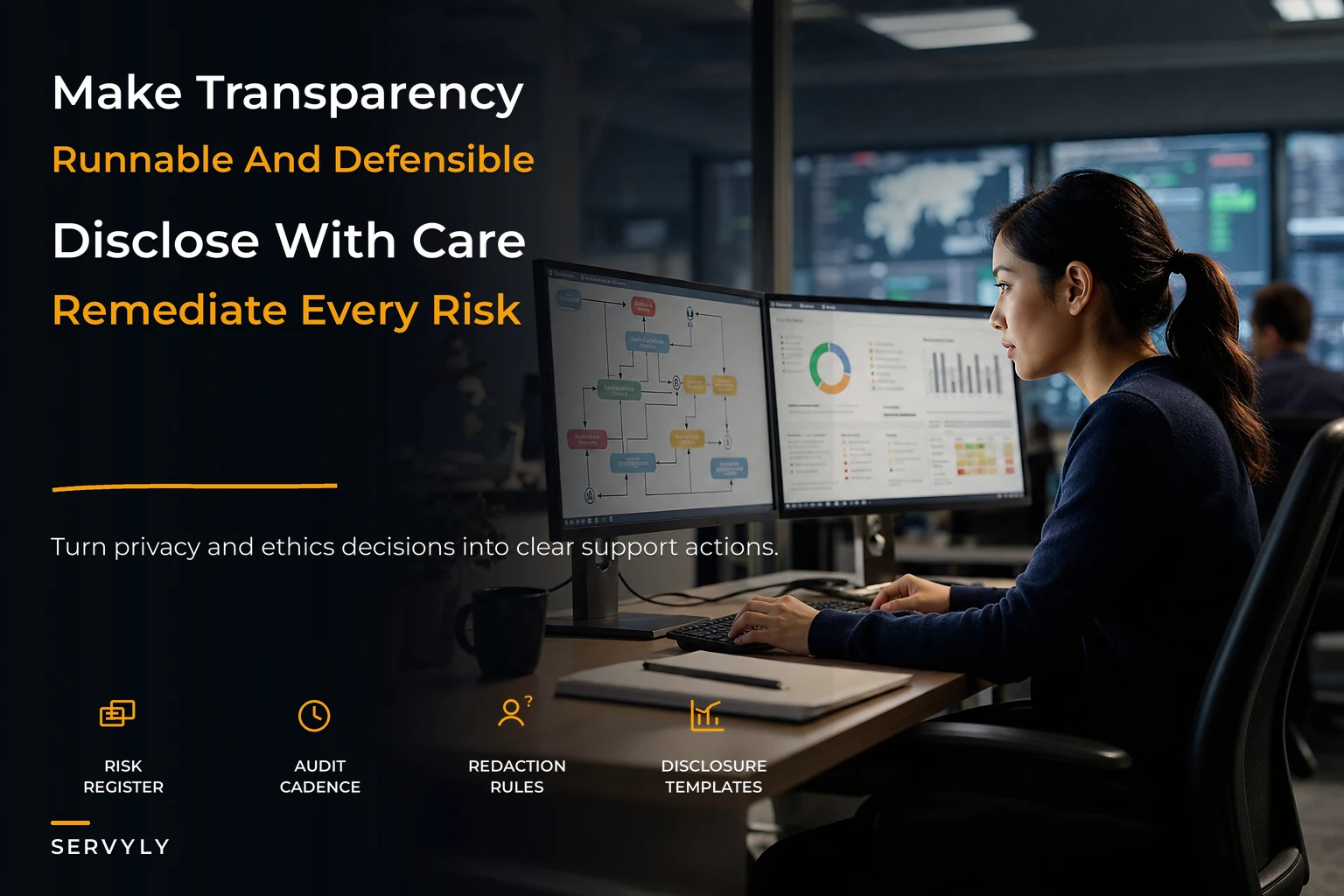
That gap between "we made a reasonable decision" and "we can prove we made a reasonable decision" is where trust actually breaks. A risk and trust charter closes that gap. Not a compliance binder nobody reads — a working set of artifacts. A risk register, runbooks, disclosure templates, and an audit cadence that lets a support agent, on a Tuesday afternoon, defend a privacy or automation decision to a customer and a legal reviewer using the same source of truth.
This is about support trust and AI ethics at the operational level, not the philosophical one. Customers don't care about your ethics statement. They care whether you can explain what happened to their data and what you're doing about it.
## Why the trust gap shows up at exactly the wrong moment
The pattern is almost always the same. A team ships automation — auto-close rules, AI-drafted replies, a bot that pulls account data, a sentiment router that deprioritizes certain tickets. It works fine for months. Then one of three things happens:
-
A customer asks, "Did a human read my message, or did a machine decide this?"
-
Legal or a security reviewer asks, "What data does the bot see, and where does it go?"
-
Something breaks publicly, and now you owe a disclosure, and every word you write becomes a potential liability.
In all three cases, the support team is suddenly expected to speak with precision about decisions that were made pretty casually. The person who built the auto-close logic left six months ago. The redaction rule everyone assumed was in place turns out to only cover credit cards, not health information. The disclosure draft goes to legal, who rewrites it into something unreadable, and the customer gets a notice that sounds like it was designed to avoid responsibility rather than explain anything.
The trust failure is rarely the original decision. The decision was usually fine. The failure is that the reasoning was never captured in a form anyone could retrieve under pressure. A charter forces that capture to happen before the pressure hits, not during.
## The four artifacts that actually hold up
A trust charter is only useful if it survives contact with a skeptical lawyer and a frustrated customer in the same week. That requires four connected pieces, and the connection between them matters more than any single one.
Never lose track of a customer request again.
Servyly helps you track, assign, and resolve every ticket quickly and efficiently.
- Centralized ticket management
- Automated response workflows
- Team collaboration tools
No credit card required
| Artifact | What it answers | Who reads it | Failure mode if missing |
|---|---|---|---|
| Risk register | "What could go wrong, and how bad is it?" | Support leads, legal, security | Decisions made without knowing the stakes |
| Runbooks | "What do we do when it does go wrong?" | Agents, on-call | Improvised remediation, inconsistent handling |
| Disclosure templates | "What do we tell the customer, in plain words?" | Agents, comms, legal | Legalese notices that destroy trust |
| Audit cadence | "How do we know any of this is still true?" | Support ops, compliance | Documented rules that quietly drift out of date |
The register feeds the runbooks. The runbooks reference the disclosure templates. The audit cadence checks all three against reality. Build them in isolation — a risk doc here, a comms template there — and they drift apart within a quarter and you're back to improvising. This connects directly to how an audit-ready ticketing operating model works, because the charter is essentially the trust layer sitting on top of that compliance foundation.
This connects directly to how an audit-ready ticketing operating model works, because the charter is essentially the trust layer sitting on top of that compliance foundation.
## Starting with the risk register, not the rules
Teams usually want to jump straight to writing policies. That's backwards. You can't write a sensible disclosure rule until you know what you're actually exposed to.
A support risk register isn't a generic risk matrix copied from a template. It's specific to the automation and data decisions your team actually makes. For each entry, you want:
-
The decision or automation — e.g., "AI drafts the first reply on billing tickets," or "sentiment router deprioritizes tickets scored as low urgency."
-
What could go wrong — the AI drafts a reply that gives wrong refund info; the router buries an actual emergency because the customer wrote calmly.
-
Who it affects — a single customer, a segment, everyone.
-
Data exposure — what personal or sensitive data touches this path.
-
Severity if it fires — embarrassing, costly, or reportable.
-
Current controls — human review threshold, redaction, rollback.
The insight most teams miss: severity should be driven by who the customer is, not just what the automation does. The same auto-draft mistake is a minor annoyance for a self-serve customer and a contract-threatening incident for an enterprise account. Your register needs to reflect that, which is why it should tie into whatever high-risk customer triage protocol you already run. A VIP, legal-sensitive, or security-flagged account changes the severity of every automated decision that touches their ticket.
A realistic register for a small team is somewhere around 15–25 entries. The temptation is to catalog every theoretical risk. Don't. The register is only useful if the team actually maintains it, and a bloated one gets abandoned fast.
## Runbooks that someone can actually run at 4pm
A runbook that says "escalate to the appropriate team and follow established procedures" is useless. The whole point is that an agent who has never handled this specific situation can execute it correctly without a manager in the room.
The runbooks that hold up under audit share a few traits. They name the exact trigger. They specify who does what, in order. They point to the disclosure template to use. And they include a stop condition — the point at which the agent must hand off rather than continue.
A workable remediation flow for an automation error looks roughly like this:
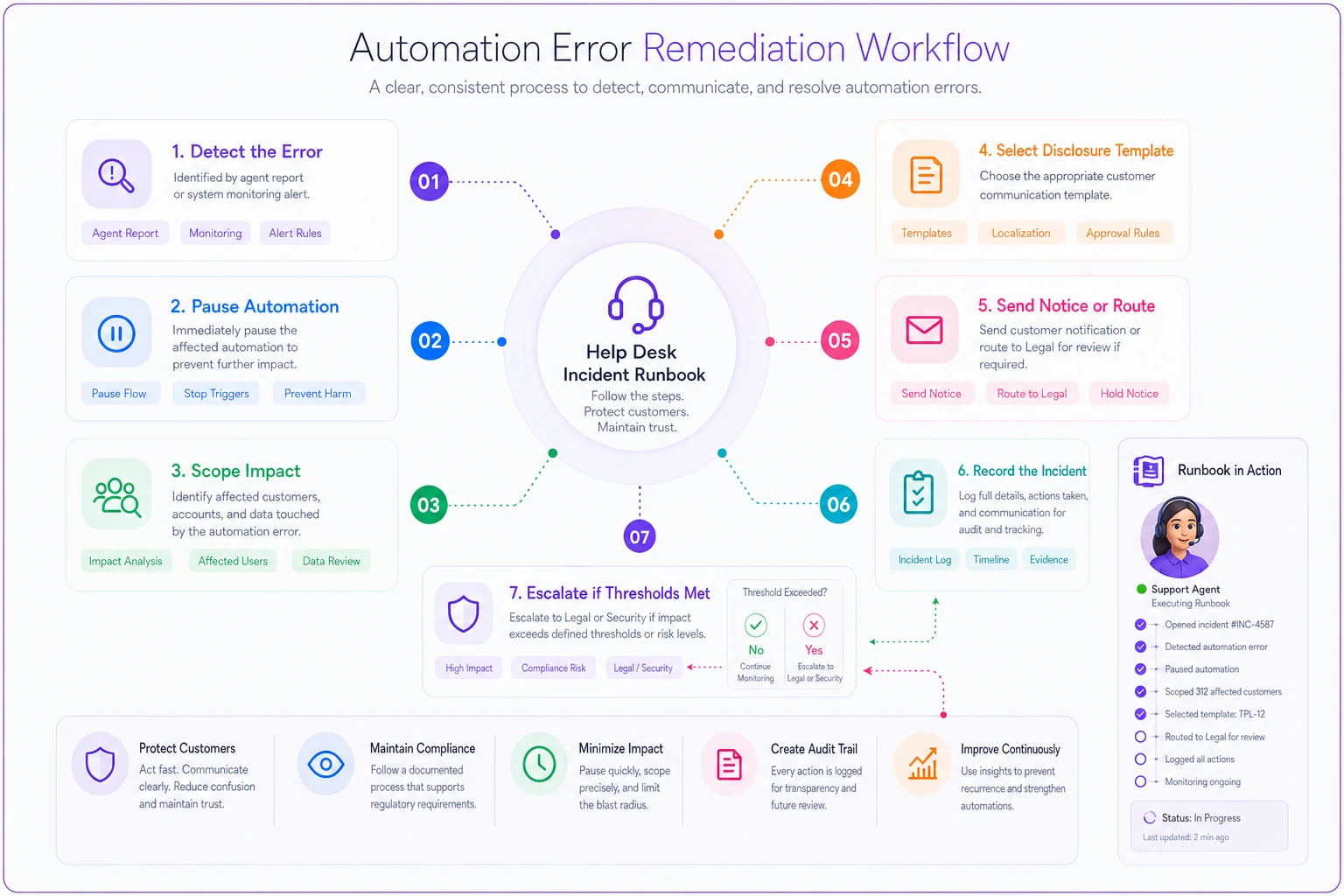
This diagram shows the pause-scope-notify-record-escalate flow.
An agent or a monitoring signal catches that an automated reply gave incorrect information. The agent opens the relevant runbook. Step one is containment: pause the automation rule for the affected segment so it doesn't fire again while you're cleaning up. Step two is scope: identify how many customers got the bad output, using ticket taxonomy and automation logs. Step three is the customer notice: pull the matching disclosure template, fill in the specifics, and — depending on severity from the register — send it directly or route through legal first. Step four is the record: log what happened, what you did, and what data was involved, in the same place every time. Step five is the handoff condition: if exposure crosses a defined line — regulated data, more than a set number of customers, anything a regulator might want to see — it stops being a support-level remediation and becomes a formal incident with legal and security looped in.
Each step either completes or escalates. There's no state where the agent is stuck guessing. That matters especially when AI-generated content causes the problem, because teams freeze — they're unsure if they're allowed to touch the model, pause the rule, or communicate with the customer. The runbook removes that hesitation. If you're building these alongside AI features, it's worth pairing them with proper rollback controls and phased knowledge engineering, because a runbook that says "roll back the automation" only works if a rollback mechanism actually exists.
## Disclosure templates in language a human would use
This is where most trust charters quietly fall apart. The disclosure gets drafted by legal, optimized to minimize liability, and sent to the customer. The customer reads something like "We regret to inform you that an incident may have resulted in the potential unauthorized exposure of certain data elements" and immediately assumes you're hiding something. The notice meant to preserve trust destroys it.
Plain-language disclosure means writing what you'd actually want to receive. A good customer notice tells the person: what happened, what it means for them specifically, what you've already done, and what they should do if anything. In that order. Short sentences. No hedging that sounds like evasion.
Pre-write templates for your most likely disclosure scenarios, get them reviewed by legal once, in advance, and store them in the charter. Common ones worth having:
-
An automated reply gave you incorrect information.
-
A bot or integration accessed more of your data than it should have.
-
We detected a delay or error in how your request was handled.
-
A feature behaved in a way that affected your account.
When legal pre-approves the template rather than reviewing every individual notice, two things improve at once: the customer gets a faster, clearer message, and legal stops being a bottleneck on every incident. The template still has blanks for specifics, but the structure and tone are locked and defensible.
Redaction rules that agents can apply without a legal degree
Disclosure templates only work if agents know what they can and can't include. Redaction rules are the other half. Writing redaction policy at the level of "redact PII" tells an agent nothing useful at 4pm.
Useful redaction rules are concrete: this field is never included in a customer-facing notice; this data type is never pasted into the AI tool; internal ticket IDs are fine to reference but internal reviewer names are not; account identifiers get partially masked in this specific format. Short enough to post near the agent's screen and specific enough that two different agents would redact the same message identically.
## The audit cadence that keeps the whole thing honest
Everything above decays. Automation rules change. New features ship. The redaction rule written for last year's data model misses this year's new fields. A charter with no audit cadence is a document that was true once.
-
Monthly spot-check a handful of resolved tickets against the register — did the right controls fire, did the right disclosures go out?
-
Quarterly review the full risk register. Add new automations that shipped. Retire controls for things you no longer do. Re-rate severity if your customer mix changed.
-
After every incident feed what you learned back into the register and runbooks. An incident that didn't change something in your charter was a wasted incident.
-
Whenever automation changes no new auto-rule, AI feature, or data integration goes live without a register entry and a matching runbook. This is the gate that prevents drift.
That last one is the real discipline. The register stays accurate only if updating it is part of shipping automation, not a separate task someone gets to eventually. The teams that actually keep their charter current are the ones who made "add the register entry" a checklist item in their release process, the same way they'd add a test.
## A real scenario
A mid-sized B2B software company — support team of around nine — rolled out AI-drafted first replies across their billing queue. It worked well, deflected a solid chunk of manual drafting, and nobody thought much about it. Then a draft reply quoted the wrong cancellation terms to roughly 30 customers over about two weeks before anyone caught it. The AI was pulling from an outdated help article.
When they caught it, there was no runbook. It took nearly three days to figure out who was affected, another couple of days of back-and-forth with legal over what to say, and the notice that finally went out was dense enough that it generated a second wave of confused tickets. A handful of accounts escalated to their account managers. Two mentioned it during renewal conversations.
They built a charter afterward. The register flagged AI-drafted billing replies as higher-severity automation tied to contract terms. The runbook defined the pause-scope-notify-record-escalate flow. Legal pre-approved a plain-language template for exactly that situation. The next time an automation produced a wrong answer — smaller incident, maybe a dozen customers — the whole remediation ran in under a day, the notice was clear enough that it generated almost no follow-up tickets, and nothing escalated. Same category of failure, completely different outcome. The difference wasn't smarter people. It was that the reasoning and the response were written down before they were needed.
## When a formal charter makes sense — and when it's overkill
This isn't free. Building and maintaining a charter takes real effort, and not every team needs the full version.
When it's worth it: you run meaningful automation that touches customer data, you serve customers who ask hard questions about privacy, you have enterprise or regulated accounts, or you've already had one incident where you couldn't explain yourself cleanly. Any of those alone justifies it.
When it's overkill: a tiny team with almost no automation and self-serve customers who'd never ask. Writing 25 risk entries for a two-person team running one auto-close rule is bureaucracy for its own sake. Start with a single-page version — the three or four automations you actually run, what could go wrong, and one plain-language notice template.
Who should not do this half-heartedly: teams that will write the charter and never maintain it. A stale charter is worse than none, because it creates false confidence and gives legal a document that's wrong. If you can't commit to the audit cadence, don't pretend to have the controls.
The point of all of it
The reason to build a support risk and trust charter isn't to satisfy an auditor or check an AI ethics box. It's so that when a customer or a lawyer asks the hard question, the answer already exists — written in plain language, backed by a decision you can defend, with a response you've already thought through.
Trust, operationally, isn't a feeling. It's the ability to show your work. The teams that keep customer trust through automation mistakes aren't the ones who never make mistakes. They're the ones who, when the mistake surfaces, can say exactly what happened, exactly what they're doing about it, and point to the fact that they saw the risk coming. That's a system, not a personality trait — and it's the kind of thing you build before you need it, because you never get to build it during.
Ready to transform your support operations?
Join 500+ support teams using Servyly to reduce resolution times, improve customer satisfaction, and boost team productivity.