

Most support teams don't discover their compliance gaps until someone external forces them to. It's the enterprise prospect's security questionnaire asking how you handle data deletion requests. It's the SOC 2 auditor asking for proof that access to customer tickets is restricted and reviewed. It's legal asking why a ticket from 14 months ago still contains a customer's full payment details in a plaintext note.
In that moment, the honest answer is usually some version of: "We think we do that, but I can't prove it."
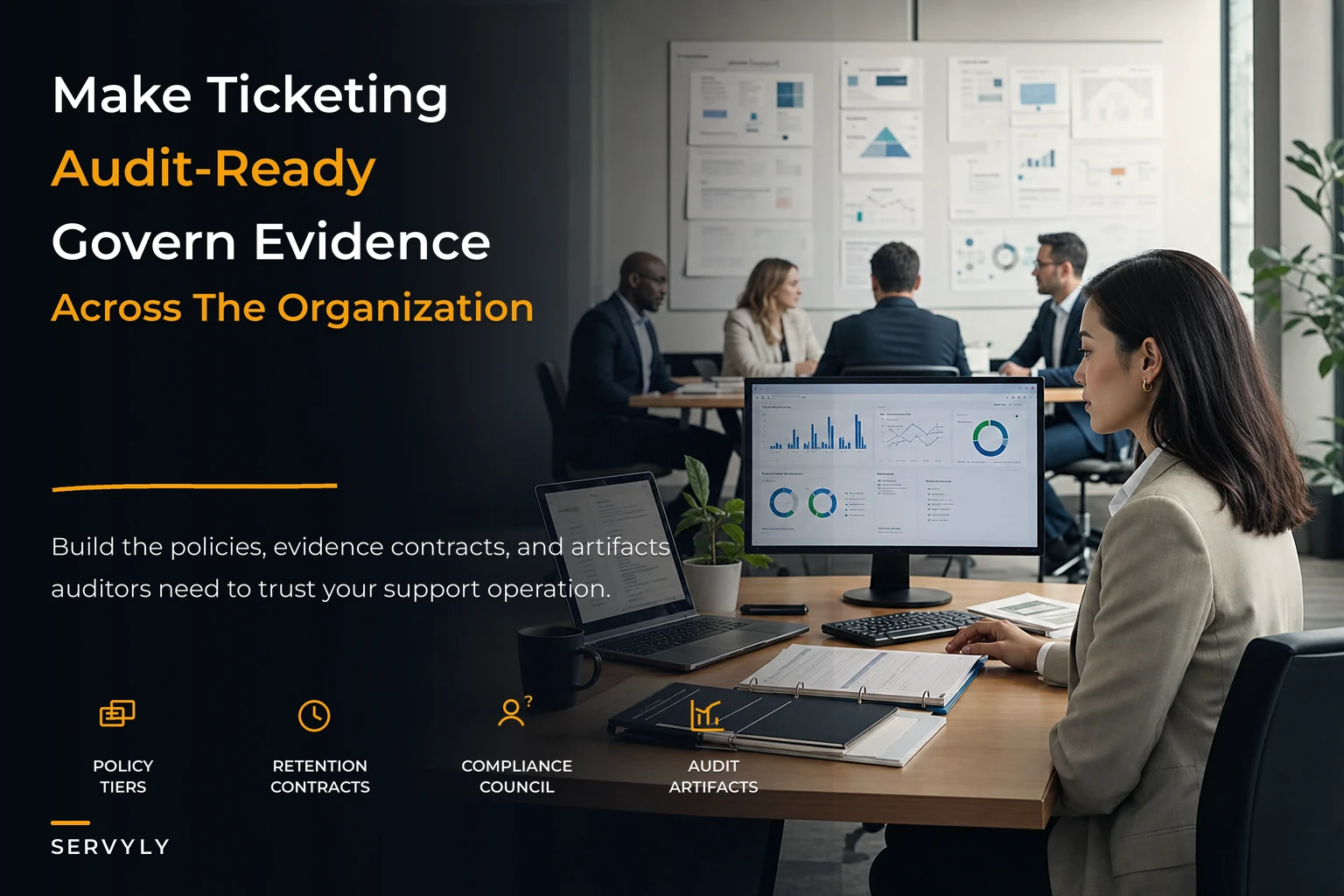
That gap — between what you believe your team does and what you can actually demonstrate with evidence — is the whole problem. A support compliance program isn't about writing more policy documents nobody reads. It's about building an operating model where the right behaviors are enforced by the system, and the evidence that they happened is generated automatically as a byproduct of normal work. This article covers the organization-level structure that makes that possible: policy tiers, evidence contracts, a compliance council, and the artifact library that ties it all together.
Why "we have a policy" is almost always a lie
A company grows past 20 or 30 agents, lands its first few mid-market deals, and someone drafts a support data-handling policy. It lives in a wiki. It says agents must redact sensitive data, must not export ticket data to personal tools, must escalate security-related tickets within an hour.
Then nothing checks any of it.
The failure usually isn't that people are reckless. It's that the policy describes intent while the ticketing workflow describes reality, and the two drift apart within weeks. An agent copies a Stripe charge ID and the card's last four and billing address into a ticket note because it's faster than looking it up in the admin panel. A contractor who left three months ago still has an active login because offboarding was a Slack message, not a controlled process. A macro auto-inserts a customer's account email into a public-facing reply.
None of these are malicious. They're the natural result of a system that rewards speed and has no mechanism to catch drift. When the audit comes, you're not being judged on your intentions — you're being judged on your artifacts. If the only artifact is a wiki page, you fail.
What separates audit-ready teams isn't stricter rules. It's that their rules are expressed as enforceable controls with automatic evidence trails. That's the shift this operating model is built around.
The three-tier policy structure that actually holds up
One reason compliance programs collapse is that everything gets written at the same altitude. A single document tries to be both the legal commitment and the agent's step-by-step instructions, and ends up serving neither — too vague to enforce and too detailed to stay current.
Never lose track of a customer request again.
Servyly helps you track, assign, and resolve every ticket quickly and efficiently.
- Centralized ticket management
- Automated response workflows
- Team collaboration tools
No credit card required
The fix is separating policy into three tiers, each with a different owner, change cadence, and audience.
| Tier | What it is | Owner | Change cadence | Example |
|---|---|---|---|---|
| Tier 1 — Commitments | The promises you make externally: retention windows, data residency, breach notification timelines, access principles | Legal / Security | Rarely (quarterly review) | "Customer ticket data is retained no longer than 24 months after account closure." |
| Tier 2 — Controls | The enforceable mechanisms that make Tier 1 true | Compliance council | As systems change | "Tickets auto-purge 24 months after the linked account's closure date, logged to the deletion register." |
| Tier 3 — Runbooks | The actual steps a human or system takes | Support ops | Continuously | "On a GDPR deletion request: run the deletion workflow, attach the confirmation ID to the request ticket, close with reason code DSR-COMPLETE." |
The piece most teams miss: an auditor cares about the linkage between tiers far more than the content of any single one. If your Tier 1 says you delete data in 24 months, your Tier 2 must show the control that enforces it, and your Tier 3 must show the step someone actually performs — plus evidence that it happened. A commitment with no control beneath it is a liability you've written down and signed.
A common mistake is letting Tier 3 runbooks live in people's heads. "Sarah knows how to handle deletion requests" is not a control. When Sarah leaves, the control leaves with her, and your Tier 1 commitment becomes unbacked overnight. Runbooks need to be documented, versioned, and assigned to a role — not a person.
Evidence contracts: the part nobody builds until it's too late
An evidence contract is a written internal agreement that specifies, for each compliance commitment, exactly what proof will exist, where it lives, how long it's kept, and who can produce it on demand. It turns "we handle this" into "here is the specific artifact that proves we handled this, retrievable in under an hour."
Think about what an auditor or enterprise security reviewer actually asks for. They don't want to hear your process. They want:
-
A sample of deletion requests from the last quarter, with timestamps and confirmation IDs
-
Proof that agent access to tickets is provisioned through a controlled process and reviewed periodically
-
Evidence that security escalations met their response windows
-
A record showing sensitive data was redacted or never stored
If you haven't decided in advance what evidence each of these produces, you'll spend the week before the audit frantically reverse-engineering it from logs — and some of it simply won't exist because the system never captured it.
A practical evidence contract for a single commitment looks like this:
-
Commitment Security-flagged tickets get a first response within 1 hour.
-
Evidence produced Ticket timestamp log showing creation time, security-flag application time, and first-agent-response time.
-
Where it lives The ticketing platform's audit log, exported monthly to the artifact library.
-
Retention 3 years.
-
Who can produce it Support ops lead, within 2 business hours.
-
Known gap Flags applied manually can lag; a routing rule auto-applies the flag on keyword match to close the gap.
Notice that last line. A good evidence contract names its own weaknesses. Auditors trust teams that volunteer their gaps far more than teams that claim perfection. The ones who get burned are the ones who overstate their controls and then can't produce the backing artifact.
Your evidence contracts are only as trustworthy as the metrics and timestamps underneath them. If your SLA clocks are inconsistent or your event data is noisy, your evidence is noise too. That's why a serious compliance program needs to sit on top of disciplined support metric governance for trustworthy SLIs and SLAs — you cannot produce defensible evidence from numbers you don't trust.
The compliance council: who owns this when it spans four teams
Support compliance is genuinely cross-functional, and that's exactly why it falls through the cracks. Legal owns the commitments. Security owns access and incident handling. Support ops owns the daily workflow. Engineering owns the data pipelines and retention jobs. Each assumes another is handling the parts they don't see.
The structural answer is a standing compliance council — a small, named group with a recurring cadence and real decision authority. Not a committee that produces meeting notes. A body that owns the Tier 2 controls and arbitrates when a commitment and an operational reality conflict.
For a company somewhere in the 50–200 employee range, this council is usually four to five people:
-
A support ops lead — owns runbooks and the daily evidence trail
-
A security or IT representative — owns access controls and incident response
-
A legal or privacy contact — owns the external commitments
-
An engineering representative — owns data retention, deletion jobs, and log integrity
-
An executive sponsor — breaks ties and funds the work
The council's real job is handling conflicts nobody else can resolve alone. Example: support wants to keep closed tickets searchable for context and repeat-contact analysis; legal's retention commitment says purge at 24 months. That's not a support decision or a legal decision — it's a council decision, made once, documented, and turned into a control. Without the council, that tension gets resolved informally and inconsistently, which is exactly the kind of inconsistency that fails an audit.
Companies that assign compliance to a single person almost always end up with a program that's one resignation away from collapse. Distributing ownership across a council with documented decisions is what makes the program survive turnover.
Runbook templates that generate their own evidence
A runbook that only tells a human what to do is half a control. The better design is a runbook template where completing the steps produces the artifact as a natural byproduct — no separate "remember to log it" step that everyone forgets under load.
A reusable runbook template should include:
-
Trigger — the specific condition that starts it (a reason code, a flag, a request type)
-
Steps — the ordered actions, assigned to a role
-
Required evidence — what must be attached or logged before the ticket can close
-
Closure reason code — the standardized code that makes the action queryable later
-
Escalation path — who gets pulled in if a step can't be completed
That "required evidence before close" line is the quiet workhorse. When your ticketing system won't let a deletion-request ticket close without a confirmation ID attached and the correct reason code applied, your evidence contract essentially fulfills itself. The audit sample becomes a filtered query against reason codes, not a scavenger hunt.
Make closure rules strict enough that the ticketing system enforces required evidence before allowing a ticket to close.
This is also where runbooks and engineering handoffs intersect. Security-sensitive escalations need to reach engineering with a complete, reproducible record — not a vague "customer says data looks wrong." The same discipline that makes engineering handoffs actionable with a reproducible escalation packet is what makes a compliance-relevant escalation defensible after the fact. The packet is part of the evidence trail.
A concrete workflow: handling a data subject request end to end
-
The request hits support and gets tagged with reason code
DSR-RECEIVED, which starts a visible clock against the Tier 1 commitment window. -
The DSR runbook fires
the agent verifies identity using the documented method, which auto-logs the verification step.
-
The deletion workflow runs across linked systems. Engineering's retention job returns a confirmation ID.
-
The runbook requires that confirmation ID attached before the ticket can move to closed.
-
The ticket closes with
DSR-COMPLETE, writing an entry to the deletion register automatically. -
At month-end, that register exports to the artifact library — no one assembles it by hand.
At audit time, proving your DSR handling is a single query. No frantic reconstruction. That's the entire point of the operating model: the evidence already exists because the workflow couldn't proceed without creating it.
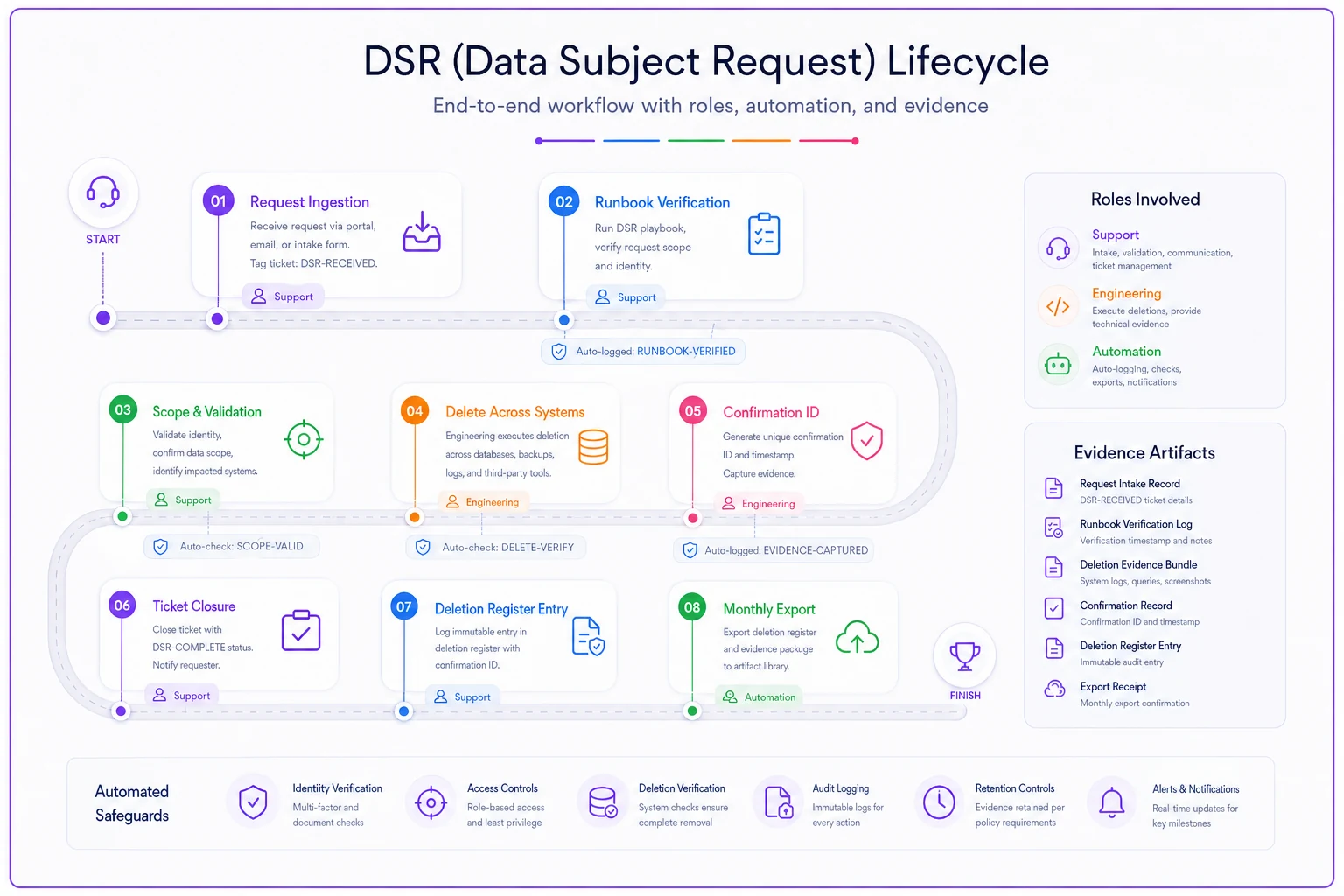
This diagram illustrates the flow from request to artifact library and highlights where evidence is produced automatically.
Retention contracts and the artifact library
Two structural pieces hold the long tail together.
Retention contracts are explicit, per-data-type rules for how long something lives and what destroys it. The failure mode here is nearly universal: teams set a retention policy but never build the mechanism, so data just accumulates forever. Five-year-old tickets with sensitive data sitting in a "closed" status aren't closed from a risk standpoint — they're a breach waiting to be discovered. A retention contract names the data type, the window, the destruction method, and the log that proves destruction happened.
The artifact library is the single, organized place where every piece of audit evidence lands — access review exports, deletion registers, SLA timestamp logs, policy version history, council decision records, completed runbook samples. The difference between a two-day audit and a two-week scramble is whether this library exists and is kept current, or whether evidence is scattered across six tools and three people's memories.
A minimum viable artifact library should contain:
-
Current versions of all three policy tiers, with change history
-
Evidence contracts, one per commitment
-
Access provisioning and periodic access-review records
-
Deletion/retention registers with confirmation IDs
-
SLA and response-time logs for compliance-relevant ticket types
-
Council meeting decisions and the rationale behind each control
-
A sample set of completed runbooks for each sensitive workflow
One pattern worth flagging: teams tend to over-collect and under-organize. Dumping every log into a folder isn't an artifact library — it's a liability you can't navigate. The value is in the structure and the index, not the volume.
This connects directly to operational resilience too. When a vendor fails or a tool migration happens, your evidence trail can snap if nobody accounts for it. The same thinking behind a support resilience framework for vendor failure and SLA recovery applies here — your artifact library needs to survive a platform change, which means exports and portability, not evidence locked inside one vendor you might leave.
Where modern tooling quietly carries the load
None of this works if it depends on humans remembering to log things. The teams that stay audit-ready are the ones where the operating software enforces the control and captures the evidence as a byproduct of normal work.
In practice, that means your ticketing and workflow platform is configured so closure rules block tickets from closing without required evidence, reason codes are standardized and queryable, retention jobs run on schedule and log their own completion, and access changes are recorded automatically rather than remembered. Where AI automation genuinely helps is in the drift-detection layer — flagging a ticket where sensitive data appears in a plaintext note, catching a security-relevant keyword that should have triggered a flag, or surfacing tickets approaching a retention deadline before they become a problem. These are the exact tasks humans miss under volume, and they're where automation earns its place: not replacing the judgment, but making sure nothing slips through the gap between policy and reality.
The goal isn't a wall of dashboards. It's that when the audit request lands, the answer to "can you prove it?" is a query, not a prayer.
When this operating model makes sense — and when it's overkill
When it makes sense: You're selling to mid-market or enterprise, pursuing SOC 2 or ISO certification, handling regulated data (health, financial, EU personal data), or you've already been burned by a security questionnaire you couldn't answer. If any of these are true, build this now — retrofitting evidence onto two years of uncontrolled tickets is far more expensive than enforcing it going forward.
When it's premature: You're a five-person team with a handful of SMB customers and no regulatory exposure. Building a compliance council and a full artifact library at that stage is bureaucracy for its own sake. Start with a single retention contract and clean reason codes, and layer the rest in as you grow.
Who should not do this half-heartedly: Teams that write Tier 1 commitments they can't back with controls. Overstating what you do and hoping no one checks is worse than admitting a gap — it turns a documentation problem into a credibility and legal problem the moment an auditor pulls the thread.
A real scenario
A B2B SaaS company with around 40 support agents started losing enterprise deals at the security-review stage. Prospects asked for proof of data deletion handling and access controls, and the team could describe their process but couldn't produce artifacts. Deals stalled for weeks while they scrambled.
They stood up a compliance council, rewrote their policies into the three-tier structure, and drafted evidence contracts for their six most-asked-about commitments. Runbooks were rebuilt so sensitive-workflow tickets couldn't close without the required evidence attached, and reason codes were standardized across the board.
The visible change wasn't dramatic in daily operations — agents barely noticed the extra guardrails after the first couple of weeks. Security reviews that used to take two to three weeks of back-and-forth started closing in a few days, because the answers were queries against the artifact library instead of reconstruction projects. Over the following couple of quarters, the team stopped treating audits as fire drills. The evidence was simply there.
The real shift
A support compliance program isn't a document or a certificate on the wall. It's an operating model where your external commitments, your enforceable controls, and your daily runbooks are linked — and where doing the work correctly generates the proof automatically. The teams that get this right aren't the ones with the strictest rules. They're the ones who stopped relying on people to remember, and built a system where the evidence takes care of itself.
Start with one commitment. Write its evidence contract. Trace it down through a control to a runbook, and make the runbook produce the artifact. Then do the next one. The audit-readiness compounds from there.
Start with one commitment. Write its evidence contract. Trace it down through a control to a runbook, and make the runbook produce the artifact. Then do the next one. The audit-readiness compounds from there.
Ready to transform your support operations?
Join 500+ support teams using Servyly to reduce resolution times, improve customer satisfaction, and boost team productivity.