

Most support stacks don't fail at the vendor level. They fail at the seams between vendors.
Your chat tool works. Your ticketing system works. Your CRM works. Your automation layer works. And yet somehow a VIP escalation sits untouched for four hours because the event that was supposed to flag it either never fired, fired twice, or arrived with a malformed payload that your automation quietly ignored. Nobody gets paged. No alarm goes off. The breach just... happens, and you find out when the customer emails your VP.
That's the real problem with integration. It's not that the connections don't exist — it's that nobody owns the contract between them. A support platform integration strategy isn't about wiring more tools together. It's about defining what each system promises the next one, measuring whether those promises hold, and having a plan for when they don't.
This is the part of the stack that almost nobody designs on purpose. It accumulates. And then it breaks in ways that are brutally hard to debug.
Why integrations rot even when every individual tool is healthy
Worth internalizing: the reliability of your automation is not the reliability of your worst tool. It's the product of every hop in the chain.
If your chat vendor delivers events 99.5% of the time, your event bus delivers 99.9%, and your automation platform executes 99.8%, your end-to-end reliability isn't 99.5%. It's roughly 99.2% — and that compounds downward with every integration you add. Throw in a CRM sync, a billing lookup, and a Slack notification, and you're quietly operating somewhere around 98% end-to-end while every dashboard you own shows green.
That gap between "every tool is healthy" and "the workflow actually completed" is where SLA breaches live.
In practice, this usually comes down to a handful of predictable problems:
-
Nobody defined the event schema. Each vendor emits whatever shape it wants. Your automation parses it by guessing field names. A vendor ships an API update, renames
customer_tiertotier, and your VIP routing silently stops matching. -
There's no SLA on the handoff itself. You have SLAs on agent response time. You have none on "how long after a chat ends does the ticket actually get created." That delay is invisible and unbounded.
-
Failures are silent. When a webhook times out, most platforms log it somewhere nobody reads and move on. No retry, no alert, no dead-letter queue.
-
Retries make things worse. The ones that do retry often have no idempotency, so a retried "create ticket" event spawns duplicate tickets, and now you're reopening and merging instead of resolving.
The core issue is that integrations get treated as setup tasks — something you wire up once during onboarding and never revisit — instead of living contracts that need monitoring, versioning, and ownership.
It accumulates. And then it breaks in ways that are brutally hard to debug.
The mental model: vendor → event bus → automation
Before fixing anything, it helps to think of your stack as three layers with explicit boundaries between them.
Never lose track of a customer request again.
Servyly helps you track, assign, and resolve every ticket quickly and efficiently.
- Centralized ticket management
- Automated response workflows
- Team collaboration tools
No credit card required
Vendors are the systems of record and channels: your chat tool, phone system, CRM, billing, ticketing. They emit events and receive actions.
The event bus is the layer in the middle — whether that's a real message queue, an iPaaS, or just a thin webhook router. Its job is to receive events, validate them against a schema, and hand them off. This is the layer most teams skip entirely, and it's the single highest-leverage thing you can add.
Automation is where the logic lives: routing rules, escalation triggers, auto-responses, CRM enrichment. Business decisions happen here.
Drawing these boundaries sharply matters because each boundary is where you enforce an SLA and validate a schema. If events flow directly from vendor to automation with nothing in between, you have no place to catch a bad payload, no place to retry, and no place to measure latency. A thin middle layer gives you a chokepoint where you can actually observe what's happening.
This also connects to how your underlying data flows are designed. If you haven't thought through your event pipelines and single source of truth, the integration layer is going to inherit every ambiguity in your data model. It's worth reading Designing Support Data Architecture: SLIs, Event Pipelines and a Trustworthy Single Source of Truth alongside this — a clean integration strategy sits directly on top of a clean data architecture.
Here's a quick diagram of the flow.
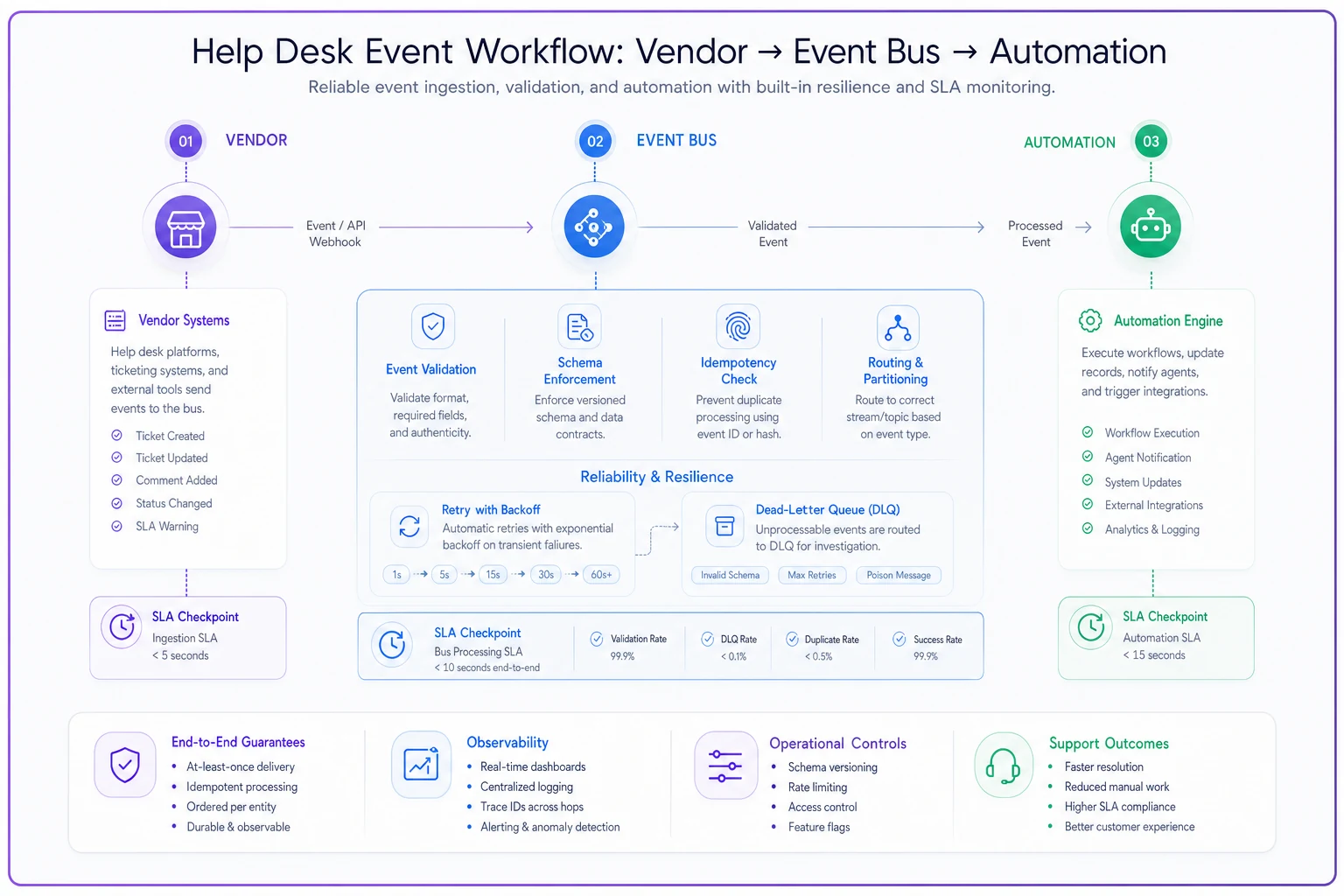
This sketch shows where to enforce SLAs and validate schemas.
Step one: write a canonical event schema
The first concrete artifact you need is a canonical event schema — one internal shape that every incoming event gets normalized into, regardless of which vendor it came from.
This is the move that pays off for years. Instead of your routing logic knowing that Intercom calls it conversation.user.last_reply and Zendesk calls it something else, both get mapped to one internal event type. Your automation only ever reads the canonical shape. When you swap vendors — and you will — you rewrite one mapping instead of every downstream rule.
{ "eventid": "evt01HQ8...", // unique, for idempotency "eventtype": "ticket.escalated", "schemaversion": "1.2", "occurredat": "2026-01-14T09:22:11Z", "sourcevendor": "zendesk", "idempotencykey": "zd-ticket-88213-escalated", "customer": { "id": "cus4482", "tier": "enterprise", "account_owner": "amelia.r" }, "ticket": { "id": "88213", "priority": "urgent", "channel": "chat", "tags": ["billing", "vip"] }, "payload": { } // vendor-specific extras, never parsed by core logic }
Three fields in there do a disproportionate amount of work:
-
eventid/idempotencykey— so a retried or duplicated event never triggers a second action. This single discipline eliminates most duplicate-ticket and double-notification problems. -
schema_version— so when you change the shape, old and new consumers can coexist during migration instead of everything breaking at once. -
occurred_atvs. arrival time — the gap between these two is your integration latency SLI. You can't manage what you don't timestamp.
A common mistake is shoving vendor-specific fields into the top level. Keep the core shape stable and dump the vendor's raw blob into a payload object that your business logic is forbidden from reading. That firewall is what keeps a vendor's API change from rippling into your routing rules.
Step two: define integration SLAs for each hop
Response-time SLAs for agents are well understood. Integration SLAs are the ones nobody writes down — and they're the promises that break silently.
For each hop in the chain, you want a stated target for latency, delivery, and what happens on failure. Here's what a practical set looks like:
| Hop | Latency target (p95) | Delivery target | On failure |
|---|---|---|---|
| Vendor → event bus | < 5s | 99.9% received | Retry 3x, then dead-letter + alert |
| Schema validation | < 500ms | 100% validated | Reject to quarantine, alert owner |
| Event bus → automation | < 2s | 99.95% delivered | Retry with backoff, page on dead-letter |
| Automation → vendor action | < 10s | 99.9% completed | Rollback + human-in-loop flag |
| End-to-end (chat end → ticket live) | < 30s | 99.5% | Breach alert to ops channel |
The specific numbers matter less than the fact that they exist and are measured. The end-to-end row is the one your customers actually feel. If you only monitor per-hop, you can have every row green and still blow the end-to-end target because of accumulated slack.
Measure baseline performance for a couple of weeks with no SLA before choosing targets.
Your metric definitions here need the same rigor as your customer-facing ones. If "delivered" means three different things to three different people, your integration SLA is theater. Support Metric Governance for Trustworthy SLIs and SLAs covers how to lock those definitions down so they hold up.
Step three: observability acceptance tests
Most integrations are "tested" exactly once, by hand, the day they're built. After that, they run on faith.
Observability acceptance tests fix this by defining — before you ship an integration — what observable evidence proves it's still working. Not unit tests of code. Assertions about the live system.
A good acceptance test recipe has three parts: a trigger, an expected observable outcome, and a time bound.
Recipe: VIP escalation routing
-
Inject a synthetic
ticket.escalatedevent withcustomer.tier = enterpriseinto the event bus every 15 minutes. -
Assert that a corresponding routing action appears in the automation log within 10 seconds, and a notification lands in the VIP channel within 30 seconds.
-
Assert that no duplicate action fires for the same
idempotency_key. -
If two consecutive synthetic events fail, page the integration owner.
The synthetic-event approach is the key insight. Instead of waiting for a real customer to expose a broken routing rule, you fire a test event through the real pipeline on a schedule and watch for the expected result. The difference between finding out from your monitoring versus finding out from an angry account manager is exactly this.
A short checklist for any integration before you call it "done":
-
Is there a canonical schema it maps to, with a version number?
-
Is there a synthetic test firing on a schedule through the live path?
-
Is there an alert when the synthetic test fails twice in a row?
-
Is there a dead-letter queue, and does someone own watching it?
-
Is idempotency enforced on every action that writes data?
-
Is the end-to-end latency being measured, not just per-hop?
-
Does someone's name sit next to this integration in a registry?
If you can't check all seven, the integration is fragile. It might work today. It won't survive the day a vendor ships an unannounced update.
Step four: retry and rollback policies that don't make things worse
Retries are where good intentions cause outages. The instinct is "if it failed, try again" — but a naive retry on a non-idempotent action is how one failed ticket-creation becomes six duplicate tickets.
A few principles that hold up in practice:
Only retry what's safe to retry. Reads and idempotent writes (keyed on your idempotency_key) can retry freely. Non-idempotent actions should retry only if you can verify the first attempt didn't partially succeed.
Use exponential backoff with a cap. Hammering retries immediately just adds load onto a vendor that's already struggling. Something like 2s, 8s, 30s, then dead-letter.
Dead-letter instead of dropping. A failed event should never vanish. It goes to a queue a human can inspect and replay. Dead-letter queue depth is one of the most honest health metrics you have — if it's climbing, something upstream is broken even if every dashboard is green.
Define rollback for multi-step automations. If an automation does three things — create ticket, enrich from CRM, notify Slack — and step two fails, you need a defined state. Does the ticket stay? Does it get flagged as partially processed? The worst outcome is a half-completed workflow that looks complete. A partial failure should flag for human review, not silently proceed.
The mistake that comes up most often is treating retry logic as a per-integration afterthought that each engineer implements differently. Centralize it at the event bus layer so every integration inherits the same backoff, idempotency, and dead-lettering behavior. Consistency here is worth more than cleverness.
Vendor integration scorecards
The final piece is holding vendors accountable over time, because "it worked at signing" tells you nothing about month nine.
| Dimension | What you measure | Weight |
|---|---|---|
| Delivery reliability | % of expected events actually received | 30% |
| Latency | p95 vs. agreed SLA | 20% |
| Schema stability | # of breaking changes / unannounced field changes | 20% |
| Error transparency | Do their errors tell you why it failed? | 15% |
| Recovery | Mean time to restore after their outages | 15% |
Run this for a quarter and patterns jump out fast. One vendor is reliable but ships breaking schema changes with no notice. Another has clean schemas but webhook delivery drops under load. That's the kind of evidence that makes renewal conversations grounded in data instead of gut feel.
The scorecard also feeds into how you plan your overall stack. When a vendor scores poorly on schema stability across two quarters, that's a signal to add insulation, reduce dependency, or consolidate. Thinking about this at the portfolio level is covered in the Support Technology Roadmap to Prevent Tool Sprawl and SLA Risk — the roadmap tells you where you're going, the scorecards tell you which vendors are actually getting you there.
A real scenario: the invisible four-hour delay
A mid-sized SaaS support team — around 14 agents, roughly 2,800 tickets a month — had a recurring problem they couldn't pin down. Enterprise escalations were occasionally going hours without a first response, even though their routing automation was configured correctly and their agent SLAs looked fine on paper.
When they finally instrumented the handoff, the cause was ugly but mundane. Their chat vendor was batching webhook deliveries during high-traffic windows, so "chat ended" events sometimes arrived 10–15 minutes late. On top of that, about 1 in 40 events arrived with a malformed customer object, which their automation silently skipped — no error, no log anyone watched. Those skipped events were the enterprise escalations sitting untouched.
The fix wasn't a new tool. It was adding the missing layer: a canonical schema with validation (malformed events now went to a quarantine queue with an alert), an integration SLA on the chat-end-to-ticket hop with synthetic tests firing every 15 minutes, and a dead-letter queue someone actually owned.
Within the first month, silent skips dropped to effectively zero because malformed events surfaced immediately instead of vanishing. The mystery delays stopped. The team went from discovering breaches via customer complaints to catching integration problems before a customer ever noticed — usually within a minute or two of the synthetic test failing. Same vendors, same automation logic. The difference was that the seams between them finally had contracts, measurement, and an owner.
When this level of rigor makes sense — and when it doesn't
When it's worth it: You're running more than a couple of integrations, you have tiered SLAs where some customers genuinely matter more, and a missed handoff has real cost — churn, a breached enterprise contract, an escalation that reaches a VP. Once you're past three or four integrated systems, the compounding-reliability math starts working against you quickly, and the investment pays for itself the first time it catches a silent failure.
When it's overkill: If you're a small team with two tools and a Zapier connection handling low-stakes events, building a full canonical schema and synthetic test suite is premature. Start with the cheap wins — idempotency keys and a dead-letter queue — and skip the rest until you feel the pain.
Who should not do this yet: Teams that haven't nailed down their metric definitions or data architecture first. Building integration SLAs on top of ambiguous data just encodes the ambiguity into more places. Get the foundation stable, then layer the integration contracts on top.
Bringing it together
The teams that run reliable automation aren't the ones with the fanciest tools. They're the ones who treat the connections between tools as first-class things that have contracts, get measured, and belong to someone.
Start small. Pick your one highest-stakes workflow — probably VIP or enterprise escalation routing — and give it the full treatment: a canonical event shape, an SLA on each hop, a synthetic test firing through the live path, idempotency on every write, and a dead-letter queue with a name next to it. Prove the pattern there, watch it catch a failure you'd otherwise have missed, and expand outward from there.
The whole point of a real integration strategy is to move your failure discovery earlier — from "the customer told us" to "our monitoring told us" to, eventually, "our test caught it before it ever touched a customer." Every layer in this playbook pulls that discovery a little further upstream, and that's the entire game.
Ready to transform your support operations?
Join 500+ support teams using Servyly to reduce resolution times, improve customer satisfaction, and boost team productivity.