

Most support teams don't have a metrics problem. They have a trust problem. The dashboard says first response time is 42 minutes. The account manager swears their client waited three hours. Engineering claims the escalation SLA was met. Finance wants to know why the same "resolution rate" shows up as 87% in one deck and 94% in another. Everyone is technically right, because nobody agreed on what any of it actually means.
That's the real failure mode. It's not that the numbers are wrong — it's that the same word points to different math depending on who's holding the calculator. And once a metric can be argued, it can be ignored. The moment your SLA breach signal fires and three people can plausibly dispute it, the signal stops triggering decisions. It just becomes background noise.
Support metric governance is the boring, unglamorous discipline that fixes this. Not more dashboards. Not fancier charts. Just a set of agreements — contracts, really — about what each number means, where it comes from, who owns it, and how disagreements get resolved. That's the layer that makes SLIs and SLAs actually do something instead of just existing.
Why the same metric means five different things
Almost every growing support org hits the same pattern. Early on, one person builds the reporting. They know that "resolution time" excludes weekends, counts business hours in the customer's timezone, and stops the clock when a ticket hits "pending customer." All of that lives in their head. Nobody wrote it down because nobody needed to.
Then the team scales. A second analyst joins and builds a churn-risk report that also uses "resolution time" — except they measure calendar hours, don't exclude pending states, and pull from a slightly different export. Now you have two resolution-time numbers, both labeled identically, both feeding into decisions, quietly disagreeing by 30–40%.
-
Definition drift — the same term calculated differently across different reports
-
Source ambiguity — nobody knows whether the "real" number lives in the help desk, the data warehouse, or a spreadsheet someone maintains manually
-
Ownership vacuum — when a number looks wrong, there's no single person responsible for confirming whether it's right
None of these are technical problems. They're governance problems. And they get worse, not better, as you add tooling.
What breaks at scale
At 5 agents, informal metrics are fine. Everyone's in the same channel, and if a number looks off, someone just asks. At 25 agents across two timezones — with an account team, a QA function, and an engineering escalation path — informal metrics quietly become dangerous.
Never lose track of a customer request again.
Servyly helps you track, assign, and resolve every ticket quickly and efficiently.
- Centralized ticket management
- Automated response workflows
- Team collaboration tools
No credit card required
The failure shows up in a few predictable places.
Cross-functional decisions stall. Your SLA breach for the enterprise segment is supposed to trigger a staffing adjustment or a customer comms plan. But when the breach signal fires, the ops lead pushes back on the definition, the account team pulls their own numbers, and by the time everyone agrees the breach was real, the customer has already escalated to their VP. The metric existed. The decision didn't happen. That's a governance failure dressed up as a data problem.
Metrics get quietly gamed. When "resolution time" isn't clearly defined, agents figure out which statuses stop the clock. Tickets get parked in "pending customer" to protect the number. The dashboard looks fine while the actual customer experience deteriorates. It's not malice — it's rational behavior in the absence of a clear contract about what the metric is supposed to represent.
Reconciliation becomes a monthly fire drill. Finance and support show up to a QBR with different cost-per-ticket numbers, someone spends two days figuring out why, and the actual strategic conversation never happens. That reconciliation should've been a five-minute automated check.
The underlying issue is that metrics are only as trustworthy as the agreements behind them. A lot of this ties back to how you structure your data foundation — if you haven't sorted out your support data architecture and single source of truth, governance will always be fighting uphill. But even with clean pipelines, you still need the human contracts on top.
The metric contract: the core building block
The fix isn't complicated conceptually. Every metric that feeds a decision gets a contract — a short, written definition that everyone agrees to and that becomes the single reference when disputes come up. Think of it as a spec sheet for a number.
A good metric contract answers six questions and nothing more. If it takes three pages, nobody will maintain it.
Here's the template that actually gets used:
| Field | Example: "Enterprise First Response Time" |
|---|---|
| Canonical name | Enterprise First Response Time (FRT-ENT) |
| Plain-language definition | Time from ticket creation to first human agent reply, for Enterprise-tier accounts only |
| Exact calculation | firstagentreplyts − ticketcreated_ts, measured in business minutes (Mon–Fri, 8am–8pm customer local time) |
| Inclusions / exclusions | Excludes auto-replies and internal notes. Excludes tickets created by internal users. |
| Authoritative source | Data warehouse table support.fctticketevents, not the help desk UI |
| Owner | Support Ops Lead (accountable for definition + disputes) |
| Reconciliation cadence | Weekly automated check against help desk; monthly manual audit |
One number, one page. The value isn't in any single field — it's that all of them exist in one place, agreed on by everyone who uses the number.
Two fields do most of the heavy lifting. The authoritative source permanently kills the "which export are we using" argument. And the owner means there's always exactly one person who can rule on whether the number is right. Not a committee. One name.
A note on what counts as an "acceptable" data source
The source field gets less attention than it deserves. A common mistake is treating the help desk UI as the source of truth. The UI is a display layer — it applies timezone conversions, business-hour logic, and status filters that you may not fully control and that vendors change without notice.
The rule worth adopting: the source of record is event-level data, not an aggregated report. Aggregations should always be reproducible from raw events. If your only source for a number is a dashboard export that can't be recomputed from underlying events, that number can't hold up in a dispute and shouldn't be feeding decisions.
Reconciliation cadence: catching drift before it costs you
Contracts prevent new disagreements. Reconciliation catches the drift that creeps in anyway — vendor changes, pipeline bugs, someone editing a query without telling anyone. The goal is finding discrepancies while they're small, not during a QBR.
-
Automated weekly checks. For each contracted metric, run the canonical calculation against a secondary source (usually the help desk's own reporting) and flag any variance above a threshold — more than 5% is a reasonable starting point. Most weeks this passes silently. When it fires, someone investigates that week while the cause is still traceable.
-
Monthly manual audit. Pick two or three high-stakes metrics and trace a handful of individual tickets end to end. Does the raw event data, the warehouse calculation, and the dashboard all tell the same story for ticket #48213? This catches the subtle logic errors that aggregate checks miss.
A lightweight reconciliation checklist for the weekly pass:
-
[ ] Does each contracted metric's canonical value match its secondary source within tolerance?
-
[ ] Did any metric's row count change unexpectedly from last week?
-
[ ] Were there any schema or status changes in the source systems this week?
-
[ ] Did any metric's definition get edited? If so, was the change communicated?
-
[ ] Are there any metrics flagged for dispute from the prior week still open?
Writing this down turns reconciliation into a role someone owns rather than a heroic effort someone occasionally remembers. A 20-minute weekly ritual beats a two-day quarterly investigation every time.
A simple reconciliation workflow looks like this:
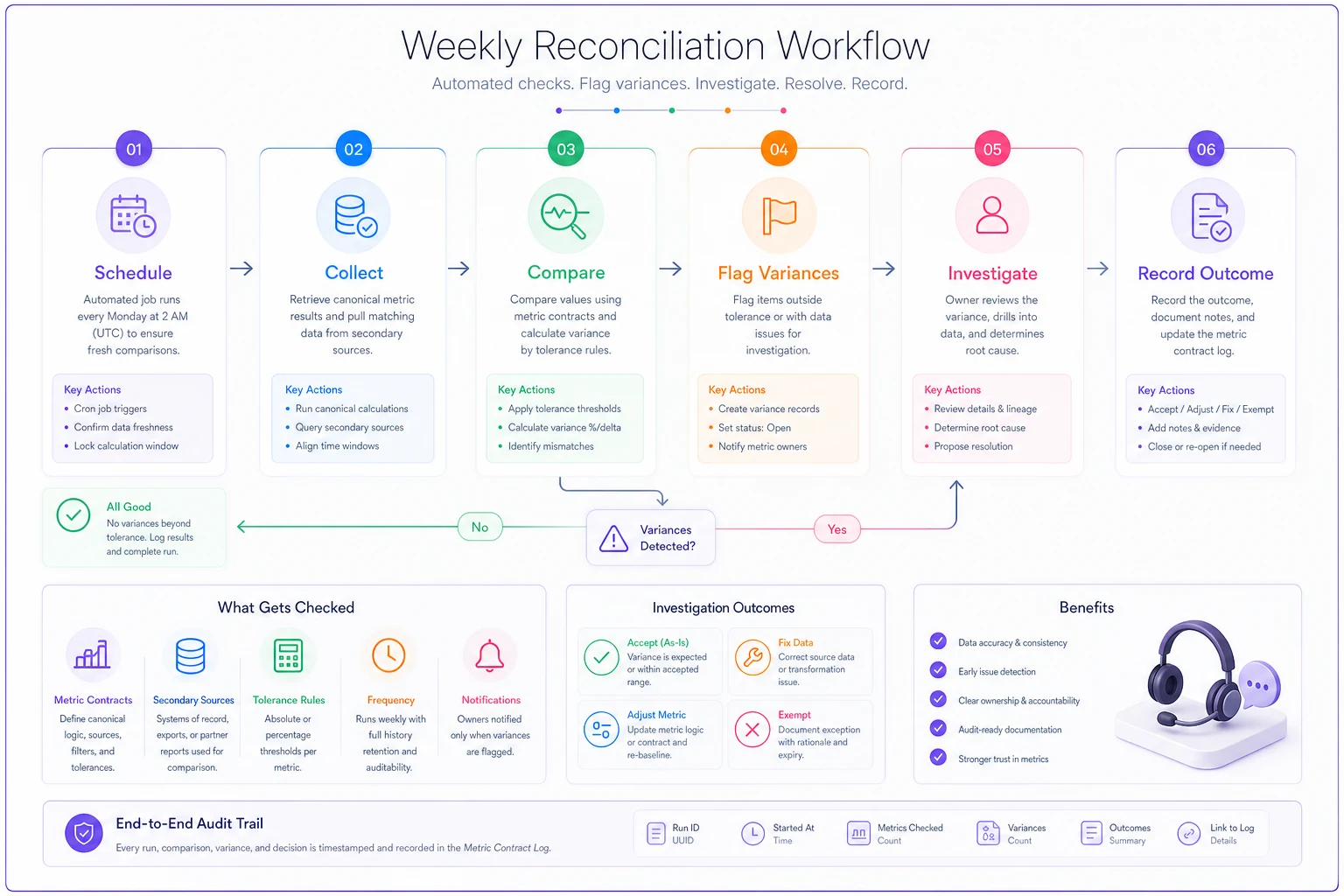
Keep the workflow lightweight and visible so small drifts get fixed before they become quarterly fire drills.
Ownable contracts and lightweight enforcement
A contract with no owner is a suggestion. Assigning every metric to exactly one accountable person — and making that ownership visible — is the single most important governance move you can make.
Ownership without enforcement drifts back to chaos, though. The trick is keeping enforcement lightweight. You don't need a governance board that slows everything down. A few simple rules baked into how the team works is enough:
-
No new metric enters a decision-making dashboard without a contract. If it's not contracted, it's exploratory — clearly labeled and not allowed to trigger SLA decisions.
-
Definition changes require the owner's sign-off and a broadcast. If FRT-ENT's calculation changes, everyone who uses it gets told, and the change is dated in the contract's history.
-
Disputed metrics get a status. A number under active dispute is flagged on the dashboard so decisions aren't made on a contested figure.
This connects directly to how you structure your broader KPI hierarchy. If you're building a tiered KPI hierarchy that turns support signals into revenue and churn insights, governance is what keeps those higher tiers trustworthy. A churn-prediction metric built on three ungoverned inputs inherits all three of their trust problems.
Make ownership visible in dashboards and contract metadata so anyone can see who to ping when a number looks wrong.
Where operational software helps is mostly in making enforcement automatic rather than manual. A workflow platform that stores contracts alongside dashboards, flags variance during reconciliation, and tags disputed metrics keeps the discipline alive without turning it into someone's second full-time job. The value isn't the automation itself — it's that governance stops depending on people remembering to be disciplined.
Dispute resolution: the part everyone skips
Even with contracts, disagreements happen. The difference between a mature support org and a chaotic one isn't the absence of disputes — it's having a fast, boring way to resolve them.
-
The contract is the first authority. If two numbers disagree, check them both against the contracted definition and source. Most of the time, one isn't following the contract, and the dispute ends there.
-
If the contract is ambiguous, the owner rules — and updates the contract. The output of any dispute where the definition wasn't clear enough is a sharper contract. Disputes are free debugging for your definitions.
-
If the disagreement is about whether the contract itself is right, that's a change request, not a dispute. It goes through the definition-change process, with the owner deciding and broadcasting.
What this does is take the emotion out. Nobody's "wrong" in a personal sense — the contract is either being followed or it needs to be clearer. That framing matters more than it sounds. Metric arguments quietly turn into cross-team resentment when they feel like accusations.
A real scenario: the SLA that nobody trusted
A B2B software company with a support team of roughly 18 people kept hitting the same wall in their weekly ops review. Their enterprise SLA attainment showed 96% in the support dashboard, but the account management team insisted that at least a quarter of their key accounts had experienced slow responses that month. Both sides brought numbers. Both sides were annoyed. The meeting produced no decisions, week after week.
When they dug in, the cause was pure definition drift. Support's "first response" counted automated acknowledgment emails as a response. Account management, reasonably, only counted a real human reply. On top of that, support measured in business hours; account management measured in wall-clock time, which mattered because several key accounts were in timezones the business-hour window didn't fully cover.
Neither number was wrong. They just measured different things under the same label. Writing a single metric contract — human replies only, business hours defined per customer timezone, sourced from event data — collapsed both numbers into one. Attainment came out around 88%, lower than support's figure but higher than account management's worst fears. More importantly, once everyone trusted the 88%, the breach signal actually triggered action: they adjusted coverage for two undercovered timezones, and the recurring argument in the ops review just stopped. The reconciliation check afterward took about ten minutes a week.
The real win wasn't the corrected number. It was that the metric finally became trustworthy enough to base a staffing decision on.
When heavy governance is a bad idea
This discipline scales with your risk, not your headcount. A five-person team running everything out of one help desk doesn't need metric contracts for twenty numbers. Formalizing governance too early creates overhead that slows a small team down and teaches everyone to resent process.
-
Multiple teams (support, account management, engineering, finance) make decisions off the same metrics
-
The same metric name shows up in more than one report or tool
-
SLA breaches are supposed to trigger cross-functional action but keep getting disputed
-
You've already had at least one "which number is right" meeting that burned an hour of everyone's time
It's premature when you have one reporting owner, one source, and everyone can just ask them directly. In that case, write down the definitions for your three or four most important metrics and stop there. Contract the numbers that trigger decisions or feed executive views. Leave the exploratory stuff loose.
Treating governance as all-or-nothing is a mistake in both directions. Start with the handful of metrics that actually cause arguments or drive money decisions, and expand only as the pain shows up.
Bringing it together
Trustworthy SLIs and SLAs aren't a data engineering achievement — they're an agreement problem. The pipelines can be flawless and you'll still argue about numbers if nobody agreed on what the numbers mean, where they live, and who gets the final say.
Metric contracts, a steady reconciliation rhythm, clear ownership, and a dull-but-fast dispute process are what turn a dashboard from a debate topic into a decision tool. The teams that get this right aren't the ones with the prettiest charts. They're the ones where a breach signal fires and, instead of a fifteen-minute argument about whether it's real, someone just acts on it. That's the whole point of governance: making your metrics boring enough to trust, and trustworthy enough to act on.
Metric contracts, a steady reconciliation rhythm, clear ownership, and a dull-but-fast dispute process are what turn a dashboard from a debate topic into a decision tool. The teams that get this right aren't the ones with the prettiest charts. They're the ones where a breach signal fires and, instead of a fifteen-minute argument about whether it's real, someone just acts on it. That's the whole point of governance: making your metrics boring enough to trust, and trustworthy enough to act on.
Ready to transform your support operations?
Join 500+ support teams using Servyly to reduce resolution times, improve customer satisfaction, and boost team productivity.