


Most support orgs don't have a decision problem. They have a decision location problem. The call about whether a new automation ships lives in one Slack thread. The call about retiring a stale KB article lives in a quarterly doc nobody reads. The call about whether a vendor missing their SLA actually triggers a penalty lives in someone's head — usually the person who negotiated the contract and left eight months ago.
When those decisions are scattered, each one feels small. The damage shows up in aggregate: a routing change that quietly broke a segment SLA, a knowledge article that contradicted the product for three releases, a vendor who's been missing their uptime target for two quarters with zero consequence because nobody owned the enforcement.
A support governance mesh is the fix — not another committee, but a connected layer where decisions that span teams get standardized into contracts, run through gates, and reviewed on a predictable cadence. The word "mesh" matters. It's not one centralized board approving everything. It's a set of lightweight, interlocking mechanisms that each own a slice of the decision space and hand off cleanly to the next.
Here's how the whole thing fits together, where it breaks, and what the artifacts actually look like.
Why scattered decisions quietly rot the operation
There's a pattern that shows up across teams that have outgrown their original process but haven't built a replacement.
Early on, decisions are fast because everyone's in the same room (or the same channel). The head of support, the KB owner, and the one engineer who understands the automation all talk constantly. No governance needed — the governance is the three of them.
Then you add a product line. Then a second region. Then a BPO partner. Then an experiment backlog. Suddenly the three-people-talking model can't hold the load, and three things happen almost simultaneously:
-
Metrics drift. Two dashboards report "first response time" with different definitions, and a decision gets made on the wrong one.
-
Knowledge goes stale silently. Nobody owns the retirement of old content, so the help center accumulates contradictions.
-
Vendor accountability evaporates. The contract says 99.5% uptime, but there's no mechanism that converts a miss into an action.
These aren't three separate problems. They're one problem wearing three outfits: decisions that cross functional boundaries have no durable home. A metric decision affects knowledge. A knowledge decision affects vendor scope. A vendor SLA miss affects your own SLA commitments. When each lives in its own silo, you get what I'd call decision rot — choices that were made correctly at the time but were never recorded, revisited, or enforced.
The four pillars the mesh bundles
A governance mesh works because it treats four normally-separate concerns as one connected system. Here's what each pillar does and — more importantly — how it feeds the others.
Never lose track of a customer request again.
Servyly helps you track, assign, and resolve every ticket quickly and efficiently.
- Centralized ticket management
- Automated response workflows
- Team collaboration tools
No credit card required
| Pillar | What it governs | Primary artifact | Who owns it | Feeds into |
|---|---|---|---|---|
| Metric contracts | Definitions and thresholds for every SLI/SLO used in decisions | Metric contract doc | Support analytics lead | Every decision that cites a number |
| KB lifecycle gates | Creation → review → publish → retire path for knowledge | Lifecycle gate checklist | Knowledge manager | Vendor scope, automation safety |
| Experiment registry | Every live and proposed change, with hypothesis and rollback | Experiment record | Ops / experimentation owner | Metric contracts, release gates |
| Vendor SLA enforcement | Converting contract terms into monitored, enforceable actions | SLA enforcement matrix | Vendor / procurement owner | Your own customer SLAs |
Most teams already have fragments of all four. The mesh is the wiring — the explicit rule that a decision in one pillar isn't valid until it names its dependencies in the others.
A quick example: someone proposes an experiment that auto-closes tickets after 72 hours of customer silence. That's an experiment registry entry. But it can't pass the gate until it references the metric contract for "resolution rate" (so you measure the right thing), confirms the KB has a self-serve article the auto-close message links to, and checks whether your BPO vendor's SLA accounts for the shifted volume. One decision, four pillars, one gate. That's the mesh doing its job.
If your metric definitions aren't trustworthy, the whole mesh wobbles — which is why the metric contract layer leans heavily on the discipline covered in Support Metric Governance for Trustworthy SLIs and SLAs.
Decision contracts: the unit the whole thing runs on
The central artifact in a governance mesh is the decision contract. Not a meeting. Not a doc. A specific record that turns "we decided X" into something auditable six months later when someone asks "wait, why does routing work this way?"
-
The decision — stated in one sentence, in plain language.
-
The trigger — what prompted it (a metric breach, an experiment result, a vendor miss, a product change).
-
The dependencies — which metrics, KB articles, experiments, or vendor terms it touches.
-
The owner — one name, not a team.
-
The gate it passed — which enforcement checkpoint cleared it.
-
The review date — when it gets revisited or auto-expires.
-
The rollback condition — what signal reverses this decision.
That last field is the one most teams skip, and it's the one that saves you. A decision without a rollback condition is a decision you'll defend forever out of sunk-cost pride. A decision with one — "revert if segment-A FRT degrades more than 15% over two weeks" — is a decision you can walk back without a political fight, because the reversal was pre-agreed.
The value of a decision contract is mostly in the fields nobody wants to fill out. Anyone can write the decision sentence. Forcing the owner to name the rollback condition and the review date is where the discipline lives, because it makes people admit upfront that the decision might be wrong.
The enforcement gates
A mesh without gates is just a nicely organized wishlist. Gates are the points where a proposed decision either proceeds or stops. They need to be specific enough that a gate "passing" isn't a judgment call.
The metric gate. Before any decision cites a number, that number's definition must exist in the metric contract registry. No definition, no decision. This kills the "two dashboards, two definitions" problem at the source. In practice this gate catches a surprising amount — one team found that "escalation rate" had three competing definitions across product, support, and the BPO, and two quarters of decisions had been made on mismatched figures.
The KB lifecycle gate. No knowledge article publishes without an owner and a review date, and no article survives past its review date without re-certification. This is the gate that prevents the slow accumulation of contradictory content. The governance-first logic behind this is worth reading in full in Why a Governance-First Knowledge Strategy Keeps Your Help Center Healthy.
The experiment gate. Nothing that changes customer-facing behavior goes live without a registry entry that includes a hypothesis, a success metric (from the metric contract), and a rollback trigger. This is the gate that stops the "someone shipped a change nobody tracked" failure.
The vendor enforcement gate. When a vendor misses a contracted SLA, the miss must route to a pre-defined action — not a conversation about whether it's worth raising. Either the penalty applies, the scope adjusts, or someone with authority explicitly waives it and records why.
Gates aren't meant to slow everything down. A well-designed gate is fast for routine decisions and slow only for the risky ones. If your gate adds friction to every tiny change, people will route around it — and a routed-around gate is worse than no gate. It creates the illusion of control.
Owner checklists: making the gate pass-able in two minutes
Gates die when passing them is ambiguous. The fix is a tight checklist per gate so the owner knows exactly what "ready" means.
Here's a sample experiment gate checklist — the kind that should take a prepared owner a couple of minutes, not an afternoon:
-
[ ] Hypothesis stated as "we believe X will cause Y"
-
[ ] Success metric exists in the metric contract registry (not invented for this experiment)
-
[ ] Baseline value recorded before launch
-
[ ] Affected customer segments identified
-
[ ] Rollback trigger defined with a specific threshold
-
[ ] KB impact checked — does this change what customers should be told?
-
[ ] Vendor impact checked — does this shift volume or scope for a partner?
-
[ ] Owner named and review date set
Keep checklists strictly to verifiable items so an owner can actually scan and complete them in a couple of minutes.
If an owner can't check all eight in a short sitting, the experiment isn't ready — and that's useful information, not an obstacle. The checklist turns "is this safe to ship?" from a debate into a scan.
How the whole thing runs: a workflow walkthrough
Tracing a real-shaped decision through the mesh makes the wiring concrete.
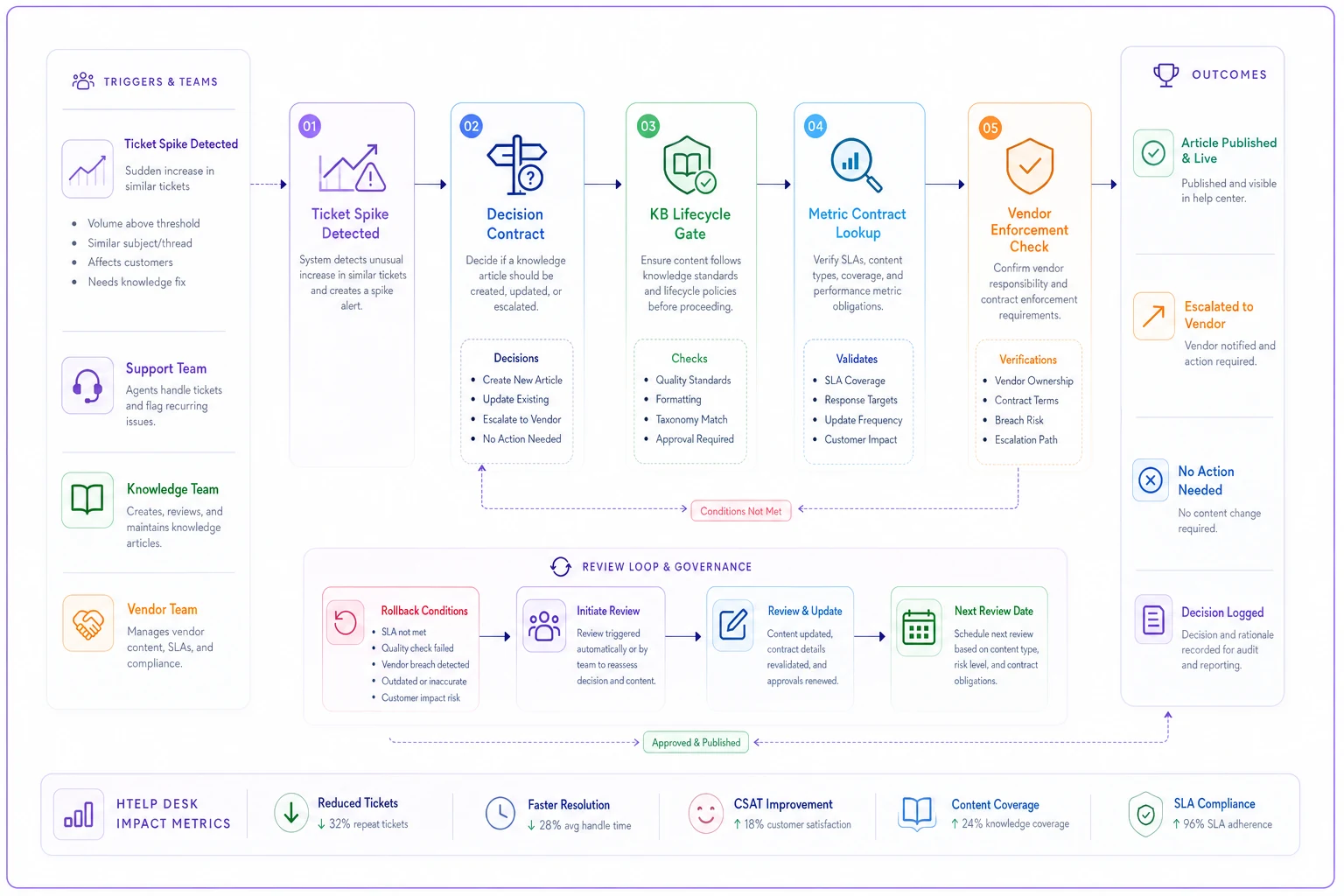
The ticket spike gets flagged by whoever's on queue duty. They don't fix it ad hoc — they open a decision contract. The trigger is logged: "feature rename causing contact spike in segment B." The owner is assigned — the knowledge manager, since the primary fix is content.
The knowledge manager hits the KB lifecycle gate. Three articles reference the old feature name. The gate forces the question: update or retire? They update, but the gate also requires naming the metric that'll confirm the fix worked — so they pull "related contact rate" from the metric contract registry rather than eyeballing it.
Because the contact volume shift might affect the BPO's staffing SLA, the contract's dependency field flags the vendor enforcement gate. The vendor owner checks: is this a volume change the contract accounts for? If yes, no action. If it pushes past the contracted band, the enforcement matrix says what happens.
The decision contract gets a review date — two weeks out — and a rollback condition: if related contact rate doesn't drop below baseline, escalate to a product-side fix rather than a content patch.
One ticket spike touched knowledge, metrics, and vendor scope — and instead of three disconnected reactions, it produced one auditable contract that any of those teams can read later. That's the difference between a mesh and a pile of good intentions.
The quarterly rituals that keep it honest
Gates handle the flow of individual decisions. Rituals handle the drift that no single decision causes but that accumulates over time. Three cadences do most of the work:
Monthly — contract review. A short session where every decision contract hitting its review date gets a verdict: keep, modify, or retire. Keeps the backlog of "decisions we forgot we made" from building. Usually 30–45 minutes if it's run tight.
Quarterly — metric contract audit. Every SLI/SLO definition in the registry gets re-checked against how it's actually being computed. This is where you catch definition drift before it poisons a quarter of decisions. It's tedious and it's the single highest-leverage ritual in the mesh.
Quarterly — vendor SLA reconciliation. Walk the enforcement matrix against actual vendor performance for the quarter. Misses that were waived get re-examined. Patterns get spotted. This is where a vendor who's been quietly underperforming finally shows up on the radar — because the ritual forces the comparison that nobody does in the day-to-day.
Worth noting: the gates catch bad individual decisions; the rituals catch bad accumulated states. You need both. A team with gates and no rituals makes good calls that slowly go stale. A team with rituals and no gates has great review meetings about a flow that's already out of control.
A real-shaped scenario
Consider a mid-sized SaaS support org — roughly 20 agents, one BPO partner handling overflow, two product lines, a help center with a few hundred articles.
Before the mesh: decisions lived wherever they were made. A routing experiment had been live for about five months with no record of why it was launched or how to tell if it worked. The BPO had missed their resolution-SLA in two of the last three months, and nobody had triggered the contract's remediation clause because the person who'd flag it assumed someone else owned it. Knowledge was the worst of it — an audit turned up somewhere around 40–50 articles referencing a deprecated UI.
After introducing decision contracts, gates, and the quarterly rituals over about a quarter: the experiment backlog got registry entries and three stale experiments got retired. The vendor reconciliation ritual surfaced the missed SLAs and triggered an actual scope renegotiation — real money, not just a stern email. The KB lifecycle gate caught new stale content before publish instead of months after. Decision-to-action time on cross-team calls dropped noticeably, mostly because people stopped re-litigating decisions that now had owners and rollback conditions written down.
Nothing here was dramatic. The mesh doesn't produce a heroic turnaround. It produces the absence of slow-motion disasters, which is harder to see but worth far more.
When this makes sense — and when it doesn't
When it makes sense: You have at least two teams whose decisions affect each other (support + product, support + a vendor, knowledge + automation). You've felt the pain of a decision nobody can explain later. You're adding complexity — new regions, new products, new partners — faster than your informal process can absorb.
When it's a bad idea: You're a five-person team where everyone genuinely is in the same conversation. Formalizing decision contracts at that scale is overhead with no payoff — the mesh solves a coordination problem you don't have yet. Build the habit of naming rollback conditions, skip the ceremony.
Who should NOT do this: Anyone hoping governance will fix a trust problem. If teams don't trust each other, a mesh becomes a weapon — gates get used to block rivals, not to protect the operation. Fix the relationship first. Governance makes a healthy org faster; it makes a dysfunctional one slower and more bureaucratic.
One more caution: don't let the mesh calcify into tool sprawl, where every pillar spawns its own system and the "governance" becomes a tax on getting anything done. The whole point is fewer, better-connected decision homes — a trap worth understanding alongside the thinking in Support Technology Roadmap to Prevent Tool Sprawl and SLA Risk.
Where tooling earns its place
A governance mesh can run on docs and a shared calendar — and for a small team, it should. The templates matter more than the software. But as the volume of decision contracts grows, the manual version starts to strain in predictable ways: review dates get missed, dependency links go stale, nobody notices when a metric definition changed underneath a live decision.
That's where a workflow platform with some automation earns its keep — not by making the decisions, but by enforcing the boring parts. Surfacing contracts that hit their review date. Flagging when a cited metric's definition changes. Routing a vendor SLA miss to its pre-defined action instead of waiting for someone to notice. The judgment stays human; the remembering and routing stop depending on someone's memory. The goal isn't to automate governance — it's to stop losing decisions to the gaps between people.
The actual point
A support governance mesh isn't about adding process for its own sake. It's about giving cross-functional decisions a durable home so they're fast when they should be fast, auditable when someone asks why, and enforceable when a vendor or a metric or a knowledge gap tries to slip through.
The teams that struggle aren't usually the ones making bad decisions. They're the ones making fine decisions that evaporate the moment they're made — no record, no owner, no rollback, no review. The mesh doesn't make you smarter. It makes your decisions stick, connect, and hold up under scrutiny. For an operation that's outgrowing the three-people-in-a-room model, that's the difference between scaling cleanly and spending every quarter cleaning up choices nobody remembers making.
A support governance mesh isn't about adding process for its own sake. It's about giving cross-functional decisions a durable home so they're fast when they should be fast, auditable when someone asks why, and enforceable when a vendor or a metric or a knowledge gap tries to slip through.
The teams that struggle aren't usually the ones making bad decisions. They're the ones making fine decisions that evaporate the moment they're made — no record, no owner, no rollback, no review. The mesh doesn't make you smarter. It makes your decisions stick, connect, and hold up under scrutiny. For an operation that's outgrowing the three-people-in-a-room model, that's the difference between scaling cleanly and spending every quarter cleaning up choices nobody remembers making.
Ready to transform your support operations?
Join 500+ support teams using Servyly to reduce resolution times, improve customer satisfaction, and boost team productivity.