



Most support teams don't have an experimentation problem. They have a memory problem.
Someone tweaks a macro, changes a routing rule, rewrites a help article, or turns on a new automation. Three weeks later, ticket volume shifts a little, CSAT wobbles, and nobody can say with any confidence whether the change caused it, whether it was seasonality, or whether a product bug quietly resolved itself. The change gets absorbed into "the way we do things now," and six months later somebody proposes the exact same idea because there's no record it was already tried.
That's the real cost. Not the individual experiment—the fact that experiments never accumulate into knowledge. Every team relearns the same lessons because nothing was written down in a way that connected the intervention to a number.
A support experimentation framework fixes this by treating changes to your support operation like changes to a product: registered, defined in advance, measured against a specific metric, and reviewed on a fixed cadence. This isn't about turning your help desk into a research lab. It's about making sure that when you spend effort changing something, you can tell whether it worked—and whether it's worth keeping.
Why support experimentation breaks down in practice
The failure isn't a lack of ideas. Support teams generate improvement ideas constantly—every retro, every escalation, every angry customer produces three suggestions. The breakdown happens between "we should try this" and "we know if it worked."
Changes overlap. You launch a new onboarding email sequence the same week you rewrite your top five help articles and change how billing tickets get routed. Ticket volume drops 8%. Which change did it? Nobody knows, because three things moved at once. This is the single most common reason support experiments produce nothing usable.
Metrics get chosen after the fact. The change ships, results come in, and the team goes looking for a metric that makes it look good. First-response time improved? Great, that's the win. But if you didn't pick the metric before running the experiment, you'll always find one that flatters the result. This is the support version of p-hacking, and it's widespread.
No baseline exists. People compare "after" to a vague sense of "before." Was your reopen rate 12% or 18% last quarter? If you can't answer that precisely, you can't measure improvement. Most teams can't, because their metric definitions drift—which is worth reading about separately in Support Metric Governance for Trustworthy SLIs and SLAs.
Effect sizes are unrealistic. A team runs an experiment on 40 tickets over a week, sees a 5% shift, and declares victory. With that sample size, a 5% shift is noise. They're reacting to randomness and building policy on top of it.
The through-line is that support changes get made impressionistically. The framework's job is to force a few decisions before the change ships, so the result means something afterward.
The four pieces that make experiments accumulate
1. An experiment registry
Never lose track of a customer request again.
Servyly helps you track, assign, and resolve every ticket quickly and efficiently.
- Centralized ticket management
- Automated response workflows
- Team collaboration tools
No credit card required
One place—a spreadsheet is genuinely fine to start—where every support experiment is logged before it launches. Not after. Before. The act of registering forces you to articulate what you're actually testing.
A registry entry doesn't need to be long. It just needs enough structure that six months later, someone can find it and understand what happened without tracking you down.
| Field | Example |
|---|---|
| Experiment ID | EXP-2026-014 |
| Hypothesis | Adding a self-serve password reset flow to the login error page will reduce password-related tickets |
| Primary metric | Weekly password-reset ticket count |
| Baseline | ~230/week (trailing 8-week avg) |
| Target (MDE) | ≥15% reduction |
| Segment affected | All web users |
| Start / end date | Mar 3 – Mar 31 |
| Owner | Priya |
| Status | Running |
| Result | (filled in at review) |
The registry does something subtle but important: it makes overlapping experiments visible. If someone wants to launch a routing change while your password-reset test is still running on the same ticket population, the registry surfaces the conflict before it contaminates both results.
2. Pre-registration of the metric and the call
Pre-registration means writing down—before launch—what metric you're measuring, what the baseline is, and what result would make you keep, kill, or iterate on the change. This one habit eliminates most of the self-deception in support experimentation.
The critical part is the decision rule. Not "we'll see how it goes," but something concrete: "If password-reset tickets drop by at least 15% over four weeks with no increase in reopen rate, we keep it. If the drop is under 8%, we kill it. Anything in between, we run it another four weeks."
Writing the decision rule in advance stops the after-the-fact rationalization. When results are ambiguous—and they often are—you already agreed on what ambiguous means and what you'd do about it.
3. MDE heuristics (so you don't chase noise)
MDE stands for Minimum Detectable Effect—the smallest change you can reliably distinguish from random variation given your ticket volume. This sounds statistical and intimidating, but for support teams it collapses into a few practical rules of thumb.
-
High-volume categories (200+/week) you can detect ~10% changes within 2–4 weeks.
-
Medium-volume (50–200/week) aim to detect 15–20% changes, expect 4–6 weeks.
-
Low-volume (under 50/week) only trust effects of 25%+, and be patient about run time—or don't run a formal experiment at all, just make the change and watch.
The mistake to avoid: running an experiment on a category too small to ever produce a trustworthy signal, then treating whatever number comes out as real. If the MDE math says you can't detect anything smaller than a 40% swing, and your hypothesis is about a modest 10% improvement, the experiment is pointless before it starts. Kill it in planning.
If a category is low-volume, consider bundling similar ticket types or extending run time rather than running an underpowered experiment.
4. Metric contracts tied to business KPIs
This is the piece most teams skip, and it's the one that keeps experimentation honest. A metric contract is an explicit agreement about what each metric means, how it's calculated, and which business outcome it maps to.
-
Ticket deflection → paired with CSAT and reopen rate (did people actually get helped, or just blocked?)
-
First-response time → paired with resolution rate (fast, or just fast-and-wrong?)
-
Automation resolution rate → paired with escalation-after-automation rate
Deflection especially needs this discipline. "Deflected" should mean the customer solved their problem, not that they gave up. If deflection goes up 20% but CSAT drops and reopens climb, you didn't deflect tickets—you deferred them into a worse form. The metric contract makes that trade-off impossible to hide.
A reproducible experiment workflow
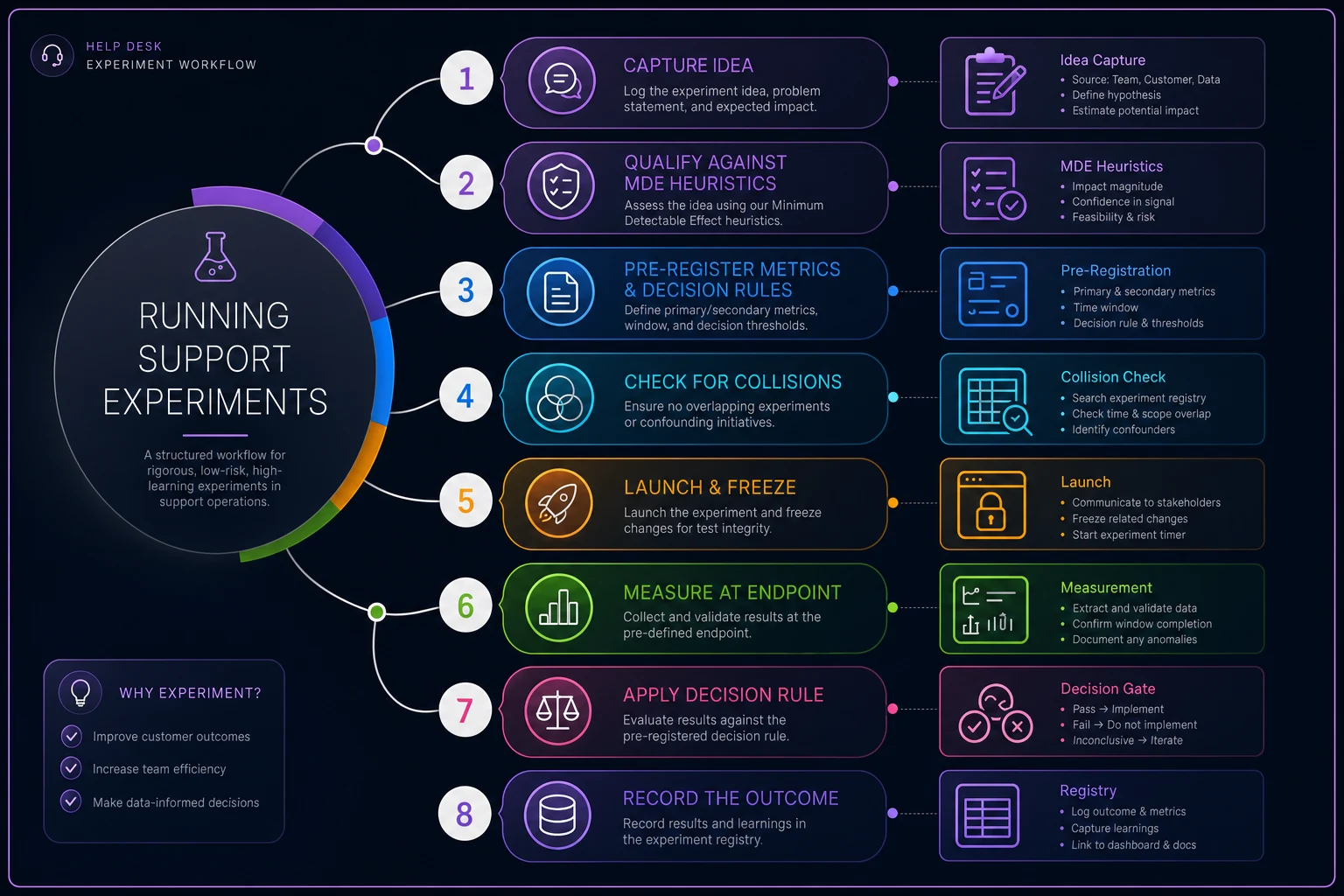
Here's the sequence that ties the four pieces together into something a team can actually run week to week.
-
Capture the idea. Any team member logs a rough hypothesis into the registry backlog. No formatting rules—just get it recorded so it isn't lost.
-
Qualify it. During weekly review, check the affected category's volume against MDE heuristics. If the category's too small to measure the expected effect, either bundle it, extend the planned run time, or reject it.
-
Pre-register. Fill in baseline, primary metric, guardrail metrics, target effect, and the keep/kill/iterate decision rule. Assign an owner and dates.
-
Check for collisions. Scan the registry for any running experiment touching the same ticket population. If there's overlap, stagger them.
-
Launch and freeze. Ship the change and don't touch anything else affecting that segment during the run. This is the hardest discipline and the most important.
-
Measure at the pre-set endpoint. Pull the primary metric and guardrails. Don't peek early and stop the moment it looks good—that's how you fool yourself.
-
Apply the decision rule. Keep, kill, or iterate based on what you wrote down before you saw the numbers.
-
Record the outcome. Write the result into the registry, including "it didn't work" results. Failed experiments are the most valuable entries—they stop future teams from repeating dead ends.
Step 8 is where the whole framework pays off. Most teams document wins and quietly forget failures. But a registry full of honest "we tried this, here's why it didn't move the needle" entries is worth more than any dashboard, because it prevents the endless re-litigation of settled questions.
Here's a visual of the workflow.
Step 8 is where the whole framework pays off. Most teams document wins and quietly forget failures. But a registry full of honest "we tried this, here's why it didn't move the needle" entries is worth more than any dashboard, because it prevents the endless re-litigation of settled questions.
Cadence: how often to review
Weekly operational review (30 minutes). Look at what's running, what's finished, what needs a decision. Fast, tactical. The goal is to keep experiments moving through the pipeline and catch collisions early.
Monthly KPI review (longer). Zoom out to the business metrics—ticket volume trend, deflection rate, cost-per-ticket, CSAT—and ask which of last month's experiments actually contributed to movement there. This is where you connect small individual experiments back to the numbers leadership cares about, and where you notice if a bunch of "wins" somehow didn't add up to any real change in total volume. That disconnect is common and worth paying attention to—it usually means your primary metrics and your business KPIs aren't as connected as you assumed.
Tying the cadence explicitly to deflection and business KPIs is what keeps experimentation from becoming a hobby. If the monthly review can't trace experiments to the numbers the business tracks, the program will lose support—rightly.
When this framework makes sense (and when it doesn't)
When it's worth the overhead:
-
You're running enough ticket volume that categories hit thresholds where measurement is reliable (roughly a few hundred tickets a week overall).
-
You're making frequent changes—automation rules, KB updates, routing logic, macros—and losing track of what worked.
-
You're investing in automation and need to prove it's actually deflecting tickets rather than degrading experience. This connects directly to the phased, measured approach described in Avoid Costly AI Mistakes in Support: Phased Knowledge Engineering, Retrieval Design and Rollback Controls.
When it's a bad idea:
-
Very low total volume. If you're handling 40 tickets a day, you can't detect much statistically. Make changes, watch trends, trust judgment. A formal framework will just add friction and false precision.
-
You're mid-crisis. During a major incident or a product launch blowing up your queue, everything is confounded. Don't try to run clean experiments in a storm.
Who should not do this yet: teams whose metric definitions aren't stable. If two people pull "reopen rate" and get different numbers, fix that first—experimentation on top of untrustworthy metrics just produces confident wrong answers. Getting your leading indicators solid, as covered in Support Analytics That Predict Workload & Quality Issues, is a prerequisite, not an optional companion.
A real scenario
A mid-sized SaaS support team—about 11 agents, handling somewhere around 1,400 tickets a week—was drowning in what they called "obvious" work. Password resets, plan-change requests, and "how do I export my data" questions made up a big chunk of the queue, and everyone knew self-serve would help. So they'd been shipping help articles and automation rules steadily for months, and volume kept creeping up anyway.
The problem wasn't the changes. It was that they'd shipped roughly a dozen improvements in one quarter with no isolation and no baselines, so they had no idea which ones helped. Some might have been actively making things worse and nobody could tell.
They set up a registry and started pre-registering. First real experiment: a self-serve data-export flow, targeting the ~120 weekly export tickets, with a decision rule of "keep if we cut export tickets by 20%+ over four weeks without raising reopens." They froze other changes to that population during the run.
Result: export tickets dropped by roughly 30% and held. Clean, attributable, kept. But the more useful outcome came two experiments later, when a heavily-hyped chatbot deflection change showed deflection "up" while the guardrail—reopen rate—climbed and CSAT slipped. Under the old impressionistic approach, that would've been logged as a win and expanded. The metric contract caught it, and they killed it.
Over the following two quarters, total weekly volume finally started trending down—into the ~1,150–1,200 range—not because they were doing more, but because they stopped keeping changes that didn't work and stopped re-trying dead ends. The registry had about 25 entries by then, maybe a third of them "didn't work," and that third was arguably the most valuable part.
A quick starting checklist
If you want to stand this up without overbuilding it:
-
[ ] Create a shared registry with the fields from the table above
-
[ ] Write metric definitions for your 5–6 core metrics so everyone pulls the same numbers
-
[ ] Pair every efficiency metric with a guardrail metric (deflection ↔ CSAT + reopens)
-
[ ] Set MDE thresholds by ticket category volume
-
[ ] Require a written keep/kill/iterate rule before any experiment launches
-
[ ] Book the weekly 30-minute review and the monthly KPI review
-
[ ] Commit to logging failed experiments as seriously as wins
Commit to logging failed experiments as seriously as wins
The point of all this
Support operations improve through hundreds of small changes. Without a system, those changes don't compound—they cancel out, get forgotten, and get re-attempted. A registry, pre-registration, honest effect-size math, and metric contracts turn scattered tinkering into a body of knowledge your team actually keeps.
Start small. One registry, one pre-registered experiment, one honest decision rule. The discipline matters more than the tooling, and the payoff shows up the first time someone proposes an idea and you can pull up the entry that says: we tried that, here's exactly what happened, and here's why we decided what we decided.
Support operations improve through hundreds of small changes. Without a system, those changes don't compound—they cancel out, get forgotten, and get re-attempted. A registry, pre-registration, honest effect-size math, and metric contracts turn scattered tinkering into a body of knowledge your team actually keeps.
Start small. One registry, one pre-registered experiment, one honest decision rule. The discipline matters more than the tooling, and the payoff shows up the first time someone proposes an idea and you can pull up the entry that says: we tried that, here's exactly what happened, and here's why we decided what we decided.
Ready to transform your support operations?
Join 500+ support teams using Servyly to reduce resolution times, improve customer satisfaction, and boost team productivity.