

Most support orgs don't actually decide to run five channels. They accumulate them. Someone added live chat during a product launch. A partnership required WhatsApp. Social DMs got turned on because marketing wanted them. SMS showed up because a vendor offered it in a bundle. Three years later you're staffing seven inbound channels, none of them has a clear role, and nobody can tell you what a contact costs on each one.
That's the real problem with how most teams approach an omnichannel support strategy. It isn't that they have too many channels — it's that they have no framework for what each channel is for, what it should cost, and when it should be shut down. Channels get added enthusiastically and retired never. The result is a sprawling surface area that's expensive to staff, impossible to keep consistent, and quietly eroding your SLAs because attention is stretched thin across places customers barely use.
This article treats your channels the way a portfolio manager treats assets: each one has a defined role, a cost-per-contact profile, parity rules so the experience stays consistent, and a clear playbook for killing the ones that aren't earning their keep.
The core mistake: treating every channel as equal and permanent
The default mental model in most help desks is that a channel is a channel. A ticket is a ticket. Whether it came through email, chat, phone, or Instagram, it goes into the same queue and gets handled by whoever's free.
That feels efficient. It isn't.
Different channels have wildly different economics and wildly different customer expectations. A phone call might cost $7–$12 fully loaded once you count handle time, after-call work, and the senior staff needed to answer it. A well-deflected self-service interaction might cost pennies. Chat sits somewhere in the middle but carries a hidden cost: concurrency. An agent "handling three chats at once" is rarely handling three chats well, and quality scores usually show it if you look.
When you treat all of these as interchangeable, you make two expensive errors at the same time. You over-invest in channels customers don't value and under-invest in the ones that actually move retention. The portfolio view forces the uncomfortable question: what is each channel's job, and is it doing that job better than the alternatives?
There's a second, quieter mistake underneath this. Channels almost never get retired. Teams will spend weeks debating whether to add a new one and zero minutes deciding when to turn one off. So the portfolio only grows, and every new channel dilutes the staffing and attention the existing ones need.
Step one: assign every channel a role
Before you touch economics, assign each channel a primary role. Not a vague "help customers" role — a specific job it does better than any other channel in your mix. A channel without a defined role is a channel you can't measure and can't defend.
Never lose track of a customer request again.
Servyly helps you track, assign, and resolve every ticket quickly and efficiently.
- Centralized ticket management
- Automated response workflows
- Team collaboration tools
No credit card required
In practice, most roles fall into a handful of buckets:
-
Resolution channels — where complex issues actually get solved (email, phone for certain segments).
-
Speed channels — where customers go for fast, low-complexity answers (chat, SMS).
-
Deflection channels — where you prevent contacts entirely (help center, in-product guidance).
-
Relationship channels — where high-value or at-risk accounts get white-glove handling (dedicated phone line, named-contact email).
-
Reach channels — where customers already are, even if it's awkward for you (social DMs, WhatsApp in certain regions).
Each channel gets one primary role. It can have a secondary role, but the primary role is what you staff for, measure against, and optimize. The moment a channel becomes "a bit of everything," setting a sensible SLA or cost target becomes nearly impossible.
A common pattern worth flagging: teams try to make chat do everything. It becomes the speed channel and the resolution channel and the sales-assist channel. Agents end up switching mental modes constantly, handle times balloon, and the "fast answer" promise quietly dies. Pick the role. Route the rest.
Deflection deserves special attention because it's the cheapest channel you have and usually the most neglected. If your help center is weak, every other channel in your portfolio pays for it with higher volume. Getting help-center search tuned to actually cut tickets is the single highest-leverage move in most portfolios, because it reduces the load on every paid channel downstream.
The role assignment step isn't glamorous, but skipping it means your economics work in the next step will have nothing to anchor to.
Step two: get honest about cost-per-contact
You can't manage a portfolio without unit economics. Most teams track volume per channel and maybe CSAT per channel. Very few track cost per contact per channel — which is the number that actually tells you where your money is going.
Cost per contact isn't just agent wages divided by tickets. A real number includes:
-
Average handle time (including after-contact work)
-
Fully-loaded agent cost (wages, benefits, tooling, management overhead)
-
Concurrency reality (how many contacts an agent actually handles well at once)
-
Channel-specific tooling or vendor fees
-
Rework rate (reopens, escalations, repeat contacts tied to that channel)
That last one trips people up. A channel can look cheap per interaction but generate a flood of follow-ups. Social DMs are the classic example — a single answer in 280 characters often spawns three more exchanges and still ends with "can you email us the details?" The first contact was cheap. The resolution cost three times more than it looked.
Here's a realistic cost-and-SLA breakdown for a mid-sized support operation. Numbers are illustrative but reflect the kind of spread you'll actually find when you run the math:
| Channel | Primary role | Target first response | Target resolution | Realistic concurrency | Approx. cost per contact | Best-fit volume |
|---|---|---|---|---|---|---|
| Help center / self-serve | Deflection | Instant | Instant | n/a | $0.10–$0.40 | Highest-volume, repetitive |
| Resolution | 4 hrs | 1 business day | 4–6 async | $4–$7 | Complex, documentable | |
| Live chat | Speed | 30–60 sec | Same session | 2–3 real | $5–$9 | Mid-complexity, in-flow |
| SMS | Speed / notify | 2–5 min | Same thread | 3–4 async | $3–$6 | Short, transactional |
| Phone | Relationship / urgent | 20–40 sec | Same call | 1 | $8–$13 | High-stakes, high-value |
| Social DM | Reach | 1 hr (public-facing) | Varies | 2–3 | $6–$11 | Low, brand-sensitive |
Two things usually jump out when a team builds its own version of this table for the first time. Phone is almost always more expensive than anyone guessed. And the "cheap" channels — chat, social — are cheaper per message but not necessarily cheaper per resolved issue once rework is counted.
The workflow for calculating cost-per-contact looks like a few repeatable steps:
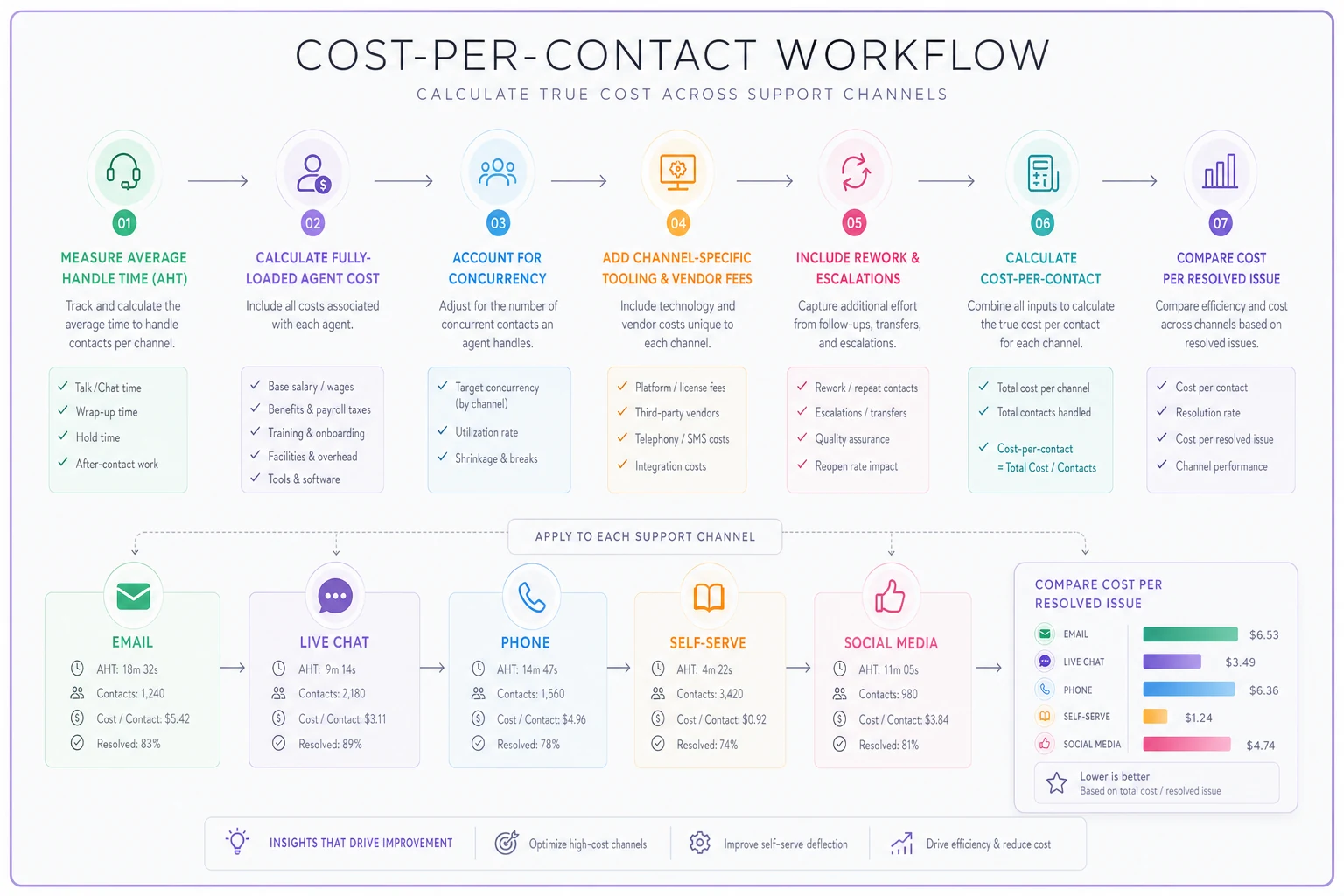
Pulling these numbers into a single view helps you compare channels side-by-side and make retirement decisions based on real economics.
Step three: set parity rules so the experience doesn't fracture
The trap of omnichannel: the more channels you add, the more ways you create for a customer to get a different answer depending on where they ask. A customer who gets told "yes, we can refund that" on chat and "no, that's not our policy" on email isn't experiencing one company. They're experiencing chaos, and they'll tell you about it loudly.
Parity rules are the guardrails that keep the experience consistent across the portfolio. They're not about making every channel identical — phone and email should feel different. They're about making sure the things that must be consistent actually are.
The non-negotiable parity items, roughly in order of how much damage inconsistency causes:
-
Policy and eligibility answers. Refund rules, warranty terms, what's covered and what isn't. These must be identical regardless of channel. This is where a shared knowledge source matters more than anything.
-
Identity and context. A customer shouldn't have to re-explain their problem because they moved from chat to email. The handoff has to carry context. The mechanics of this — reducing chat-to-ticket friction with real handoff scripts and conversion SLAs — are where most portfolios leak the worst experience.
-
Tone and brand voice. Allowed to vary somewhat by channel (social is looser, email is more formal), but within a defined band.
-
Resolution authority. What an agent can do without escalating should be consistent. If chat agents can issue a $50 credit but email agents can't, customers will channel-shop — and they'll figure it out fast.
Tie parity rules to a single, shared knowledge source so agents surface the same canonical answers.
The failure mode to watch for: parity rules that live in a slide deck nobody reads. Parity only holds if the same canonical answer surfaces to agents regardless of which channel they're working. If each channel team maintains its own macros and its own interpretation of policy, you don't have parity — you have five slightly different companies sharing a logo.
What breaks as you scale
At small scale, everyone handles every channel. It works because the team is small enough to stay coordinated informally. The cost is invisible because nobody's measuring per-channel economics yet.
At the first growth stage, you specialize. Chat has its own team, phone has its own team. Suddenly the channels drift apart. Each team develops its own habits, its own macros, its own unofficial policies. Customers start noticing the inconsistency — usually around the time "why did two different reps tell me two different things" complaints start showing up in CSAT verbatims.
At larger scale, the drift becomes structural. Channel owners optimize for their own metrics — chat chasing response time, phone chasing resolution rate — and those local optimizations pull against each other. A chat agent hits their response-time target by punting the hard part to email, which blows up email's resolution time. Nobody's lying; everybody's optimizing their own number. The portfolio as a whole gets worse while every individual dashboard looks fine.
Add multiple time zones and the coordination problem compounds again. A channel that's well-staffed in one region becomes a dead zone in another, and customers can't tell the difference between "closed" and "ignored." If you're operating across regions, planning global coverage with timezone routing and SLA tiers has to happen per channel, not as a blanket policy, because each channel's customer expectations are different.
Scale doesn't just add volume. It adds coordination cost, and coordination cost is where omnichannel strategies quietly die.
The retirement playbook: how to kill a channel
This is the part almost nobody does, and it's the part that keeps the portfolio healthy. A channel should be reviewed on a schedule and retired when it stops earning its role.
A channel is a candidate for retirement when:
-
Its volume has dropped below the threshold that justifies dedicated staffing (a channel taking 1% of contacts but requiring its own coverage is a luxury you're probably paying for twice).
-
Its cost per resolved issue is meaningfully higher than an alternative that could absorb the same contacts.
-
Its CSAT is structurally lower and can't be fixed with reasonable investment.
-
It consistently violates parity because it's too hard to keep in sync.
-
Another channel does its job better and the overlap is large.
Retiring a channel isn't flipping a switch. Done badly, you strand customers and generate a wave of angry contacts on the remaining channels. Done well, it's a quiet migration. A workable sequence:
-
Confirm the alternative. Make sure the channel absorbing the volume can actually handle it. Model the load increase before, not after.
-
Announce the change in-channel. Tell the people using the dying channel where to go instead, well before you close it.
-
Add deflection at the entry point. Route anyone trying to reach the old channel toward self-serve or the replacement with a clear message, not a dead end.
-
Run a soft-close period. Keep the channel technically alive but de-emphasized for a few weeks so stragglers migrate gradually.
-
Hard close and monitor spillover. Watch the receiving channels for the volume bump and staff accordingly for the transition window.
Teams that do this well treat it as routine portfolio maintenance, not a crisis. Reviewing the portfolio once a quarter — adding, repositioning, and retiring — is the difference between a lean omnichannel operation and an ever-growing sprawl that slowly strangles your SLAs.
A real scenario: trimming the portfolio
A subscription software company with a support team of about 18 was running six inbound channels: email, chat, phone, SMS, Facebook DM, and Instagram DM. The social channels had been added during a brand push two years earlier and never revisited.
When they finally ran per-channel economics, the picture was stark. The two social channels together accounted for roughly 3% of total contacts but required a dedicated person to monitor during business hours. Cost per resolved issue on social was running around $10–$11, because nearly every meaningful conversation ended with "please email us so we can verify your account." They were, in effect, paying a premium to route customers to a cheaper channel anyway.
They consolidated. Instagram and Facebook DMs were set to auto-respond with a pointer to the help center and a direct link to chat, and the dedicated social monitor was folded back into the chat team. First response targets on chat held steady because the added volume was small. Over the following quarter, that person contributed to a backlog reduction on email instead — the kind of shift that doesn't show up as a dramatic revenue number but noticeably tightened their resolution times.
The outcome wasn't "social is bad." It was that social wasn't doing a job worth its cost in their portfolio. A consumer brand with heavy social engagement might make the opposite call. That's the whole point: the decision comes from the economics and the role, not from a general belief about what channels are supposed to be good for.
When this framework makes sense — and when it doesn't
The portfolio approach is worth the effort when you're running three or more channels, you've got enough volume that per-channel economics are measurable, and you're seeing either consistency complaints or creeping cost-to-serve. If any of those are true, this view will pay for itself quickly.
It's overkill for a small team running one or two channels. They need good execution on what they have, not elaborate parity rules and retirement playbooks. Building that kind of process for a two-channel shop is process for its own sake.
Who should be careful: teams under heavy pressure to add channels without adding staff. The portfolio view will tell you honestly that you can't run a seventh channel well on the same headcount — and that message isn't always welcome. But it's a lot cheaper to have that conversation now than to run seven mediocre channels and wonder why your SLAs keep slipping.
Bringing it together
The shift that matters is going from collecting channels to managing them. A channel is not a feature you turn on and forget. It's an asset with a job, a cost, a quality profile, and a lifespan. Some channels earn their place. Some used to and no longer do. The only way to tell the difference is to assign roles, measure cost per resolved issue, enforce the parity rules that keep the experience whole, and retire the channels that have stopped pulling their weight.
Most teams already have the data to do this — it's just scattered across separate dashboards that were never designed to be compared. Pulling it into one view, where you can see each channel's role against its real economics side by side, is usually when the obvious decisions become, well, obvious. The portfolio was there all along. It just needed someone to manage it like one.
Ready to transform your support operations?
Join 500+ support teams using Servyly to reduce resolution times, improve customer satisfaction, and boost team productivity.