
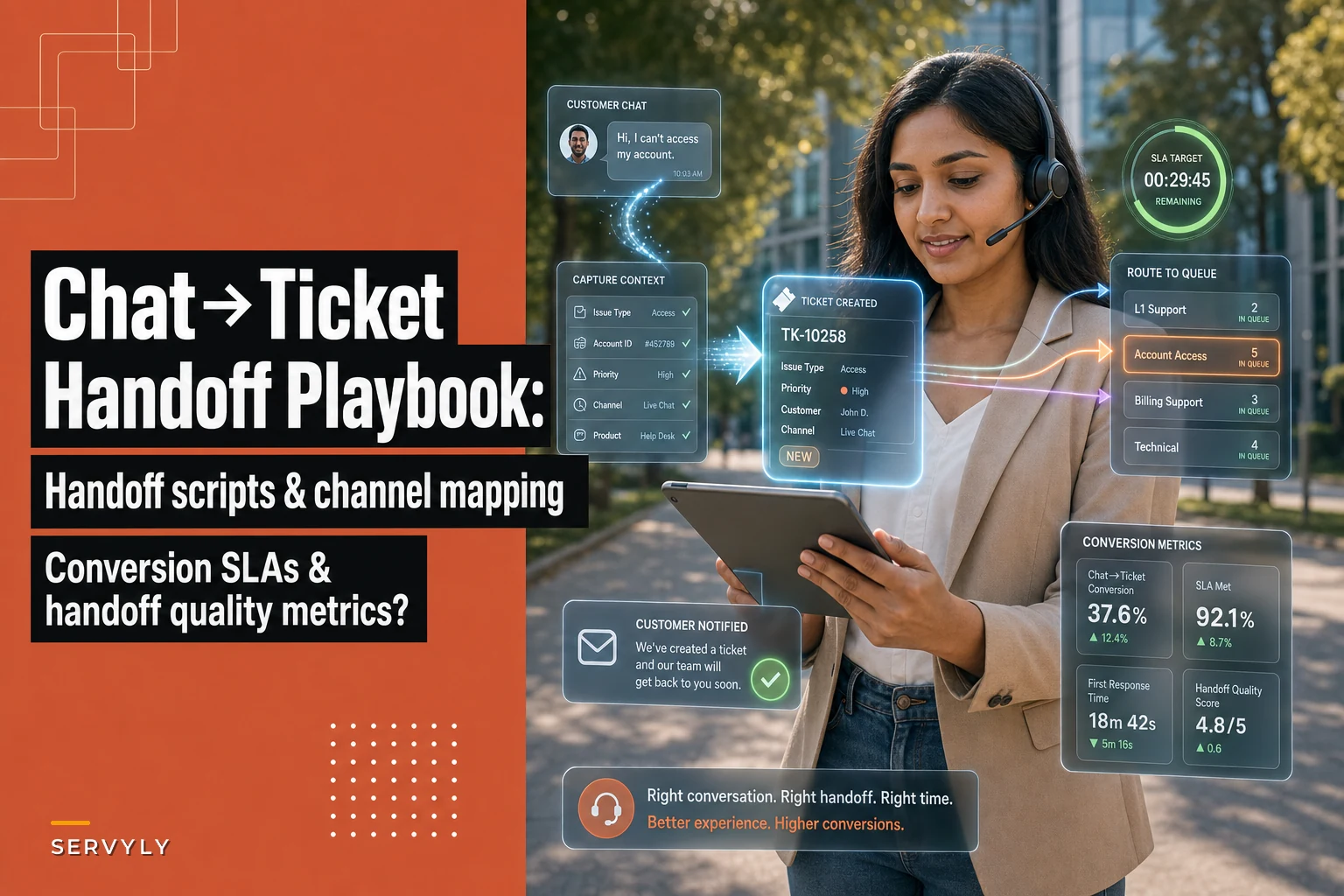

Chat feels fast. That's the whole appeal. A customer types, an agent replies, problem solved in three minutes. But a huge chunk of chats aren't three-minute problems — they're forty-minute problems that started in a channel built for three-minute answers. And when a live chat can't close on the spot, someone has to convert it into a ticket that lives past the current conversation.
That conversion — the moment a synchronous chat becomes an asynchronous ticket — is where most support teams quietly bleed context, time, and customer trust. The chat to ticket routing step gets treated like an afterthought instead of a real workflow with actual rules. This post is about fixing that one specific transition.
The exact moment things break
Picture the chat queue at 2pm. An agent is juggling three conversations. One customer's issue clearly needs engineering, a refund approval, or a callback tomorrow. The agent knows they can't solve it live. So they do what everyone does: type "Let me create a ticket for you and someone will follow up," click a button, and move on to the next chat.
The ticket usually gets created with:
-
A subject line like "chat follow up"
-
The chat transcript pasted in as one giant unstructured block
-
No priority, no category, no owner
-
No note about what was already tried
-
No expectation set with the customer about when they'll hear back
The chat closes. The customer assumes they're in a queue. The ticket lands in a general inbox where nobody feels ownership. Three days later the customer is back — a fresh chat — asking why nobody replied. Now you have a reopen, an angry customer, and a duplicate.
This happens because chat tools and ticketing tools are optimized for two completely different rhythms. Chat rewards speed. Tickets reward structure. The handoff between them is nobody's job, so it becomes everybody's problem.
Why the transition fails (it's rarely the agent's fault)
The instinct is to blame the agent for a lazy ticket. But when you look at a bunch of these bad conversions, the pattern is almost always structural.
Never lose track of a customer request again.
Servyly helps you track, assign, and resolve every ticket quickly and efficiently.
- Centralized ticket management
- Automated response workflows
- Team collaboration tools
No credit card required
No decision rule for what stays in chat vs. what converts. Agents guess. Some try to solve everything live and let chats run 45 minutes. Others convert too eagerly and clog the ticket queue with things they could've answered in two lines.
The conversion click discards context. Most integrations dump a raw transcript and call it done. All the reasoning the agent did — the diagnosis, the ruled-out causes — evaporates because there's no field asking for it.
No SLA attached at the moment of conversion. The chat had an implied "instant" expectation. The ticket has nothing. The customer's mental clock is still running on chat speed while the ticket sits in a 48-hour queue.
The customer is never told what changed. From their side, they were talking to a person one second and staring at silence the next. Nobody explained that the channel changed, the speed changed, and here's what to expect now.
That last one is the quiet killer. A customer who knows "you'll hear from us by tomorrow afternoon" waits patiently. A customer who heard "someone will follow up" with no timeframe assumes you forgot them — and 24 hours later, they're back in chat, starting over.
Channel mapping: decide what belongs where before the shift starts
Before you touch scripts or SLAs, you need a simple map of which conversation types should convert and which should stay live. This isn't complicated, but almost nobody writes it down, so every agent improvises.
A practical mapping that works for most small and mid-sized help desks:
| Conversation type | Stay in chat | Convert to ticket | Why |
|---|---|---|---|
| Password reset, order status, how-to | ✅ | ❌ | Fully solvable live in under 5 min |
| Billing dispute needing approval | ❌ | ✅ | Requires a second person / audit trail |
| Bug that needs engineering | ❌ | ✅ | Async by nature, needs a reproducible packet |
| Feature request | ❌ | ✅ | No live resolution possible |
| Angry customer, simple fix | ✅ | ❌ | Speed is the de-escalation |
| Multi-step account change | Depends | ✅ if >10 min | Chat time cost outweighs the benefit |
| Anything requiring a callback | ❌ | ✅ | Scheduling is inherently async |
The point of the table isn't the exact rows — yours will differ. The point is that agents shouldn't be deciding conversion policy on the fly at 2pm with three chats open. Give them a map so the decision is already made.
One thing worth flagging: the "multi-step account change" row is where teams lose the most time. Agents feel obligated to finish it live because they already started. A ten-minute chat becomes thirty, the queue backs up, and the customer would've been happier with a clean async resolution and a real timeline anyway.
Handoff scripts that actually preserve the customer's trust
The handoff sentence the agent types is doing more work than most people realize. It's setting the customer's expectations for the entire async experience. Compare these two:
Weak: "I'll make a ticket and someone will get back to you."
Strong: "I'm going to move this to our billing team since it needs a manager approval. I've written up everything we covered so you won't have to repeat it. You'll get an email update from us by tomorrow, 3pm your time — that's a firm commitment, not a maybe."
The second one does four things: names the reason for the shift, confirms context is being carried over, sets a specific time, and signals accountability. It costs the agent maybe fifteen extra seconds.
A few script templates worth keeping in your macros:
-
Bug handoff "This looks like a bug on our end, not something you did. I'm packaging up the details for our engineers so they can reproduce it. Expect an update from me within [X hours] — I'll stay as your point of contact so you're not passed around."
-
Approval needed "I can see what needs to happen here, but this amount needs a manager sign-off, which I can't do from chat. I've documented the full case. You'll hear back by [time], and the decision will come from someone who can actually approve it."
-
Callback "This is easier to sort by phone than by typing. I've noted everything down. What's the best number and time window tomorrow? I'll make sure whoever calls has the full history in front of them."
None of these say "ticket." Customers don't care about your internal object model. They care about who's helping them and when. Save the word "ticket" for your own systems.
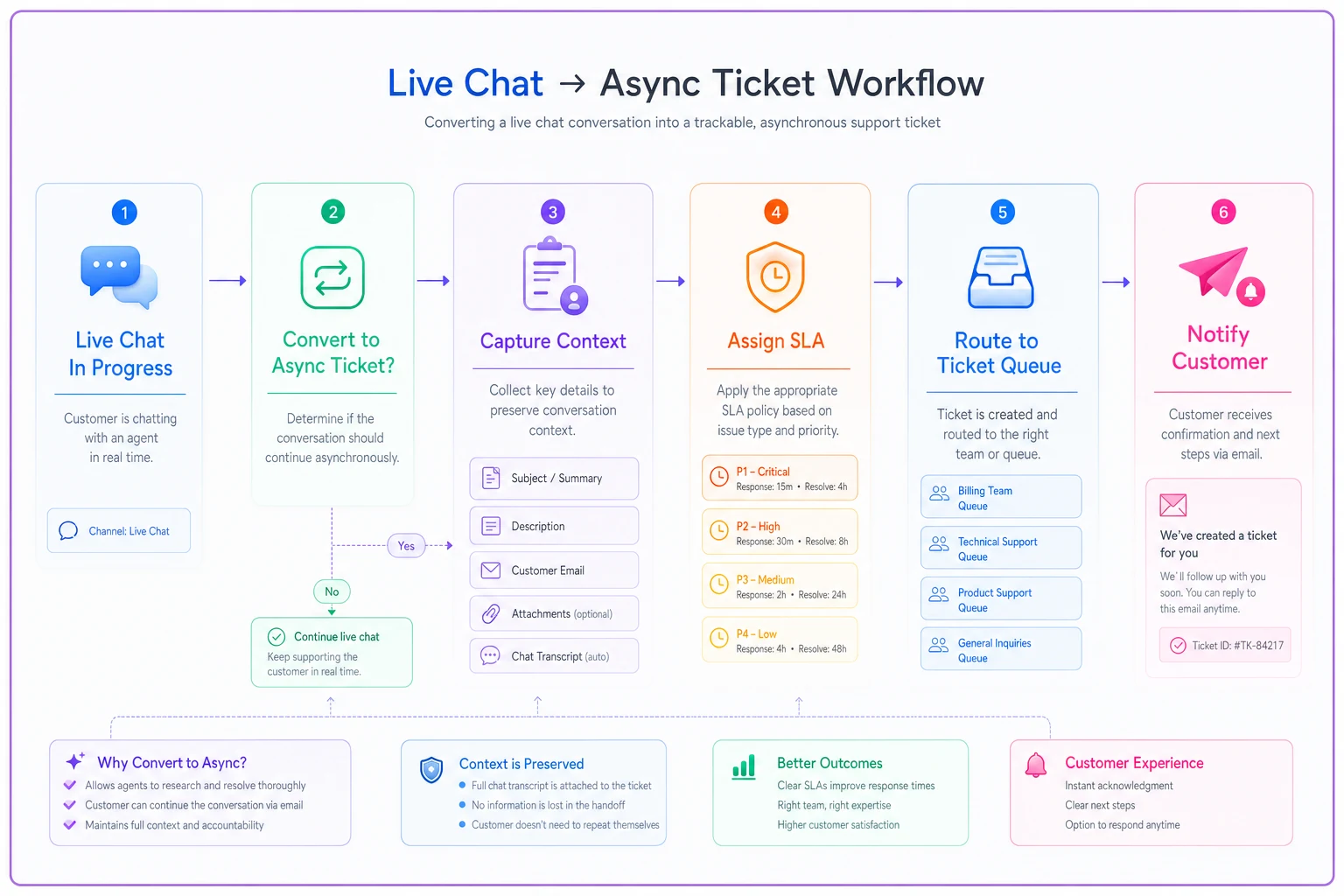
This flow shows the main steps an agent follows during a conversion so everyone understands the sequence.
Conversion SLAs: the number the industry keeps forgetting
Most teams have first-response SLAs and resolution SLAs. Almost nobody has a conversion SLA — a specific promise for how fast a chat-originated ticket gets its first async response.
This matters because chat-origin tickets carry a heavier expectation than email-origin tickets. The customer just came from a real-time conversation. Making them wait 48 hours after that feels like a downgrade even if 48 hours is your standard email SLA.
-
Chat converted to ticket — first async response within 4 hours during business hours (customer was just talking to you; don't let the thread go cold).
-
Bug/engineering handoff — acknowledgment within 2 hours, even if it's just "we've received your report and reproduced it / are trying to."
-
Approval-required handoff — decision within 1 business day, with a status note at the halfway mark.
-
Callback commitment honored within the exact window promised, no exceptions — a missed callback is worse than never promising one.
The specific numbers are yours to set based on staffing. What matters is that the conversion SLA is tighter than your general async SLA, because the customer's expectation clock started running at chat speed.
If you're already building out segmented SLA logic, this connects directly to the work of designing an end-to-end support operations system that keeps tickets flowing and SLAs predictable. Conversion SLAs are just one more lane in that system — but they're the lane most people forget to pave.
Carrying context so the next person isn't starting from zero
The worst outcome of a chat-to-ticket conversion is when the async agent reads a raw transcript and has to reverse-engineer what already happened. That reading time is pure waste, and worse, they often re-ask questions the chat agent already answered — which is exactly how reopens and frustration pile up.
The fix is a lightweight structured capture at the moment of conversion. Not a form so long that agents skip it — just enough to eliminate re-work:
-
What the customer wants (one line, in plain terms)
-
What was already tried (so nobody repeats it)
-
What's ruled out (equally valuable)
-
Why it's being converted (approval, bug, callback, etc.)
-
The commitment made to the customer (so the next person honors the exact promise)
For anything heading to engineering, this capture needs to go further — you want a reproducible set of steps, not a vague "it's broken." That's its own discipline, and it's worth building a real reproducible escalation packet with triage filters so bug handoffs from chat arrive in a state engineers can actually act on.
Use a single-line 'What the customer wants' field in your macros so agents can capture intent in under five seconds.
The person doing the conversion knows the most about the issue. Capture their knowledge while it's in their head, not after three other chats have pushed it out.
A real scenario
A mid-sized SaaS help desk — team of nine agents handling roughly 380 chats a week — was seeing about a quarter of their chats fail to close live. Those chat-origin tickets had a reopen rate noticeably higher than their email tickets, and their chat CSAT was dragging.
When they dug in, the cause was exactly what you'd expect: no conversion rule, no context capture, and a handoff line that was some variation of "someone will follow up" every single time. Chat-origin tickets were landing in the same general queue as everything else and waiting the same 24–48 hours.
They made three changes over about a month. First, a channel map so agents stopped debating what to convert. Second, three canned handoff scripts with real time commitments baked in. Third, a 4-hour first-response conversion SLA for chat-origin tickets, routed to a dedicated lane instead of the general pile.
Results weren't dramatic overnight, but they were steady. Chat-origin reopens dropped by roughly a third within six weeks. The "why haven't you replied" repeat-chats — customers basically checking if they'd been forgotten — fell off sharply once people were getting real time commitments. Agents also stopped burning through twenty-minute chats trying to finish things that should've been async from the start.
Nothing here required new software. It required deciding the transition was a real workflow and writing down the rules.
Metrics that tell you the transition is actually working
You can't manage this by feel. A handful of metrics will tell you whether your synchronous-to-asynchronous transitions are healthy:
-
Conversion rate what percent of chats convert to tickets. Too high means agents are punting; too low might mean they're over-solving live and blowing up chat wait times.
-
Chat-origin first-response time measured separately from email. This is your conversion SLA compliance.
-
Chat-origin reopen rate vs. email reopen rate if chat-origin is much higher, your context capture is failing.
-
Repeat-contact rate on converted tickets customers coming back to ask "any update?" is a direct signal your expectation-setting is weak.
-
Context completeness score spot-check converted tickets — did the async agent have to re-ask anything? Even a rough weekly sample tells you a lot.
The one people consistently skip is measuring chat-origin tickets separately from the rest. Blend them into your overall ticket metrics and the specific pain of bad conversions disappears into the average — you'll never see it.
When tightening this actually matters — and when it doesn't
This whole thing is worth the effort when chat is a meaningful channel and a real share of chats can't close live. If you're converting more than 15–20% of chats to tickets, you have a transition problem worth formalizing.
It's less urgent if chat is a small side channel handling mostly quick answers, or if your volume is low enough that every conversion gets personal attention anyway. Don't build a five-tier conversion SLA for a team fielding a dozen chats a day.
Adding heavy structured-capture forms when your agents are already drowning is also a bad call. A long conversion form they skip is worse than a short one they actually fill out. Start with the handoff script and the SLA; add context capture once those are habits.
The takeaway
The chat-to-ticket transition isn't a technical step — it's a promise handoff. The customer trusts you at chat speed, and the moment you convert them into an async ticket, you're either keeping that trust or quietly breaking it. Channel mapping decides what converts, handoff scripts protect the customer's expectations, conversion SLAs keep the promise honest, and context capture makes sure the next person isn't starting from scratch.
Get those four things written down and enforced, and the mysterious pile of "chat follow up" tickets that nobody owns just stops accumulating. Not because you worked harder, but because you finally treated the transition as the real workflow it always was.
Get those four things written down and enforced, and the mysterious pile of "chat follow up" tickets that nobody owns just stops accumulating. Not because you worked harder, but because you finally treated the transition as the real workflow it always was.
Ready to transform your support operations?
Join 500+ support teams using Servyly to reduce resolution times, improve customer satisfaction, and boost team productivity.