


Most support orgs don't actually manage their knowledge. They accumulate it. Someone writes an article when a ticket spikes, another gets bolted on after an incident, a product manager drops a half-finished macro into the KB, and three years later you've got 1,400 articles where nobody can tell you which 60 are carrying 80% of the deflection load — or which 300 are quietly feeding wrong answers to your AI assistant.
The companies that get this right stop thinking in articles and start thinking in portfolios. A knowledge portfolio strategy means you look at your entire help content estate the way a portfolio manager looks at holdings: every asset has an expected return, a cost to maintain, a risk profile, and a lifecycle. Some assets deserve more investment. Some should be sunset. Some need localization across six languages because they touch revenue markets, and some will never be worth translating.
This is about the executive-level model that connects demand signals to prioritization gates, localization commitments, lifecycle budgets, and — the part most teams skip — the actual P&L tradeoffs. Less about writing better articles, more about deciding which content deserves money, attention, and SLAs at all.
Why knowledge estates drift into chaos
The drift isn't a discipline failure. It's a structural one. Knowledge work is funded reactively — a spike happens, someone reacts, an article appears. Nobody owns the question of whether that article will still earn its keep in eight months. So the estate grows faster than anyone's ability to maintain it, and maintenance debt compounds silently.
The pattern that keeps showing up: content gets created based on who shouted loudest, not based on where demand actually concentrates. A loud enterprise account triggers five new articles about an edge case affecting 0.3% of users, while the highest-volume "how do I reset my billing cycle" question sits in a stale three-paragraph stub that hasn't been touched since the pricing model changed.
At small scale, this is survivable. One person roughly knows what's in the KB. They remember what's stale. The knowledge lives partly in their head. The trouble is that this human index doesn't scale — when that person leaves or volume doubles, the whole estate becomes opaque overnight. You can't prioritize what you can't see, and you can't see a 1,200-article KB without a system.
The second structural driver is that demand signals and content investment live in different systems that nobody has connected. Search logs sit in one tool. Ticket tags in another. Deflection data somewhere else, if it exists at all. The person deciding what to write next is usually working off gut feel and the last angry Slack message, not off a consolidated view of signal → cost → return.
The signal layer: what should actually drive prioritization
Before you can run a portfolio, you need to define the inputs. Two demand signals matter most, and they tell you very different things.
Never lose track of a customer request again.
Servyly helps you track, assign, and resolve every ticket quickly and efficiently.
- Centralized ticket management
- Automated response workflows
- Team collaboration tools
No credit card required
Search signals tell you what people are trying to self-serve. High-volume searches with low click-through or high refinement rates — people typing, failing, retyping — are flashing lights. Demand exists but your content isn't meeting it. This is the cheapest, highest-leverage signal most teams underuse. If you haven't done the work to tune help-center search around your top queries and synonym gaps, your search signal is noisy and you'll prioritize off garbage.
Ticket signals tell you what self-service failed to solve. The gold is in the overlap and the gap between the two. A topic with high search volume and high ticket volume is a content failure — people looked, didn't find, and contacted you anyway. A topic with high tickets but low search usually means people aren't even trying to self-serve, which is a discoverability or trust problem, not a content-quality one.
-
Contact volume (how many tickets/searches touch this topic)
-
Deflection potential (realistically, what fraction could self-serve)
-
Cost-to-serve per contact (a billing question costs less than a complex integration escalation)
-
Revenue/segment weighting (is this topic hit by expansion accounts or trial users?)
-
Decay rate (does this topic churn with every release, or is it stable?)
That last one — decay rate — is the signal almost everyone ignores, and it drives your entire lifecycle budget. Content about a stable feature is a bond. Content about a feature that ships changes every sprint is a high-maintenance, high-turnover holding, and you need to price that maintenance in before you commit to translating it into nine languages.
Prioritization gates: deciding what gets funded
Signals produce a ranked list of candidate work. Gates decide what's actually allowed through. The point of a gate is to force an explicit decision instead of defaulting to "sure, write it."
A workable gate model runs candidate content through three sequential checks:
-
Demand gate — Does this topic clear a minimum combined signal threshold? If a topic generates fewer than roughly 40 combined monthly contacts and isn't tied to a strategic segment, it doesn't get a dedicated, maintained article. It gets folded into a broader page or left to general search. This single rule prevents the long-tail bloat that poisons AI retrieval later.
-
Economic gate — Does the expected return clear your ROI threshold? If writing and maintaining this content costs more than the deflection and cost-to-serve savings it produces over its useful life, it fails the gate regardless of volume.
-
Risk/strategy gate — Even if it fails the economic gate, does it need to exist for compliance, legal exposure, security, or a top-tier account commitment? Some content loses money and must exist anyway. The point is to know that and decide deliberately, not discover it by accident.
The gate isn't just for new content. You run existing content back through the same gates on a cadence. An article that cleared the demand gate two years ago may be sitting at four contacts a month now. That's a sunset candidate. Portfolios get rebalanced; so should knowledge estates. A governance-first posture — the kind described in why a governance-first knowledge strategy keeps your help center healthy — is what makes recurring gate reviews a routine instead of a heroic annual cleanup.
Start gate reviews with your top 200 articles first to get quick wins and prove the cadence before expanding to the long tail.
Portfolios get rebalanced; so should knowledge estates.
The ROI threshold: putting a number on content
Executives fund what they can model. The simplest defensible content ROI model, per article or content cluster:
Annual value = (monthly contacts × deflection rate × 12 × cost-per-contact) + segment/revenue adjustment
Annual cost = creation cost (amortized over useful life) + maintenance cost + localization cost (if applicable)
ROI ratio = Annual value ÷ Annual cost
A typical example: a billing-cycle article sees around 900 combined monthly contacts, you estimate a realistic 35% deflection rate, and your blended cost-per-contact is around $6. That's roughly 900 × 0.35 × 12 × $6 ≈ $22,700 in annual value. Creation ran maybe $400 amortized, maintenance around $600/year because billing changes occasionally. The ROI ratio is enormous — this is a core holding, fund it, localize it, SLA it.
Compare that to an edge-case integration article: around 50 monthly contacts, 20% deflection, but a high cost-per-contact of $28 because those tickets are technical. That's 50 × 0.20 × 12 × $28 ≈ $3,360 annual value. Creation was expensive ($900 — it needed engineering review) and maintenance runs $700/year because the integration changes. ROI is positive but thin. Fund it, but don't localize it, and keep it on a light-touch maintenance tier.
Set a hard ROI threshold for gate 2. Many teams land around a 3:1 ratio for standard funding, with anything between 1:1 and 3:1 requiring a strategic justification to proceed. Below 1:1, it's a sunset or merge candidate unless the risk gate overrides. The exact threshold matters less than the discipline of having one and applying it consistently.
Localization SLAs as a portfolio decision, not a blanket policy
Localization is where portfolio thinking pays for itself most obviously, because translating everything is how you set money on fire. Every translated article multiplies your maintenance liability by the number of languages — a change to the source now triggers N re-translations, N review cycles, and N opportunities for a stale translation to give a customer the wrong answer in their own language.
| Tier | What qualifies | Languages | Source-change → localized SLA |
|---|---|---|---|
| Tier 1 – Core | Top-ROI, high-volume, stable, revenue-market topics | Full language set | 3–5 business days |
| Tier 2 – Priority | Solid ROI, meaningful volume in specific markets | Market-specific subset | 10 business days |
| Tier 3 – Standard | Passes gates, modest volume | English + machine translation on demand | Best-effort, no commitment |
| Tier 4 – Edge/legal | Low volume, exists for risk reasons | English only (unless legally required) | N/A |
The SLA column is the part teams forget. Translating content once is easy. Keeping translations in sync with the source is the real cost, and an out-of-sync localized article is often worse than none — it looks authoritative and is wrong. The localization SLA is a promise about synchronization latency, and it should be tighter for higher tiers precisely because those articles change in ways that affect the most people. This connects directly to how you route and quality-check multilingual demand, and pairs well with a broader unified knowledge and AI operating model that keeps source and localized versions governed together rather than drifting apart.
Lifecycle budgets: funding content across its whole life
Most budgets fund creation and quietly ignore maintenance and retirement. That's backwards. Over a multi-year horizon, maintenance usually costs more than creation, and the absence of a retirement budget is why estates bloat.
-
Create — one-time cost, amortized over expected useful life.
-
Maintain — recurring, scaled to decay rate. High-decay topics get a bigger maintenance allocation; stable topics get almost none.
-
Monitor — the cost of running the signals that tell you whether the content is still earning its ROI. Cheap but non-zero.
-
Rebalance — periodic re-gating, merging, splitting, or refreshing based on shifted demand.
-
Retire — the deliberate, budgeted act of sunsetting content, redirecting its traffic, and removing it from AI retrieval sources.
A practical allocation pattern for a mature estate lands somewhere near 30% creation, 45% maintenance, 10% monitoring, 15% rebalancing and retirement. The exact split matters less than the fact that maintenance and retirement are funded on purpose. Teams that allocate 90% to creation and 10% to everything else are the ones whose KBs rot.
A quick self-check to see whether your estate is actually being managed as a portfolio:
-
[ ] You can rank your top 50 articles by economic value, not just pageviews
-
[ ] You know your estate's overall decay rate and which clusters drive it
-
[ ] Localization is tiered, not blanket, with synchronization SLAs per tier
-
[ ] Maintenance has a dedicated, recurring budget separate from creation
-
[ ] Content gets retired on a cadence, with traffic redirected
-
[ ] Your AI assistant's retrieval source is pruned to governed, in-tier content
-
[ ] Every funded article has a named owner and a next review date
If you're missing more than two of these, you have an accumulation, not a portfolio.
A real scenario: a mid-market SaaS support org
A B2B software company with a support team of about 18 agents had grown their KB to roughly 1,100 articles across four languages over five years. Deflection had plateaued and multilingual complaints were rising — customers in their German and French markets kept hitting translated articles that referenced UI from two releases ago.
When they inventoried the estate against actual signals, the picture was stark: about 70% of self-serve traffic landed on roughly 90 articles. The other ~1,000 were collectively generating noise, maintenance drag, and — worse — feeding their new AI help assistant a lot of stale, inconsistently-translated content that produced wrong answers.
They didn't rewrite everything. They ran the portfolio model. Around 85 articles got classified Tier 1 with tight localization sync SLAs. Roughly 400 got merged or consolidated into broader pages. About 320 were retired outright and redirected. The remaining long tail was kept English-only and dropped from the AI retrieval source entirely.
The results over the following two quarters weren't dramatic headline numbers, but they were the right ones: localized-content complaints dropped to a trickle, the AI assistant's wrong-answer rate fell noticeably once it was only drawing from governed Tier 1–2 content, and the team reclaimed a meaningful chunk of maintenance time. Translators stopped re-translating articles nobody read. Cost-to-serve on their top topics improved because the core content was finally accurate and findable in-language. No revenue miracle — just an estate that stopped leaking money.
When this approach makes sense — and when it doesn't
When it makes sense: You have more than a few hundred articles, multiple channels, more than one language, or an AI assistant drawing from your KB. The moment your estate exceeds what one person can hold in their head, portfolio discipline stops being overhead and starts being the only thing keeping the estate honest. It's especially critical before you point any AI retrieval system at your content — an ungoverned estate makes a confident, wrong assistant.
When it's overkill: A 60-article KB serving one market in one language doesn't need tiered localization SLAs and ROI thresholds. You'd spend more building the governance than you'd save. Keep it lightweight — a quarterly review and a simple "is this still accurate and used?" check is enough at that scale.
Who should NOT do this yet: Teams that don't have clean signals. If your ticket tags are chaotic and your search logs are unreadable, building a prioritization model on top of them just automates bad decisions faster. Fix the measurement layer first, then build the portfolio on top of trustworthy signals.
Making it an operating rhythm
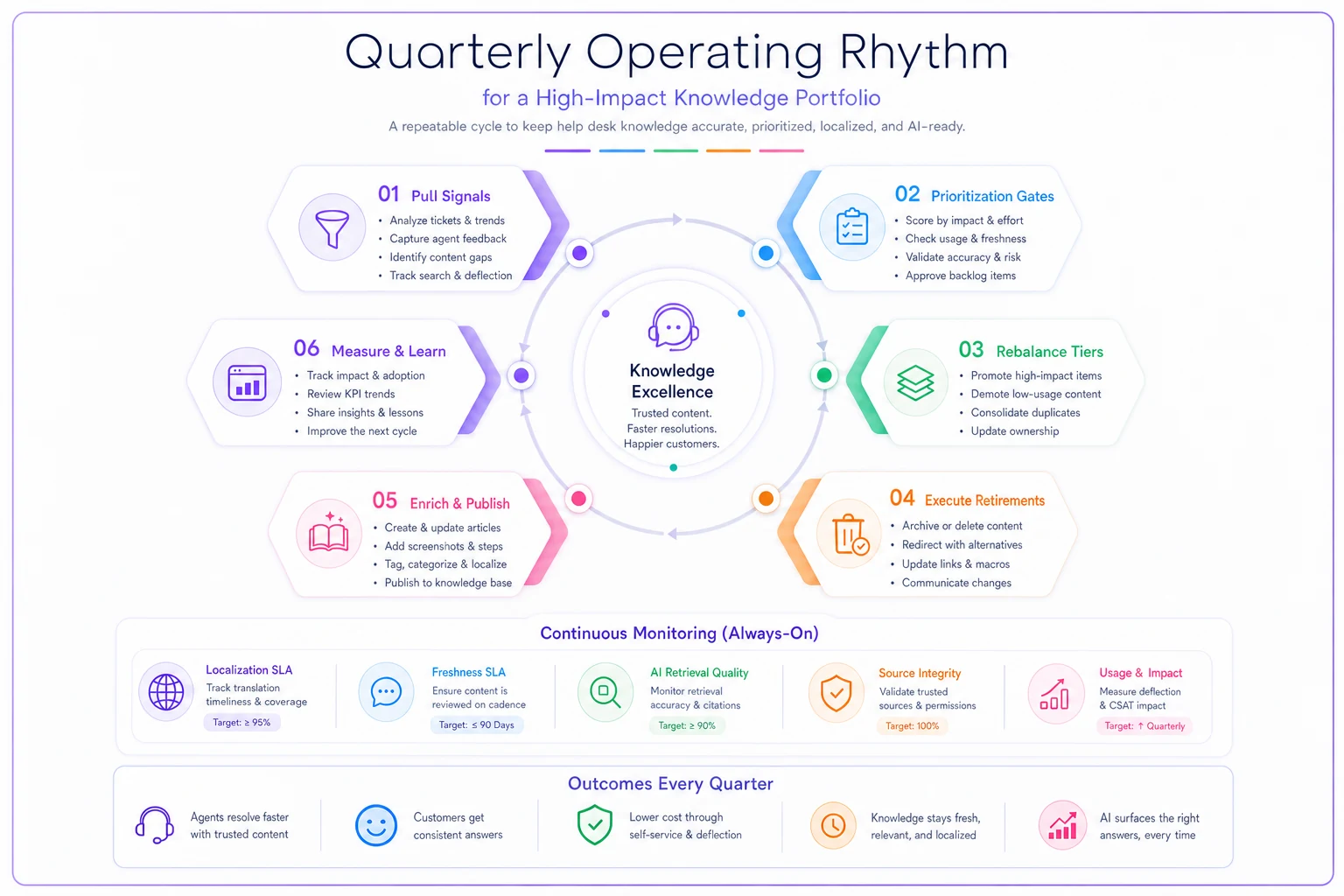
The portfolio model only works if it runs on a cadence rather than as a one-time cleanup. The orgs that sustain it bake it into a quarterly rhythm: pull the signals, re-run the gates against both new candidates and existing content, rebalance the tiers, and execute a budgeted round of retirements. Between quarters, signal monitoring runs continuously and flags anything that's decayed below its ROI threshold or whose localized versions have drifted out of SLA.
A visual of this quarterly workflow can make the cadence clear.
What changes as you scale is mostly the degree of automation required to keep the signals fresh. At 300 articles, a spreadsheet and a disciplined owner can run the whole thing. At 3,000 articles across eight languages feeding an AI assistant, you need connected systems that pull search and ticket signals, compute ROI, flag SLA breaches on localized content, and surface sunset candidates automatically — because no human can hold that estate in their head.
The teams that win here aren't the ones producing the most content. They're the ones who've decided, deliberately and with numbers, which content deserves to exist, which deserves to be translated and kept in sync, and which deserves a quiet, well-managed retirement. That's the difference between an estate that compounds in value and one that compounds in debt.
Ready to transform your support operations?
Join 500+ support teams using Servyly to reduce resolution times, improve customer satisfaction, and boost team productivity.