

Most support orgs treat every ticket like it lives on a flat plane. A password reset, a billing confusion during a trial, a churned-customer rage email, a feature question from someone about to expand their contract — they all hit the same queue, get worked in roughly the same order, and get measured with the same handful of metrics. That flatness is exactly why support stays stuck as a cost center. The same contact carries wildly different commercial weight depending on where the customer sits in their journey, and almost nobody's operating model reflects that.
A real customer-journey support strategy fixes the flatness. It's not about being nicer to VIPs. It's about building an operational layer that reads the stage a customer is in, assigns the right objective for that stage, and routes the signal to the right place — sometimes that's a fast answer, sometimes it's a save motion, sometimes it's a nudge to the account team that this person is ready to buy more. Support already sees all of this. The problem is the system throws the context away the moment the ticket closes.
Why support signals get flattened in the first place
Walk through how a ticket actually moves. It comes in, gets tagged (if your taxonomy is healthy — a big if), gets assigned, gets resolved, gets a CSAT survey nobody reads carefully. The tooling optimizes for one thing: close it fast and keep the queue moving. Reasonable local objective. Terrible global one.
Here's the pattern. A customer 40 days into a 45-day trial files three tickets in a week about the same integration. Each gets answered competently and closed. Response time looks great. CSAT is fine. And then they don't convert, and nobody in the building connects the dots, because the signal — this account is struggling during the exact window that determines whether we get paid — was never treated as anything other than three well-handled tickets.
The reason this happens is structural, not lazy. Support metrics evolved from call-center economics: handle time, first response, resolution rate. Those metrics are stage-blind by design. They measure the mechanics of a contact, never its position in the relationship. So even good teams end up with a queue where a churn-risk save opportunity and a routine how-to question sit side by side, indistinguishable to the system doing the routing.
The rubric: journey stage → support objective
The fix starts with agreeing that the purpose of a support interaction changes by stage. Same team, same tools, but the win condition is different. Here's the mapping that holds up across most B2B and product-led businesses:
Never lose track of a customer request again.
Servyly helps you track, assign, and resolve every ticket quickly and efficiently.
- Centralized ticket management
- Automated response workflows
- Team collaboration tools
No credit card required
| Journey Stage | What the customer is actually doing | Primary support objective | The wrong objective (that most teams default to) |
|---|---|---|---|
| Onboarding / Trial | Deciding if this is worth it | Time-to-first-value; remove blockers fast | "Resolve the ticket" |
| Early adoption (0–90 days) | Building habits, hitting friction | Reduce effort; prevent silent abandonment | Close rate |
| Steady state / Mature | Getting work done | Efficiency; deflect the routine | Speed for its own sake |
| Expansion signal | Pushing limits, asking about more | Route to commercial; enable, don't just answer | Answer and close |
| At-risk / Churn signal | Frustrated, quiet, or exploring exits | Save motion; escalate context to owner | Standard SLA handling |
| Renewal window | Re-evaluating the relationship | Proactive reassurance; surface unresolved friction | React only if they contact you |
The rubric's whole point is that a ticket's objective is decided by the customer's stage, not by the ticket's surface content. The same "how do I export this?" question means "help me evaluate" during a trial, "help me work faster" at steady state, and — critically — might mean "I'm building a case to leave" if it comes from an at-risk account. Same words. Three different objectives. Three different right responses.
One thing worth sitting with: the expansion stage is where support leaves the most money on the table. When a mature customer asks "can your product also do X?" and gets a clean, accurate "no, but here's a workaround" — that's often a lost expansion conversation. The right move was to answer and flag it to the account owner. The queue-clearing instinct kills the commercial one.
Prioritization: why "who's loudest" is the wrong sort order
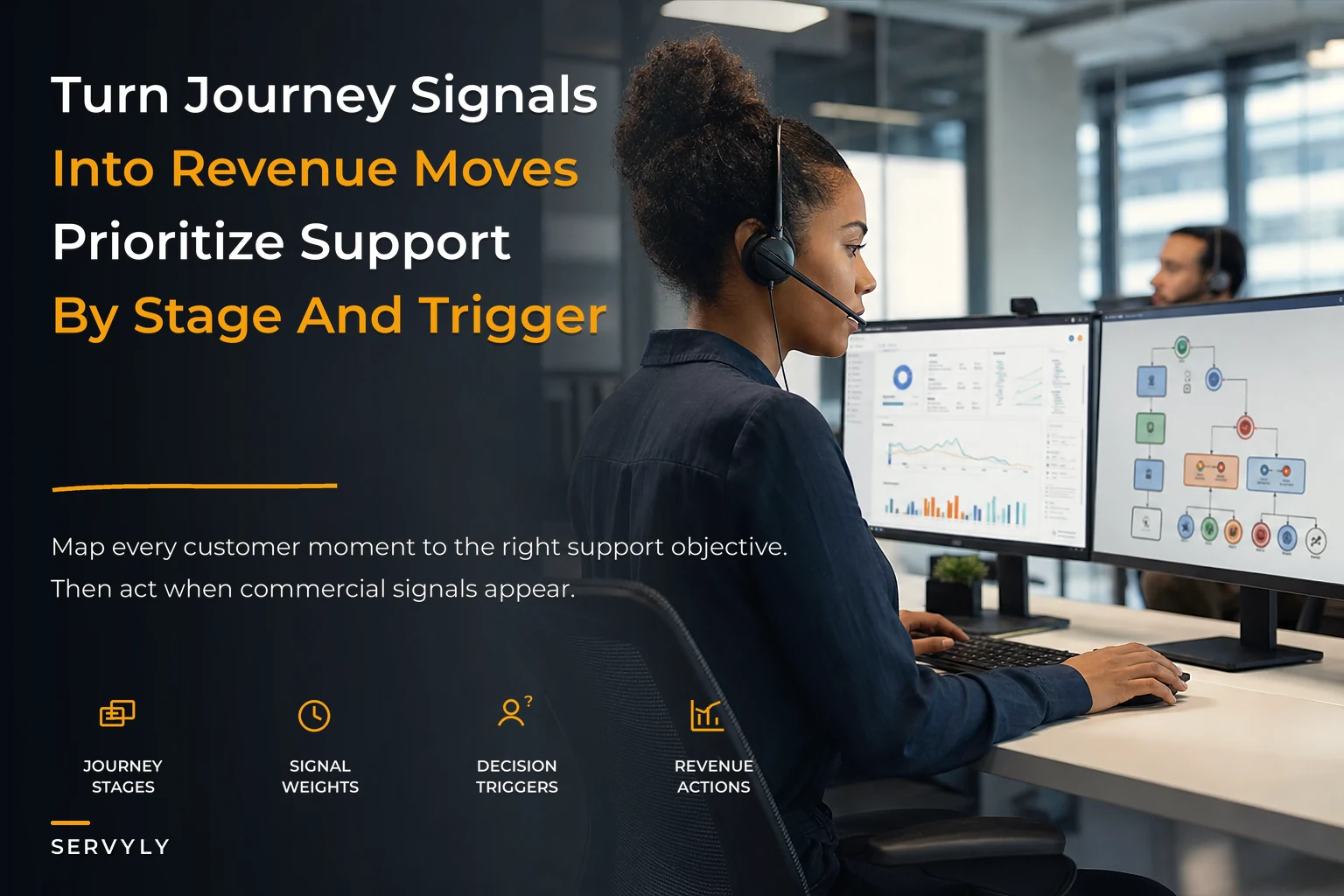
Once you accept stage-based objectives, prioritization can't just be SLA timers anymore. You need a matrix that weighs two things at once: commercial exposure (how much revenue is attached to this signal) and stage sensitivity (how much the outcome depends on getting this interaction right now).
A trial user's blocker is low revenue today but extremely stage-sensitive — get it wrong and you lose the whole future contract. A mature customer's cosmetic complaint might be high revenue but low stage-sensitivity — it can wait an hour without changing anything. Flat SLA prioritization treats those identically or, worse, prioritizes the mature customer because their plan tier is higher.
-
Churn signals on revenue-significant accounts — highest exposure, highest sensitivity, shortest reaction window.
-
Trial/onboarding blockers inside the conversion window — low dollars now, enormous dollars later, and the window closes on its own.
-
Expansion signals from healthy accounts — commercial upside that decays if you don't act while intent is warm.
-
Renewal-window friction — anything unresolved here compounds into a harder renewal conversation.
-
Everything else, sorted by normal SLA and effort.
The insight most teams miss: items 1 through 4 are all time-boxed by the customer's journey, not by your SLA clock. A trial converts or doesn't on the customer's calendar. A renewal date is fixed. So these signals need triggers that fire against their deadline, not yours. This is where thinking about support through a tiered KPI hierarchy that connects signals to revenue, churn, and adoption stops being a reporting exercise and becomes an operational one — the same hierarchy that tells your execs what happened should be driving what the queue does next.
Items 1 through 4 also share something else: they're all recoverable if you catch them early and unrecoverable if you don't. That asymmetry is why the prioritization matrix needs to exist in your tooling, not just in someone's head.
Decision triggers: turning a support signal into a commercial action
A rubric and a matrix are just documents until you wire them to triggers. A trigger is a specific, observable condition that automatically changes what happens to a signal. This is the part that actually moves support from reactive to commercial.
A practical set of triggers that translate well across businesses:
-
Repeated same-topic contacts inside a conversion window → flag to onboarding owner, not just re-answer. Two tickets on the same integration during a trial is a churn-shaped event, not a coincidence.
-
Feature request from a mature, healthy account → append to the account record and notify the CSM/AE. This is the expansion pipeline hiding in your ticket data.
-
Sentiment drop + reduced usage + a support contact → trigger a save motion, route to a senior owner with full history attached. Don't make the customer explain their frustration to a fresh agent.
-
Any contact from an account inside the renewal window → auto-tag, surface the account's open-issue history, and brief whoever owns the renewal. Support and renewal should never be surprised by each other.
-
Repeated deflection failures on a high-traffic topic → this is a product or docs problem masquerading as a support problem; route it to the feedback pipeline.
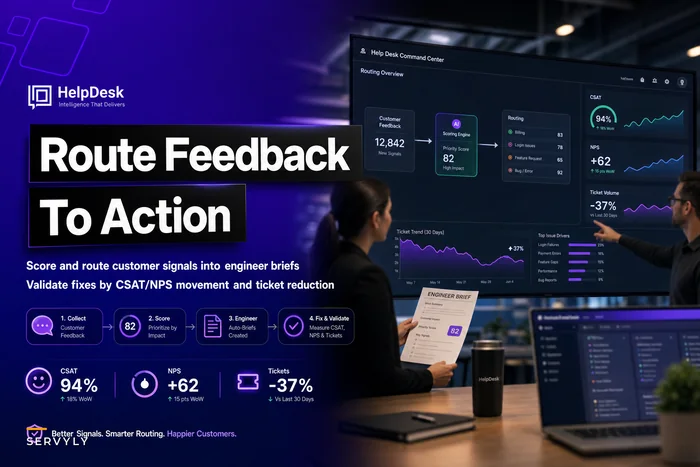
That last one connects directly to how you route customer feedback to action with scoring, engineer briefs, and post-fix validation. Triggers shouldn't just escalate to humans — some should flow into the loop that actually gets the underlying issue fixed, so the signal stops recurring.
The workflow in plain terms: a signal arrives → the system reads the account's journey stage and health → the rubric assigns the stage-appropriate objective → the prioritization matrix positions it in the queue → and if a trigger condition is met, the signal forks — it gets answered and it spawns a commercial or product action with the full context attached.
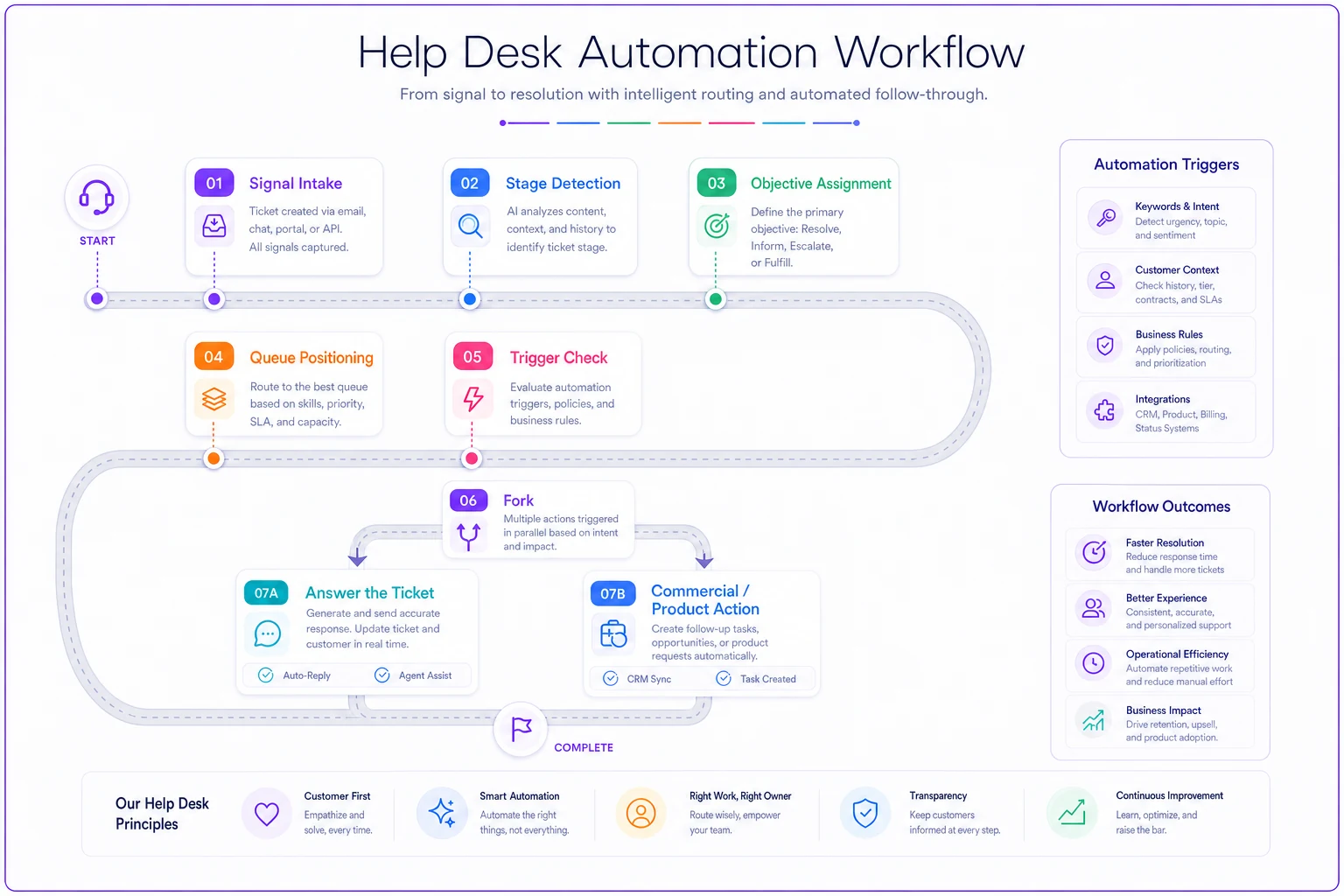
The forking is the whole game. Most systems only answer.
What breaks at scale
At ten agents and a few hundred tickets a week, a sharp support lead can hold a lot of this in their head. They know the trial accounts are struggling. They personally ping the AE. It works because one person is quietly doing the stage-mapping and trigger-firing manually.
That falls apart somewhere around the point where no single person sees the whole queue anymore. Two things break first. One: the manual triggers stop firing because the person who was firing them is now managing managers. Two: the context that made the save motions work — account history, sentiment trend, usage data — is scattered across three tools nobody stitches together in real time.
A typical example: a company grows from around 600 to 2,500 tickets a month over a year. Nothing about their rubric changed. What changed is that the informal "I'll flag the important ones" system quietly stopped scaling, and expansion signals and churn signals started slipping through as ordinary closed tickets. The revenue leak doesn't announce itself. You notice it a few quarters later when renewal saves are down and nobody can point to why.
This is where an AI-assisted operational layer earns its place — not as a chatbot answering tickets, but as the thing that reads journey stage and account context on every signal, applies the rubric consistently, and fires the triggers a busy team stops firing manually. The value isn't automation for its own sake. It's that the stage-mapping and forking logic keeps running at 2,500 tickets exactly the way it did at 600, without depending on one overloaded person's memory.
When this is worth building — and when it isn't
When it makes sense: you have identifiable journey stages (trials, onboarding, renewals, expansion motions), meaningful revenue attached to accounts, and enough volume that signals are slipping through unnoticed. If churn saves and expansion both live partly in your support queue, this pays for itself.
When it's premature: very early-stage companies where the founder is still reading every ticket. The manual system genuinely works at that size, and building rubric infrastructure before you have stable journey stages just creates process for its own sake.
Who should not do this: teams whose data foundation is a mess. If your account records don't connect to your tickets, if your taxonomy is chaos, if you can't reliably tell which stage a customer is in — fix that first. Triggers built on unreliable stage data will fire wrong, and wrong triggers are worse than none because they burn trust with the commercial team you're trying to help. The same discipline that goes into deciding when to insource, outsource, or automate parts of your cost-to-serve applies here: don't automate a judgment your data can't yet support.
A real scenario
A B2B SaaS company, around 30 people, product-led with a 14-day trial and annual contracts. Support was two people plus overflow. Their queue was flat — trials, renewals, and steady-state all in one pile, sorted by SLA timer.
The problem showed up slowly. Trial-to-paid was sitting around 22%, and when they finally pulled trial-period ticket data, roughly a third of the accounts that didn't convert had filed two or more support tickets during the trial. The signal had been there the whole time — it just kept closing as ordinary tickets.
They did three things. Tagged accounts by journey stage. Built one trigger: two same-topic contacts inside a trial fork to the founder-owned onboarding channel with the full thread attached. Added a weekly review of expansion-flagged tickets from mature accounts.
Over the next couple of quarters, trial-to-paid moved into the high-20s — not dramatic, but on their trial volume that was a meaningful chunk of new ARR. The expansion review surfaced a handful of upsell conversations per quarter that had previously just closed as "no, we don't do that." Nothing about their team size or ticket volume changed. They just stopped throwing away the context that told them which tickets were actually commercial events.
The shift that actually matters
The mental model to take away: a support ticket is a moment in a relationship, and its value depends entirely on where that moment sits in the customer's journey. A flat queue is an admission that you've decided not to know the difference.
You don't need to build all of it at once. Pick the one stage where you're most obviously leaking revenue — usually trial conversion or renewal — write the objective for it, build one trigger, and see what surfaces. The rubric grows from there. What changes isn't how hard your team works. It's whether the work they're already doing ever reaches the part of the business that can act on it.
You don't need to build all of it at once. Pick the one stage where you're most obviously leaking revenue — usually trial conversion or renewal — write the objective for it, build one trigger, and see what surfaces. The rubric grows from there. What changes isn't how hard your team works. It's whether the work they're already doing ever reaches the part of the business that can act on it.
Ready to transform your support operations?
Join 500+ support teams using Servyly to reduce resolution times, improve customer satisfaction, and boost team productivity.