

Support teams collect mountains of customer feedback every week. Feature requests buried in tickets. Bug reports scattered across chat. Pain points hiding in NPS comments. Frustrations spread across CSAT surveys. But somewhere between that feedback arriving and engineering actually fixing anything, the whole system falls apart.
Most support teams dump feedback into a shared spreadsheet nobody reads. Or they tag tickets with "product-feedback" and hope someone notices. Maybe they send a weekly summary email to product that gets skimmed during Monday standup. The result? Critical product issues hide in plain sight for months while customers keep running into the same problems.
The disconnect creates this painful cycle where support keeps apologizing for the same bugs, customers get increasingly frustrated, and engineering has no real idea which issues actually matter because everything arrives as an undifferentiated mess of complaints and suggestions.
Why traditional feedback routing fails at scale
Traditional feedback routing to product breaks down around 50 tickets per day. Below that threshold, a support manager can manually review tickets, spot patterns, and personally walk important issues over to engineering. Once volume crosses that line, manual pattern recognition becomes basically impossible.
Support agents start tagging everything as "urgent" because they lack context for what engineering is already working on. Product managers get overwhelmed by the noise and start ignoring support escalations entirely. Engineering gets frustrated because half the "critical bugs" they investigate turn out to be user errors or edge cases affecting three customers total.
The fundamental problem is that support feedback arrives without operational context. A ticket saying "search doesn't work" could mean anything from a complete system failure to one customer mistyping their query. Without scoring, prioritization, and validation systems, engineering genuinely can't tell the difference.
What makes this worse is that support and engineering speak completely different languages. Support describes problems in terms of customer impact and emotional frustration. Engineering needs reproduction steps, error logs, and affected user counts. That translation layer between the two worldviews usually doesn't exist, so critical information gets lost in every handoff.
Building a signal triage system that actually works
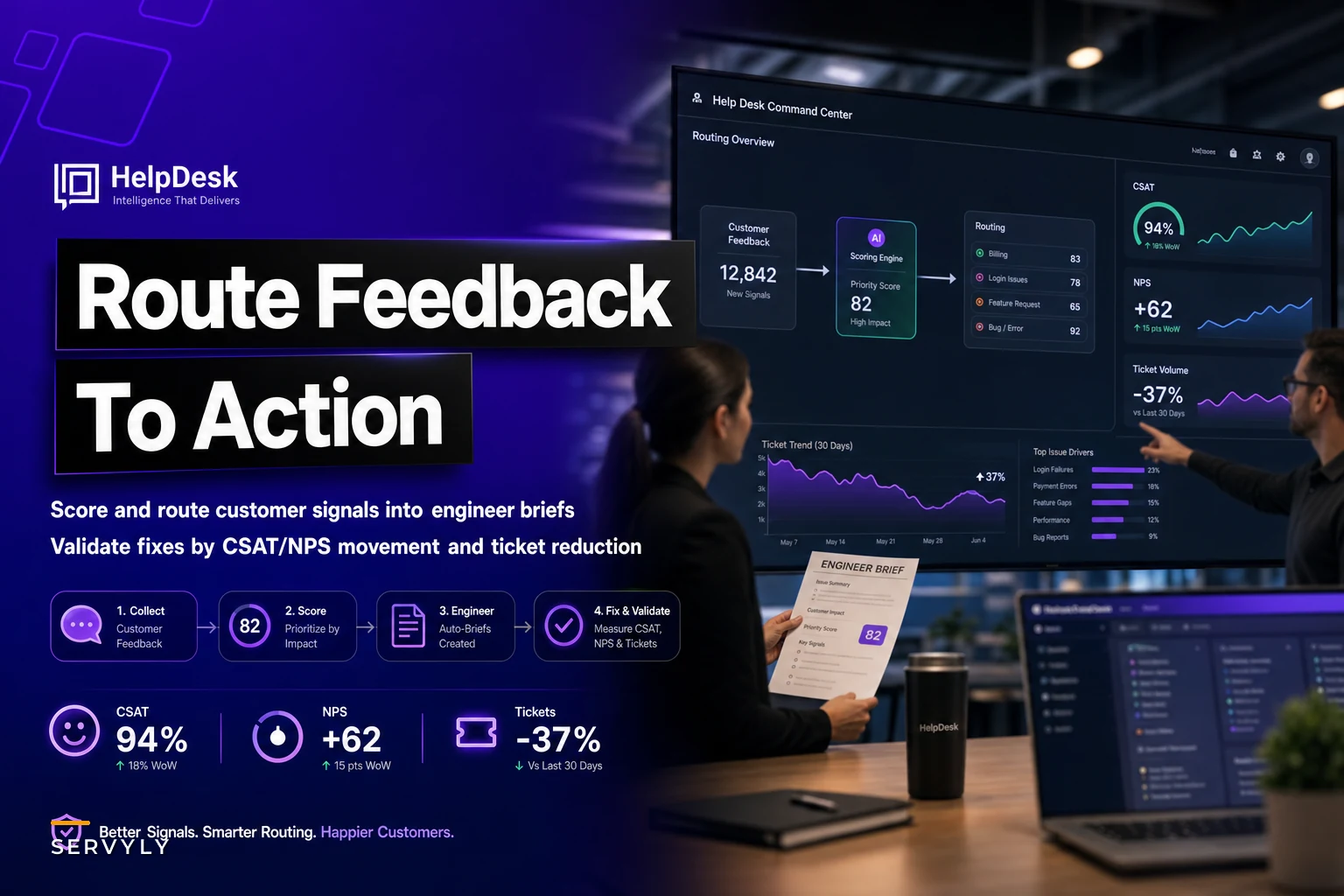
A functional feedback routing system needs three core components working together: automatic scoring based on customer impact, structured routing with clear ownership, and post-fix validation tied to measurable outcomes.
Never lose track of a customer request again.
Servyly helps you track, assign, and resolve every ticket quickly and efficiently.
- Centralized ticket management
- Automated response workflows
- Team collaboration tools
No credit card required
Start with the scoring layer. Every piece of feedback needs an impact score before it goes anywhere. Here's a basic framework:
Impact Score = (Affected Users × Severity × Frequency) / Time Since First Report
-
Affected Users
Unique customer count from your ticketing system
-
Severity
1–5 scale based on business impact (5 = revenue blocking)
-
Frequency
How often the issue appears per affected user
-
Time Since First Report
Days since the first ticket about this issue
This formula naturally surfaces widespread problems while deprioritizing edge cases. A login bug affecting 200 users scores way higher than a cosmetic issue one power user keeps mentioning.
The routing layer needs clear rules about where feedback goes based on score thresholds:
| Score Range | Route To | SLA | Required Documentation |
|---|---|---|---|
| 90–100 | Engineering Lead + Product VP | 2 hours | Full reproduction packet |
| 70–89 | Product Manager | 24 hours | Pattern summary + examples |
| 50–69 | Weekly Product Review | 1 week | Aggregated report |
| Below 50 | Monthly Backlog Review | 1 month | Basic ticket links |
Higher scores trigger faster response times and require more detailed documentation. This keeps engineering from wasting time on low-impact issues while ensuring critical problems get immediate attention.
A simple visual helps clarify how scoring, routing, and validation connect in an operational workflow.
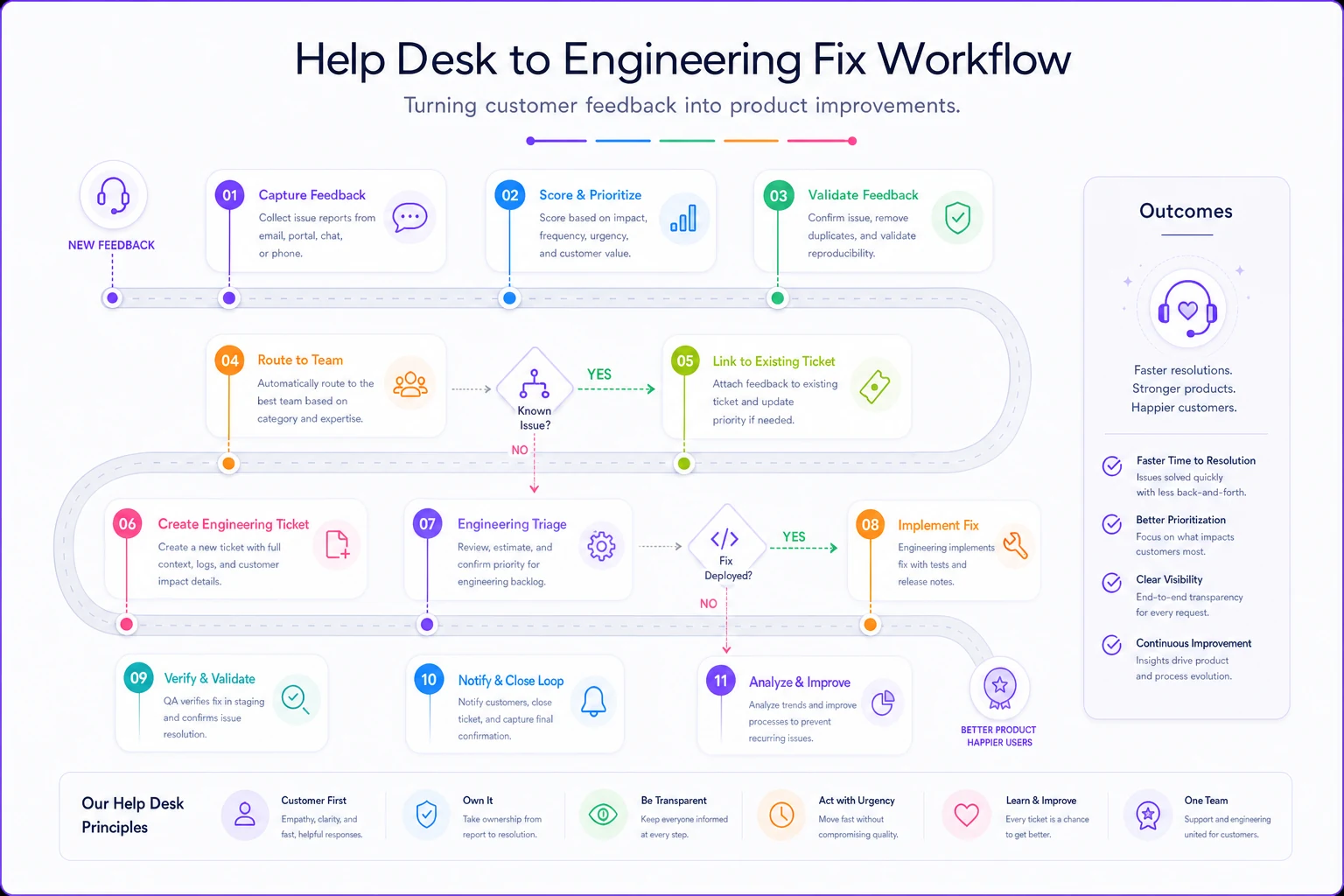
This diagram shows feedback flowing into scoring, then routing to the appropriate owner, followed by post-fix validation tied to CSAT and ticket volume metrics.
Creating engineer-ready briefs from messy support data
The hardest part of feedback routing to product isn't identifying problems — it's translating support language into engineering specifications. Support agents describe symptoms. Engineers need root causes. This translation usually fails because nobody owns it.
An engineer-ready brief needs five specific elements:
1. Problem Statement (one sentence, no customer quotes) Bad: "Customers are really frustrated with search" Good: "Product search returns zero results for queries containing apostrophes"
2. Reproduction Steps (exact sequence, testable)
-
Navigate to shop.example.com
-
Search for "women's shoes"
-
Observe zero results despite 47 products matching
3. Expected vs Actual Behavior
-
Expected
Search strips special characters and matches "womens shoes"
-
Actual
Query fails with unescaped apostrophe error
4. Business Impact (numbers, not feelings)
-
340 failed searches per day
-
67 customers affected daily
-
12% cart abandonment rate for affected sessions
5. Verification Method
-
Query
SELECT COUNT(*) FROM searches WHERE result_count = 0 AND query LIKE '%\'%'
-
Success metric
Zero results for this query after fix
This structure turns vague complaints into actionable engineering tasks. The key is making every brief independently testable — an engineer should be able to confirm both the problem and the fix without needing to chase anyone for additional context.
For complex issues spanning multiple systems, a simple diagram showing the failure point helps a lot. Text-based diagrams work fine:
Customer → Search Box → API Gateway → Search Service → Database ↑ [FAILS HERE] Special char encoding
These briefs take more work upfront but save significant time downstream. Engineering handoff packets need this same level of detail to prevent the back-and-forth clarification cycles that kill momentum.
The validation loop everyone skips
Most teams treat product fixes as one-way communication. Support reports issue → Engineering fixes issue → Done. Without validation, you never actually know if the fix solved the customer's problem or just addressed one symptom of something deeper.
Post-fix validation needs to happen at three levels.
Technical Validation (Day 1) — Engineering confirms the fix works in production. This just verifies the code change didn't break anything else. Necessary, but not sufficient.
Support Validation (Day 2–7) — Monitor incoming tickets for the same issue. If the problem was truly fixed, ticket volume for that specific issue should drop to near zero within a week. Set up saved searches in your ticketing system for the original issue keywords, the affected feature area, and the customer accounts who reported the problem. If tickets keep coming, either the fix was incomplete or there's a related issue that wasn't caught.
Customer Validation (Day 7–30) — This is where CSAT and NPS movement tells the real story. Track metrics for customers who originally reported the issue: Did their CSAT scores improve? Did they stop contacting support about related issues? Did their usage increase? Without this, you might fix a technical bug while completely missing the actual customer problem. A search bug gets resolved, but if customers still can't find products because of poor categorization, your CSAT won't move.
Connecting fixes to measurable outcomes
The entire feedback routing system means nothing if it doesn't move your core metrics. Every fix should tie to either CSAT/NPS improvement or ticket volume reduction. Without that connection, engineering has no real way to weigh customer-impacting work against internal initiatives.
Here's a scoring framework that connects fixes to outcomes:
Predicted Ticket Reduction Score — Count current weekly tickets for the issue, multiply by average handle time, calculate weekly hours saved, then convert to dollar value using your support cost per hour.
Predicted CSAT Impact — Identify CSAT scores from affected customers, calculate the gap between their scores and your target, estimate score improvement based on historical fix data, then multiply by number of affected customers.
A real example: a checkout bug affecting around 85 customers per week, generating roughly 3 tickets each, with a 14-minute average handle time. That's about 60 hours of support time weekly. At $35/hour fully loaded cost, fixing this saves over $2,000 per week. Affected customers also averaged 62% CSAT versus a 78% target. Fixing it could recover 16 points across those customers.
This math turns vague "customer pain" into concrete business value. Engineering can now compare fixing that checkout bug against building a new internal admin tool. The customer impact becomes measurable and comparable.
Templates for common routing scenarios
Different types of feedback need different routing approaches. Here are templates for the most common scenarios.
Bug Report Routing Template
Initial Triage (Support Team)
-
Confirm reproduction in production
-
Check if a known issue already exists
-
Count affected customers in the last 7 days
-
Calculate impact score
Engineering Brief (Support Lead/Manager)
-
Problem
[One sentence description]
-
Reproduction
[Step-by-step]
-
Logs
[Error messages, IDs]
-
Customer impact
[Number affected]
-
Business impact
[Lost revenue, time]
Validation Checklist (Post-Fix)
-
[ ] Fix deployed to production
-
[ ] Original reporter confirmed resolution
-
[ ] No related tickets in 72 hours
-
[ ] CSAT trend positive for affected segment
Feature Request Routing Template
Collection Phase (Ongoing)
-
Tag all related requests consistently
-
Track unique requesters, not total mentions
-
Note specific use cases, not just feature names
-
Document current workarounds customers use
Monthly Rollup (Support Manager → Product)
-
Feature
[Specific capability]
-
Unique requesters
[Count]
-
Revenue represented
[If trackable]
-
Current workaround effort
[Hours/month]
-
Competitive gap
[Yes/No, which competitors]
Critical Issue Escalation Template
Immediate Alert (Within 15 minutes)
-
Affected system
[Specific component]
-
Customer impact
[Number and type]
-
Revenue impact
[Immediate loss]
-
Reproduction
[Confirmed method]
-
Workaround
[If any exists]
Follow-up Packet (Within 2 hours)
-
Full reproduction steps with screenshots
-
Customer communication sent
-
List of affected accounts for proactive reach-out
-
Proposed monitoring for resolution
These templates provide a consistent starting point for turning support feedback into something engineering can act on quickly.
When automation makes routing worse (and when it helps)
Throwing automation at feedback routing seems like an obvious win. Automatic categorization, sentiment analysis, priority scoring — what's not to like? But automation without proper structure amplifies problems instead of solving them.
Bad automation looks like auto-tagging every ticket mentioning "slow" as "performance issue" without considering context. A customer saying "slow shipping" gets routed to engineering, who wastes time investigating server response times while the actual logistics problem goes unaddressed.
Good automation enhances human decision-making rather than replacing it. AI-powered operational software can identify patterns across hundreds of tickets that humans would miss — like detecting that login failures spike every Tuesday at 2 PM when your auth service runs maintenance, or noticing that customers who use the word "confusing" in tickets have significantly lower retention rates.
The key is using automation for pattern recognition and initial scoring while keeping humans in the loop for context and routing decisions. Your platform should surface insights like "37 tickets this week mention search returning wrong categories" but let support managers decide whether that's an engineering issue or a data problem.
Automated brief generation can also work well for common issues. If the system knows search bugs need query strings, result counts, and user IDs, it can pre-populate those fields from ticket data. But the final brief still needs human review to catch what automation misses.
Where automation really earns its place is in the validation phase. Tracking ticket patterns post-fix can happen automatically, flagging when a supposedly resolved issue keeps generating contacts. Operational software can monitor CSAT trends for specific customer cohorts and alert when fixes don't produce expected improvements.
The feedback loop that prevents future breaks
The best outcome of a signal triage system isn't just fixing current problems — it's preventing future ones. When you consistently route feedback to product with proper scoring and validation, patterns emerge that inform better development practices.
Teams with mature feedback routing often discover that a large portion of their bugs trace back to the same two or three features. Or that every third-party integration causes a support spike for a couple weeks post-launch. These patterns let you pre-allocate support resources and build better testing protocols before problems escalate.
The validation data becomes particularly valuable over time. You learn which types of fixes actually improve CSAT — usually workflow simplifications — versus which ones customers barely notice, like most performance improvements under two seconds. That distinction helps product teams make better tradeoff decisions rather than just guessing at what matters.
More importantly, engineers start seeing the direct connection between their work and customer outcomes. When a developer sees their fix dropped ticket volume by 200 per week and improved CSAT by 8 points, they understand the real impact of quality code. That visibility changes how engineering teams think about customer-reported issues over time.
Making it sustainable for small teams
Small support teams often assume signal triage requires dedicated analysts and complex tooling. A basic version can actually run with one part-time owner and a few spreadsheet templates.
Week 1: Score your top 10 weekly issues using the impact formula. Don't worry about automation — manually calculate scores to understand how they distribute.
Week 2: Create your first engineering brief using the template above. Pick your highest-scoring issue, spend 30 minutes writing a proper brief, and send it to one engineering contact.
Week 3: Set up basic validation tracking. When engineering ships the fix, mark your calendar to check ticket volume in 7 days.
Month 2: Expand to scoring all issues above a threshold — maybe 20 or more tickets. Create a simple routing rule where anything above 70 points gets a brief.
Month 3: Add CSAT correlation. For your top issues, pull CSAT scores from affected customers before and after fixes.
Month 6: Consider operational software that can automate pattern detection and brief generation. By now you'll understand your routing needs well enough to configure automation properly instead of guessing.
The whole system can run in 4–5 hours per week for teams handling 200–500 tickets daily. That time investment pays for itself just in reduced back-and-forth with engineering, not counting CSAT improvements and ticket reduction.
Conclusion
Perfect feedback routing to product doesn't exist, but functional routing does. The difference between support teams that actually influence product decisions and those that just complain into the void comes down to structure, scoring, and validation.
Start with impact scoring to separate signal from noise. Build engineering briefs that eliminate translation problems. Validate every fix against real metrics. Connect those metrics to business outcomes that matter to leadership.
Treat feedback routing as an operational system that needs maintenance and iteration. Your first scoring formula won't be perfect. Brief templates will need adjustment. Validation metrics might miss important outcomes early on. That's fine — the structure itself creates improvement opportunities that random feedback forwarding never will.
When support feedback consistently leads to meaningful product improvements that customers actually notice in their CSAT scores, the entire organization starts taking support insights seriously. That credibility shift is probably the most valuable outcome of the whole system.
Ready to transform your support operations?
Join 500+ support teams using Servyly to reduce resolution times, improve customer satisfaction, and boost team productivity.