

Most support teams don't have a governance problem. They have an invisible governance problem, which is worse, because nobody thinks to fix something they can't see.
Here's the shape of it. Support commits to an SLA. Product ships a change that quietly breaks the assumption that SLA was built on. Engineering deprioritizes a fix because it wasn't on their roadmap. Three weeks later a customer escalation lands, and now three teams are in a war room arguing about who owns the miss. Nobody was negligent. The decision cycles just never touched each other.
That gap — the space between what support promises and what product and engineering actually decide — is where most SLA failures actually live. Not in agent performance. Not in staffing. In the handoffs between decision-making bodies that were never designed to sync.
This is a governance article, not a metrics article. If you want the metrics layer, that's covered elsewhere. What we're dealing with here is the connective tissue: who has the right to decide what, when those decisions happen, and how support gets a seat at the table before the promise is made instead of after it breaks.
The core failure: support runs on a different clock than the teams it depends on
Support operates in near-real-time. A P1 doesn't wait for the Thursday planning meeting. Engineering operates in sprint cycles. Product operates in quarterly bets. These three clocks tick at completely different speeds, and support governance mostly fails at the seams where those clocks are supposed to mesh.
A typical example: a mid-sized SaaS company sets a 4-hour first-response SLA for enterprise accounts. Reasonable. But the SLA depends on engineering being reachable for a subset of tickets that need code-level answers. Engineering never formally agreed to a response window for support escalations — it just sort of happened organically. So when a senior engineer goes on leave and the informal "just ping Marco" pathway disappears, the SLA quietly degrades. Support's dashboard shows breaches. Engineering's dashboard shows nothing, because from their side, nothing changed.
Nobody broke a rule. There was no rule. That's the whole problem.
What you see across a lot of support orgs is that the SLA gets treated as a support-owned artifact when it's actually a shared liability. The moment your response or resolution commitment depends on another team's availability, that other team is a co-signer whether they know it or not. Governance is just the practice of making the co-signing explicit.
What breaks as you scale (and why the informal version stops working)
At six people, informal coordination works fine. Support knows every engineer by name. Escalations happen over a shoulder-tap or a DM. The "governance" is just relationships.
Never lose track of a customer request again.
Servyly helps you track, assign, and resolve every ticket quickly and efficiently.
- Centralized ticket management
- Automated response workflows
- Team collaboration tools
No credit card required
Then you hit somewhere around 25–40 people across support and engineering, and the relationship model quietly collapses. Here's the progression:
-
Stage 1 (small) Everyone knows everyone. Escalations are fast because they're personal. No documented rights, no cadence, and it doesn't matter.
-
Stage 2 (growing) New hires don't have the relationships. Escalations start routing through whoever's been there longest, creating a bottleneck around a handful of senior people. SLA variance widens.
-
Stage 3 (scaling) Multiple support pods, multiple eng teams, maybe an offshore shift. The informal pathways now actively mislead people — they ping the person they think owns something, who no longer does.
-
Stage 4 (multi-team) Support commitments and engineering priorities are set in completely separate meetings that never reconcile. SLA misses become structural, not occasional.
The mistake almost everyone makes is trying to fix Stage 3 problems with Stage 1 tools — "let's just communicate better" or "add a Slack channel." More communication channels don't fix a rights-and-cadence problem. They just add noise on top of it.
What actually needs to change is the structure of who decides and when. That's the part nobody wants to build because it feels bureaucratic. But the alternative to lightweight structure isn't freedom — it's chaos that scales faster than you do.
The four pieces of a support governance blueprint
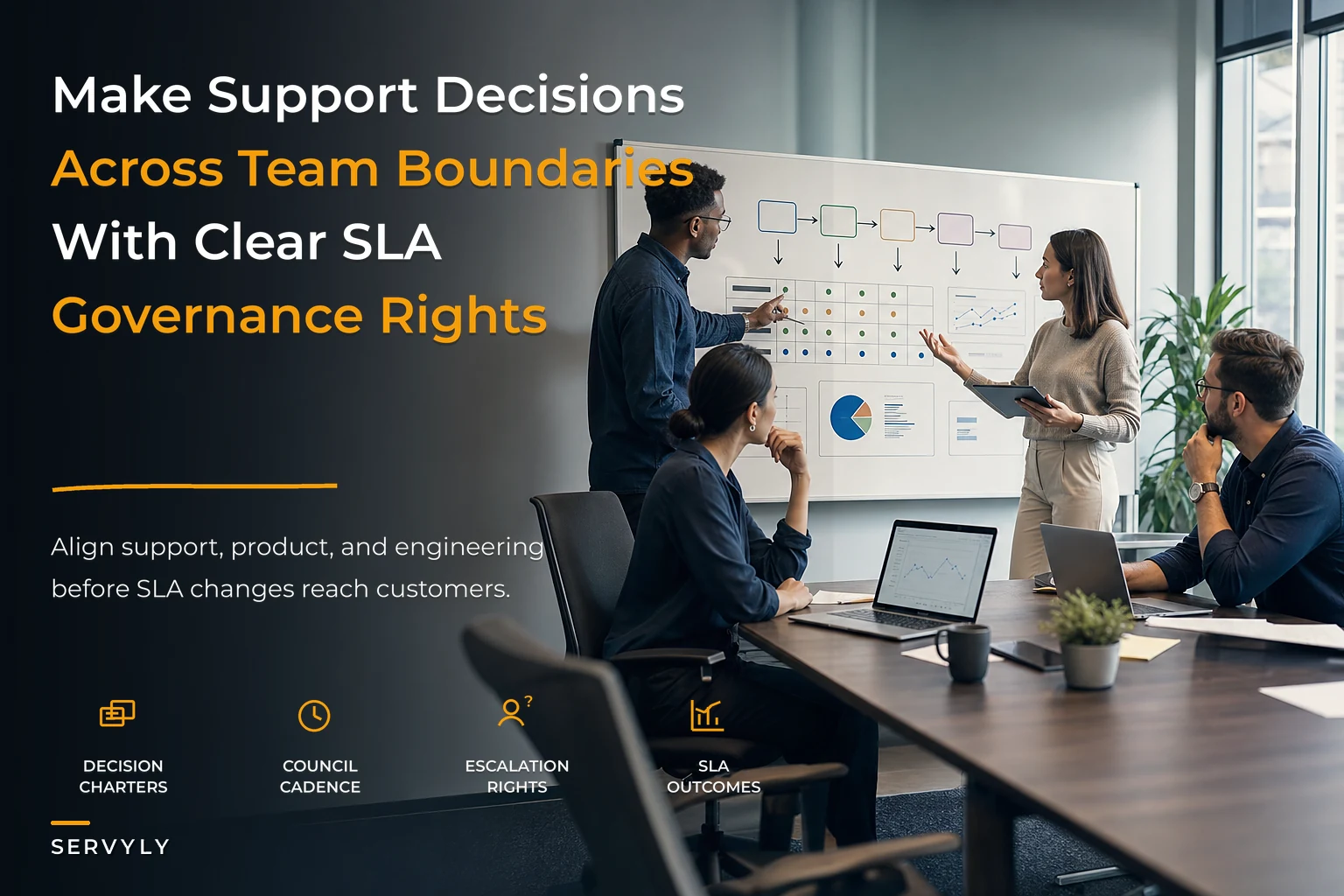
You don't need a 40-page governance manual. You need four artifacts that fit on a few pages each. Skip any one of them and the whole thing leaks.
1. Charters
A charter answers one question per governing body: what is this group allowed to decide without asking anyone else?
Most support orgs have zero written charters, which means every decision is theoretically escalatable, which means nothing moves. A support triage council with a real charter can say "we can reclassify severity and reroute without engineering sign-off" — and that single sentence removes a dozen daily bottlenecks.
Keep charters short. Purpose, decision scope, membership, and what's explicitly out of scope. The out-of-scope section is the one people forget and the one that prevents turf wars later.
2. Meeting cadences
Cadence is where the three clocks get forced to touch. You need a rhythm that connects support's real-time reality to product and engineering's slower cycles without dragging support into every planning meeting.
| Cadence | Frequency | Who | Decides |
|---|---|---|---|
| Live triage sync | Daily, 10 min | Support leads + on-call eng | Active escalations, reroutes, severity |
| SLA health review | Weekly | Support mgmt + eng lead | Breach patterns, at-risk accounts |
| Cross-functional council | Biweekly | Support + product + eng | SLA changes, routing policy, capacity |
| Governance review | Quarterly | Leadership | Charter updates, SLO targets, structural changes |
The biweekly council is the one nobody sets up and the one that matters most. It's the only forum where support can flag "this product change is going to blow our SLA" before the change ships. Without it, support is permanently reactive.
Treat the biweekly council as the gate for any product change that could affect SLAs — make attendance non‑optional for product and engineering reps.
3. Escalation‑rights matrix
This is the piece that eliminates the "who do I ping" paralysis. An escalation-rights matrix maps each escalation type to who has the right to receive it, who has the right to reprioritize it, and what the expected response window is.
The critical word is rights, not responsibilities. Responsibilities describe work. Rights describe authority. When a P1 hits, support needs to know it has the right to pull an engineer off sprint work — and engineering needs to have agreed to that in advance. If that authority is ambiguous in the moment, you've already lost the SLA.
The mechanics of what actually travels through an escalation once it's routed — the packaging side of this — is covered in Make Engineering Handoffs Actionable: A Reproducible Escalation Packet and Triage Filters. Governance decides who and when; the packet decides what information moves. You need both.
4. Templates
Templates are what keep governance from decaying back into vibes. Three that carry most of the weight:
-
SLA change proposal any change to a support commitment goes through one form that forces the proposer to name the eng/product dependency and its cost.
-
Decision log entry every council decision gets one line — what was decided, by whom, effective when. This is the single cheapest thing you can do and almost nobody does it.
-
Escalation postmortem for breaches, a short structured writeup so patterns surface instead of dissolving.
Templates are what keep governance from decaying back into vibes. Three that carry most of the weight:
A workflow for how it all connects
Here's how the pieces move together in practice, from a product change to a support commitment:
-
Product plans a change that touches a workflow support commits SLAs on.
-
The change surfaces in the biweekly council — this is the checkpoint that catches SLA-breaking changes early.
-
Support runs a quick impact check
does this change our routing, our resolution assumptions, our staffing?
-
If yes, someone files an SLA change proposal naming the dependency.
-
The council decides — using its charter authority — whether to adjust the SLA, add capacity, or accept the risk.
-
The decision hits the decision log so nobody relitigates it in three weeks.
-
Routing and the escalation-rights matrix update to match the new reality.
-
Weekly SLA health review watches whether the change actually behaves as predicted.
Visual: a workflow diagram of these steps can make the handoffs obvious.
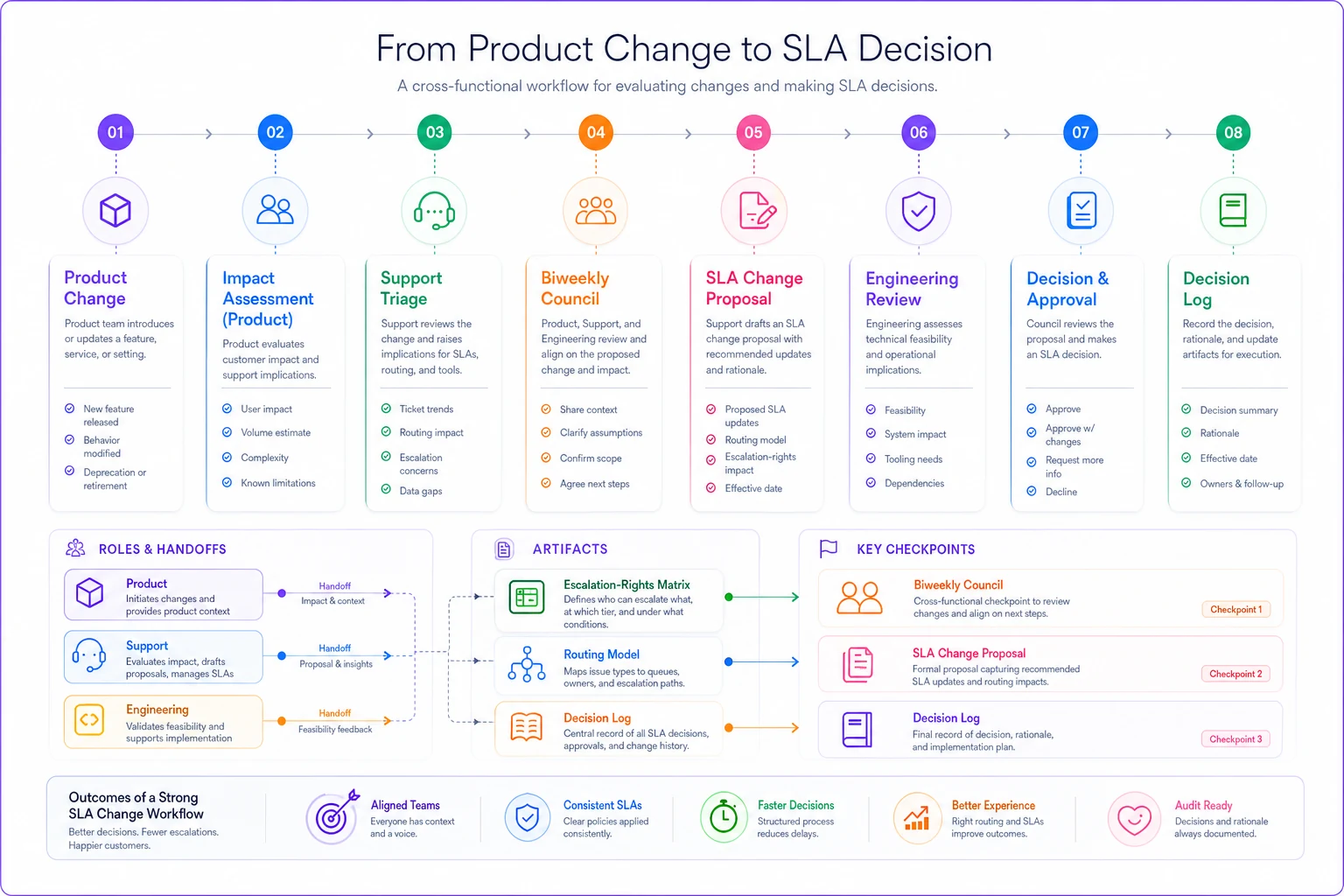
This workflow turns SLA management from something support reacts to into something the org decides on purpose. That's the entire point of governance.
Where the right tooling quietly matters
Governance lives or dies on whether the artifacts are visible where the work happens. A charter buried in a wiki nobody opens is the same as no charter.
This is where AI-assisted operational platforms earn their place — not by making decisions, but by keeping the governance layer live instead of theoretical. When routing rules, the escalation-rights matrix, and SLA definitions all sit inside the same workflow system, a few useful things happen. The system can flag when an incoming ticket type doesn't match any documented owner, so gaps surface before they cause a breach. It can nudge a decision into the log instead of letting it evaporate after a meeting. It can watch SLA health continuously and surface breach patterns rather than one-off misses, which is what the weekly review actually needs to be useful.
The point isn't automation for its own sake. Governance requires consistent, boring follow-through, and boring follow-through is exactly what humans are worst at. You keep the judgment. You offload the remembering.
When this level of governance actually makes sense
Full charters-and-councils governance is overkill for a five-person team. If you can still fix escalations with a shoulder-tap, don't build bureaucracy you don't need yet.
This makes sense when:
-
You have multiple support pods or shifts that can't all know each other.
-
Your SLAs materially depend on engineering or product availability.
-
You've had at least a couple of "who owns this" breaches that nobody could cleanly explain.
-
Support commitments and eng priorities are set in meetings that never talk to each other.
This is a bad idea when:
-
You're small enough that relationships still cover the gaps.
-
You'd build the artifacts and then never maintain them — a stale governance doc is worse than none, because people trust it and it's wrong.
Who should hold off: early-stage teams still figuring out what their product even breaks. You can't write an escalation-rights matrix for failure modes you haven't discovered. Ship, break things, learn the patterns, then formalize.
A real scenario
A B2B analytics company, roughly 30 people across support and engineering, kept missing its enterprise resolution SLA — hovering around a 78% hit rate against a 95% target. Every miss traced back to escalations stalling while waiting on engineering, and every retro ended in the same shrug about "communication."
They didn't hire. They didn't loosen the SLA. They built the four artifacts — thin versions, maybe a page each — and stood up a biweekly council plus a daily 10-minute triage sync. The escalation-rights matrix gave support explicit authority to pull an engineer for P1s, which engineering had agreed to in advance.
Over the next quarter the SLA hit rate climbed into the low 90s. What moved the needle wasn't any single rule — it was that escalations stopped dying in the ambiguous space between teams. The decision log alone killed a recurring argument that had been eating a chunk of every retro. Nothing dramatic. Just fewer things falling through cracks that used to be invisible.
Closing thought
The teams that run reliable SLAs aren't the ones with the best agents or the biggest headcount. They're the ones where support, product, and engineering have agreed in advance on who decides what and when. Everything else — feedback routing, KPI hierarchies, staffing models — sits on top of that agreement. Governance sounds like the boring part. It's actually the part that decides whether all your other good work survives contact with a growing org. Build the four artifacts small, keep them live, and let the cadence do the coordinating your relationships used to handle for free.
Ready to transform your support operations?
Join 500+ support teams using Servyly to reduce resolution times, improve customer satisfaction, and boost team productivity.