


Most support teams don't fail at launch because they're bad at their jobs. They fail because they get pulled in after the decisions are already made. Product ships a feature on Tuesday, marketing announces it Wednesday morning, and the support queue lights up by Wednesday afternoon — before anyone on the front line has read the changelog, let alone written a KB article about it.
That gap between "product is ready to ship" and "support is ready to receive the fallout" is where most of the chaos lives. And it's almost always the same story: nobody drew a line that said this launch cannot go out until support clears it.
That line is what a support release readiness system gives you. Not a vibe check. Not a Slack message saying "hey are you guys good?" A set of actual gates — hard checkpoints — where a launch either passes or gets held. This article is about building that system: the pre-launch checks, the staffing math, the cross-team ownership, the launch-day runbook, and the measurement that tells you whether any of it worked.
Why launches quietly break support (even when the product works fine)
A launch can be a technical success — code deployed clean, no bugs, metrics green — and still be an operational disaster for support.
Product measures a launch by uptime and adoption. Support measures it by ticket volume, first-response time, and how many agents stayed late. Those are completely different scoreboards, and they rarely get compared before the launch goes live.
-
Knowledge lag. The feature ships, but the help center still describes the old behavior. Agents answer from memory or guessing, which means inconsistent responses and reopened tickets.
-
Volume surprise. Nobody modeled the contact rate. A feature that changes a workflow users already know generates far more tickets than a brand-new feature nobody expected.
-
Ownership fog. A ticket comes in, it's clearly a bug in the new thing, and there's no agreement on who fields it — support, product, or engineering. So it bounces.
-
No kill switch. Something goes sideways at hour two, and there's no pre-agreed criteria for pausing the rollout. So people argue about it in real time while the queue grows.
Each of these is fixable. But not with heroics on launch day — with decisions made before it.
The gate model: what "readiness" actually means
A gate is a checkpoint with an owner and a pass/fail condition. The point isn't bureaucracy — it's to make "are we ready?" a question with a real answer instead of a shrug.
Never lose track of a customer request again.
Servyly helps you track, assign, and resolve every ticket quickly and efficiently.
- Centralized ticket management
- Automated response workflows
- Team collaboration tools
No credit card required
| Gate | When | Owner | Passes when… |
|---|---|---|---|
| Knowledge Gate | ~1 week before | KB/Content lead | Public + internal docs written, reviewed, and staged for publish |
| Staffing Gate | ~3 days before | WFM / support manager | Surge plan approved, coverage confirmed, escalation path staffed |
| Go/No-Go Gate | Launch day, T-minus 2h | Support lead + PM | Runbook loaded, monitoring live, rollback criteria agreed |
The gates don't have to be heavy. A small team can run all three in about 90 minutes total across a week. The value is that each one has a named owner who can say "no" and stop the train. That authority is the whole point — a gate nobody can fail isn't a gate, it's a formality.
One pattern worth calling out: teams that skip the Knowledge Gate almost always pay for it at the Staffing Gate. Bad docs mean higher handle times, which means you need more agents to cover the same volume. Weakness in one gate shows up as cost in the next.
Here's a simple visual of how the three gates line up across the launch timeline and the key handoffs between content, staffing, and go/no-go decision-making.
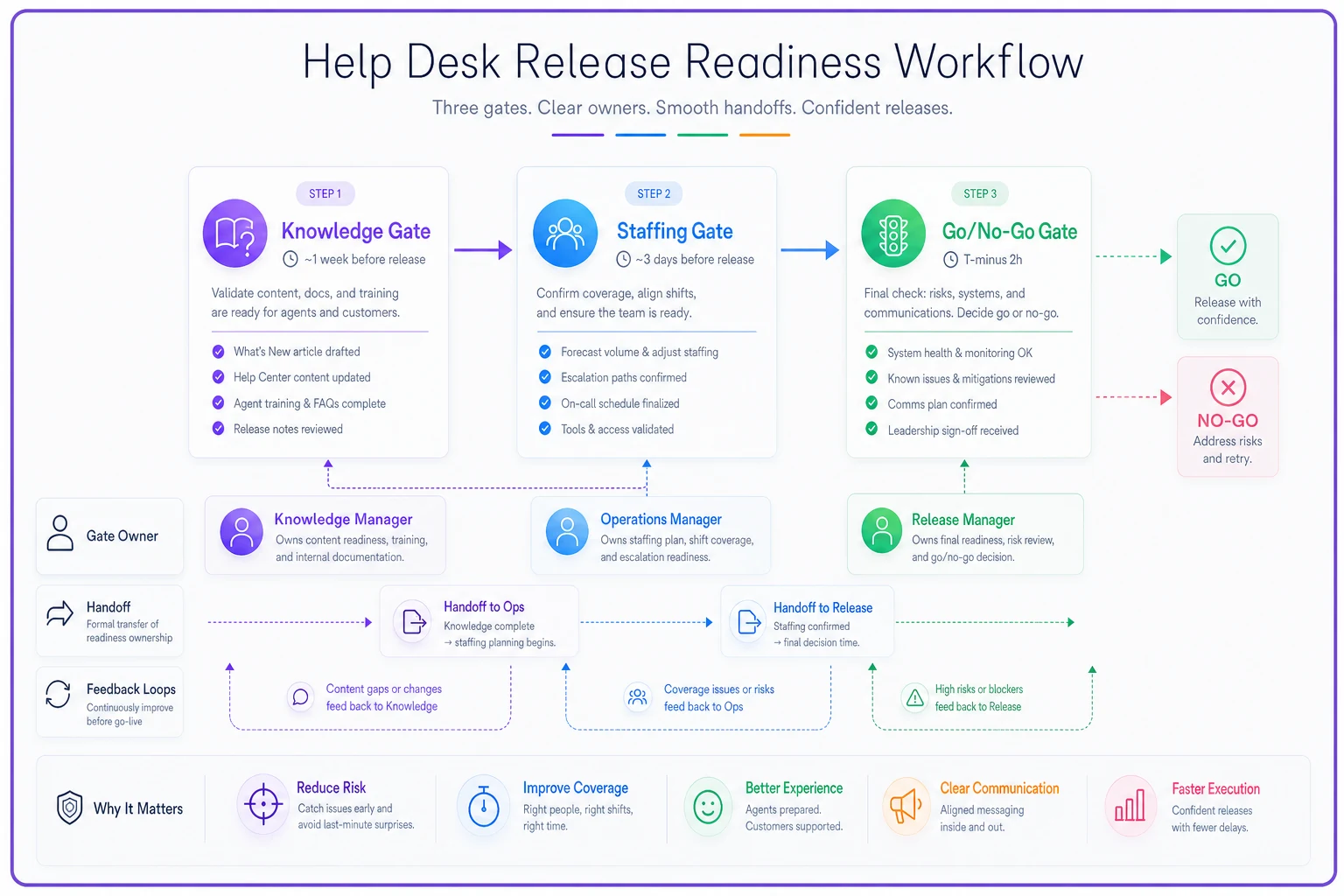
The visual shows owners, timing, and the handoff points so a team can quickly see who needs to sign off and when.
Gate 1: The Knowledge Gate (docs and playbooks)
This is the gate people most love to skip and most regret skipping. The trap is thinking "we'll write the article after it goes live and we see what people ask." By then you've already eaten a wave of inconsistent answers and reopened tickets.
The Knowledge Gate has two halves that people tend to conflate: the public KB (what customers self-serve) and the internal playbook (what agents use to respond). They serve different readers and need different content.
-
[ ] Public KB article drafted, reviewed by someone on product, and staged (not published yet — timed to launch)
-
[ ] Internal playbook with at least the top 3 anticipated questions and approved responses
-
[ ] Known-issues list documented, including anything shipping with a known limitation
-
[ ] Escalation criteria written down
what gets escalated, to whom, with what info
-
[ ] Search terms and synonyms mapped so the KB article actually surfaces when customers search
-
[ ] A "we don't know yet" section for gaps, so agents flag instead of guess
That last item gets skipped most often. Teams write for the happy path and leave agents exposed on the edges. A good playbook is honest about what it doesn't cover.
If your team already has a solid ticket-to-knowledge capture process, adapt those templates to speed KB creation for launches.
The mechanics of getting docs written fast without burning a week on it matter here too. If your team already has a solid ticket-to-knowledge capture process running, most of the launch KB work is adapting existing templates rather than starting cold. Teams without that muscle end up writing launch docs from scratch every time, which is exactly why they run out of runway before the gate.
Gate 2: The Staffing Gate (surge planning)
You can't staff a launch you haven't sized. And most teams size launches by feel — "eh, it's a big one, let's add a couple people."
The better approach is to model expected contact volume, even roughly. You don't need a perfect forecast. You need a range and a plan for the top of that range.
A workable estimate: take the number of users the feature touches, apply a contact rate, and spread it across the first few days. Contact rates vary by launch type, but some rough anchors from real launches:
-
A net-new feature most users won't touch immediately
often 1–3% of exposed users in week one.
-
A change to an existing workflow people already rely on
much higher, sometimes 8–15%, because you've disrupted a habit.
-
A pricing or billing change
the highest and spikiest, front-loading hard in the first 24–48 hours.
Say you're changing a workflow that around 4,000 active users touch weekly. At a 10% contact rate, that's roughly 400 extra contacts, and maybe 60–70% of those land in the first two days. That's a real number you can staff against.
The surge plan itself should cover:
-
Baseline coverage — your normal staffing for that window.
-
Surge coverage — who's added, from where, and for how long.
-
Trigger thresholds — the queue depth or wait time that activates the next level of surge.
-
De-escalation criteria — when you stand people back down, so you're not burning overtime on a wave that already passed.
-
Escalation staffing — someone senior dedicated to the tricky launch tickets, not buried in the general queue.
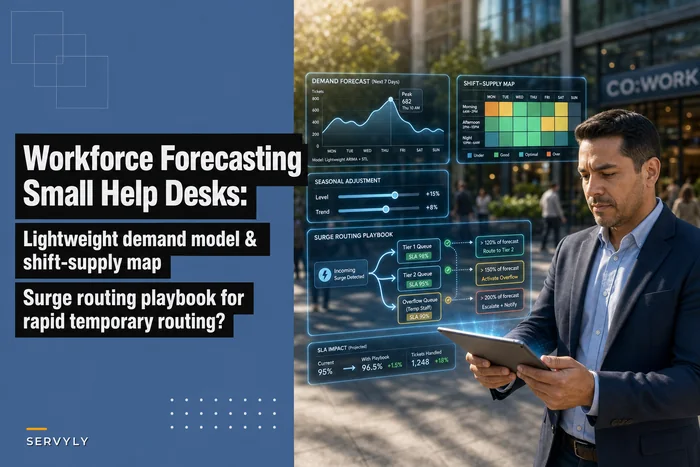
The mistake is planning for the peak and forgetting the trigger and de-escalation logic. Launches don't stay hot. If you don't define when to scale back, you overspend on the tail. If you're already running a lightweight demand model and surge routing playbook, the launch surge plan is basically a special-case overlay rather than a separate exercise.
When a full surge plan is overkill
Not every launch needs this. A tiny UI tweak, a copy change, a feature behind a flag going to 2% of users — don't build a surge plan. The gate for those is a one-line answer: "expected impact is minimal, no surge needed, signed off." Forcing a heavy process onto a trivial release just trains everyone to ignore the gates.
Gate 3: Cross-team ownership (the RACI that actually holds)
The ownership fog problem — tickets bouncing because nobody agreed who owns what — is a coordination failure, not a skills failure. And it's solved with a simple RACI drawn up before launch, not during the incident.
You don't need a giant matrix. You need clarity on the handful of things that actually cause fights:
| Activity | Responsible | Accountable | Consulted | Informed |
|---|---|---|---|---|
| KB / playbook content | Content lead | Support manager | Product | Whole team |
| Launch-day queue coverage | Shift lead | Support manager | WFM | Product |
| Bug triage on new feature | Support agent (first) | Eng on-call | Product | Support |
| Rollback decision | PM | Eng lead | Support lead | Everyone |
| Customer comms on issues | Support lead | Support manager | Marketing | Product |
The most important row is the rollback decision. When something breaks mid-launch, the worst outcome is three people assuming someone else has the authority to pull the plug — or worse, assuming they don't. Naming the accountable person in advance turns a 40-minute argument into a 4-minute call.
Worth flagging: support is almost always "Responsible" for first-touch bug triage but almost never given a clear handoff path. That's the row where tickets die. The RACI is only useful if the "Consulted" and "Accountable" people have actually agreed to be reachable on launch day.
The launch-day runbook
By the time launch day arrives, most of the work should already be done. The runbook is what keeps the day calm — a single document, open in front of the shift lead, that answers "what do I do right now" without anyone having to think.
A launch-day runbook should contain:
-
Timeline — when the feature goes live, when the KB publishes, when comms go out. Timed to the minute for the first couple of hours.
-
Monitoring targets — which metrics you're watching (queue depth, first-response time, ticket tag volume for the new feature) and the thresholds that mean trouble.
-
Named contacts — the actual humans for each RACI role, with the fastest way to reach them.
-
Rollback criteria — the specific conditions that trigger a pause or rollback, written before the day so nobody negotiates them under pressure.
-
Comms templates — pre-approved messages for "we're aware of an issue" and "resolved," ready to send without a review cycle.
The rollback criteria deserve real attention. "Roll back if it's bad" is not criteria. "Roll back if error rate on the new flow exceeds X, or if we get more than Y bug reports in the first hour, or if a data-integrity issue appears at all" — that's criteria. The tighter and more specific you make it, the less it becomes a debate when it matters.
One small thing that helps: assign one person as the launch-day "queue watcher" whose only job is to monitor the new-feature ticket tag and flag anomalies. Not answering tickets — watching. On busy launches, the signal gets buried in volume, and by the time a pattern is obvious it's already a big pile.
Post-launch measurement: knowing if it actually went well
The launch isn't over when the feature is live. It's over when you've measured the support impact and fed it back into the next launch. This is the part almost everyone drops, because by then the fire's out and people have moved on.
The core idea is the ticket window — a defined period after launch where you tag and track everything related to the release. Usually the first 7 to 14 days, depending on how long the wave takes to settle.
Within that window, the metrics that actually tell you something:
-
Contact rate vs. forecast — did you size the volume right? This is how you get better at the Staffing Gate next time.
-
New-feature ticket share — what percentage of total volume came from the launch. Tells you the real support cost of the feature.
-
KB deflection — how many people viewed the launch article vs. how many opened a ticket anyway. Weak deflection usually means the docs missed the mark.
-
Reopen rate on launch tickets — high reopens almost always mean the playbook answers were wrong or incomplete.
-
Handle time on launch tickets vs. baseline — a decent proxy for how well-prepared agents actually were.
You can also wire in experiment hooks — if product is running a staged rollout, tag support tickets by cohort. It's rarely done, but it's revealing. Sometimes the variant that "wins" on the product metric quietly generates 30% more support contacts, and nobody notices because the two scoreboards never get compared.
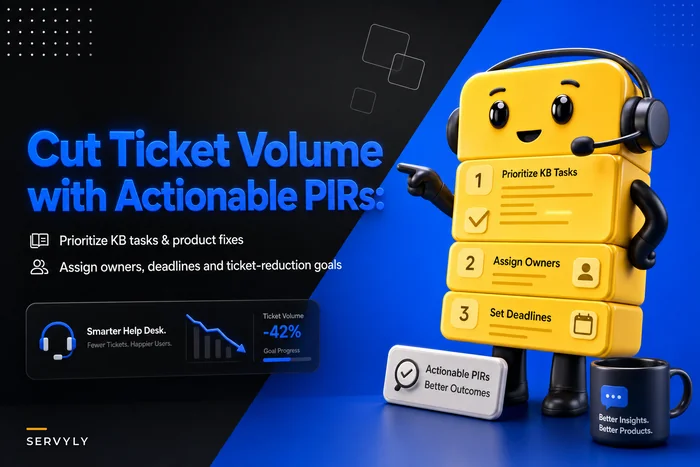
The final loop is the retro. Everything you learned in the ticket window becomes an input to the next launch's gates. A surprise volume spike should update your contact-rate assumptions. A feature that drove reopens should trigger a KB rewrite. It's essentially the same discipline as running actionable post-incident reviews that cut ticket volume — just applied to planned launches instead of unplanned incidents.
Where AI actually helps (and where it doesn't)
There's a natural place for automation in this system, but it's narrower than the hype suggests. The parts of release readiness that are genuinely repetitive — drafting first versions of KB articles from a changelog, tagging incoming tickets to the right launch, watching queue thresholds and flagging when a surge trigger is hit — those are good candidates for AI-assisted workflows inside your support platform.
What automation shouldn't own: the gate decisions themselves. Whether a launch is ready, whether to roll back, who's accountable — those stay human. The useful pattern is tooling that surfaces signals faster (this ticket tag is spiking, this KB article has low deflection, forecast vs. actual is off by 40%) so the people making the gate calls have better information sooner. Automation drafts and monitors; people decide. Get that boundary right and the system gets faster without getting reckless.
A real scenario
A mid-size SaaS team — support desk of around nine people — was rolling out a redesigned billing settings page. Their old process was informal: product told them a few days ahead, someone skimmed the changelog, and they braced for impact.
The last major launch before they built gates went badly. Contact volume roughly tripled for three days, first-response time blew past their SLA, and roughly a quarter of the launch tickets got reopened because agents were giving inconsistent answers about the new billing flow. A few customers escalated on social. Nobody could agree who should've caught it.
For the billing redesign, they ran the three-gate system. The Knowledge Gate forced the KB article and internal playbook to be done and reviewed a week out. The Staffing Gate modeled the volume — billing changes front-load, so they added two surge agents for the first 48 hours only, with a clear de-escalation plan. The Go/No-Go included specific rollback criteria and a named queue watcher.
The result wasn't magic. Contact volume still rose — it was a billing change, it was always going to. But it landed within the forecast range, first-response time held near target, and reopens on launch tickets dropped sharply because agents were reading from the same playbook. The queue watcher caught one edge case in the first hour and flagged it before it became a pattern. Total added cost was two agents for two days, which was far cheaper than the overtime and cleanup from the launch before it.
Bringing it together
The reason launches turn into support chaos isn't complexity — it's timing. Support gets involved too late, with no authority to hold the line, no volume model, no ownership map, and no rollback plan. Every one of those is a decision that could've been made calmly a week earlier.
Gates fix the timing. They move support's readiness from "hope it works out" to a set of checkpoints with owners and pass conditions. The knowledge gets written before it's needed, the staffing gets sized against a real number, ownership gets agreed before anyone's arguing under pressure, and launch day runs off a document instead of adrenaline.
Start small. Pick your next real launch, draw three gates, name an owner for each, and give them the authority to say no. You'll feel the difference the first time — and after two or three launches, running the gates becomes the normal way you ship, not an extra step. That's when post-launch support stops being a fire drill and starts being just another Tuesday.
The reason launches turn into support chaos isn't complexity — it's timing. Support gets involved too late, with no authority to hold the line, no volume model, no ownership map, and no rollback plan. Every one of those is a decision that could've been made calmly a week earlier.
Start small. Pick your next real launch, draw three gates, name an owner for each, and give them the authority to say no. You'll feel the difference the first time — and after two or three launches, running the gates becomes the normal way you ship, not an extra step. That's when post-launch support stops being a fire drill and starts being just another Tuesday.
Ready to transform your support operations?
Join 500+ support teams using Servyly to reduce resolution times, improve customer satisfaction, and boost team productivity.