

A "P1" in your support queue is not a "P1" in engineering's backlog. And neither of those matches what your security team means when they flag something "critical." Most support orgs discover this gap at the worst possible moment — in the middle of an active incident, when three teams are staring at the same ticket and arguing about whether it deserves an immediate page or a Monday morning review.
The problem isn't that people disagree about what's urgent. It's that each team built its severity vocabulary in isolation, optimized for its own workflow, and never reconciled the definitions. Support thinks in customer pain. Product thinks in roadmap disruption. Security thinks in exposure and blast radius. When a ticket crosses a boundary, the label travels with it — but the meaning gets lost in translation.
This article is narrowly about one thing: building a shared severity taxonomy support teams, product, and security can all use without constant re-litigation. Not a philosophy of incident management. Not an org redesign. Just the decision ladder, the mapping matrix, and the acceptance tests that make a "P2" mean the same thing no matter whose queue it sits in.
What a semantic handoff failure actually looks like
Here's the pattern. A customer reports that exported reports are showing data from the wrong account. Support, trained to think about customer impact, tags it P1 — data integrity, customer-facing. It gets routed to engineering.
Engineering's intake sees "P1" and checks it against their severity scale, which is calibrated around system availability. The service is up. Latency is fine. No outage. So the on-call engineer mentally downgrades it to "important but not a fire" and schedules it for the next sprint grooming session.
Meanwhile nobody told security, even though "wrong account's data appearing in another account's export" is a textbook data-leakage event that likely triggers disclosure obligations.
Three teams. Three severity frameworks. One ticket. The actual risk — a potential privacy breach — slips between all three because the word "P1" carried a different payload for each reader.
What makes this insidious is that everyone followed their process correctly. Support labeled it by their rubric. Engineering triaged it by theirs. The failure was entirely in the handoff — the moment the label crossed a team boundary and silently changed meaning.
In practice, this usually breaks down along three fault lines:
-
Support ↔ Product, where "urgent for the customer" collides with "urgent for the roadmap."
-
Support ↔ Security, where a customer-impact label fails to flag a compliance or exposure dimension entirely.
-
Product ↔ Security, where a known bug gets deprioritized without anyone asking whether it's exploitable.
The fix isn't forcing everyone onto one team's scale. Support should not have to think like a security analyst, and security should not have to care about CSAT. The fix is a translation layer: a shared ladder plus explicit mapping rules so each team keeps its native vocabulary while the handoff stays lossless.
Separate severity from impact — they are not the same axis
The single biggest source of confusion is that teams smash two different questions into one label.
Never lose track of a customer request again.
Servyly helps you track, assign, and resolve every ticket quickly and efficiently.
- Centralized ticket management
- Automated response workflows
- Team collaboration tools
No credit card required
-
Severity = how bad is the technical/operational state right now? (Is it broken? How broken?)
-
Impact = who and how many are affected, and what's the business/risk consequence?
A bug can be low-severity but high-impact (a tiny formatting error on the pricing page that's costing conversions). It can be high-severity but low-impact (a subsystem is completely down, but only an internal tool nobody uses externally). When you collapse these into a single "P1–P4" number, you lose the ability to reason about either.
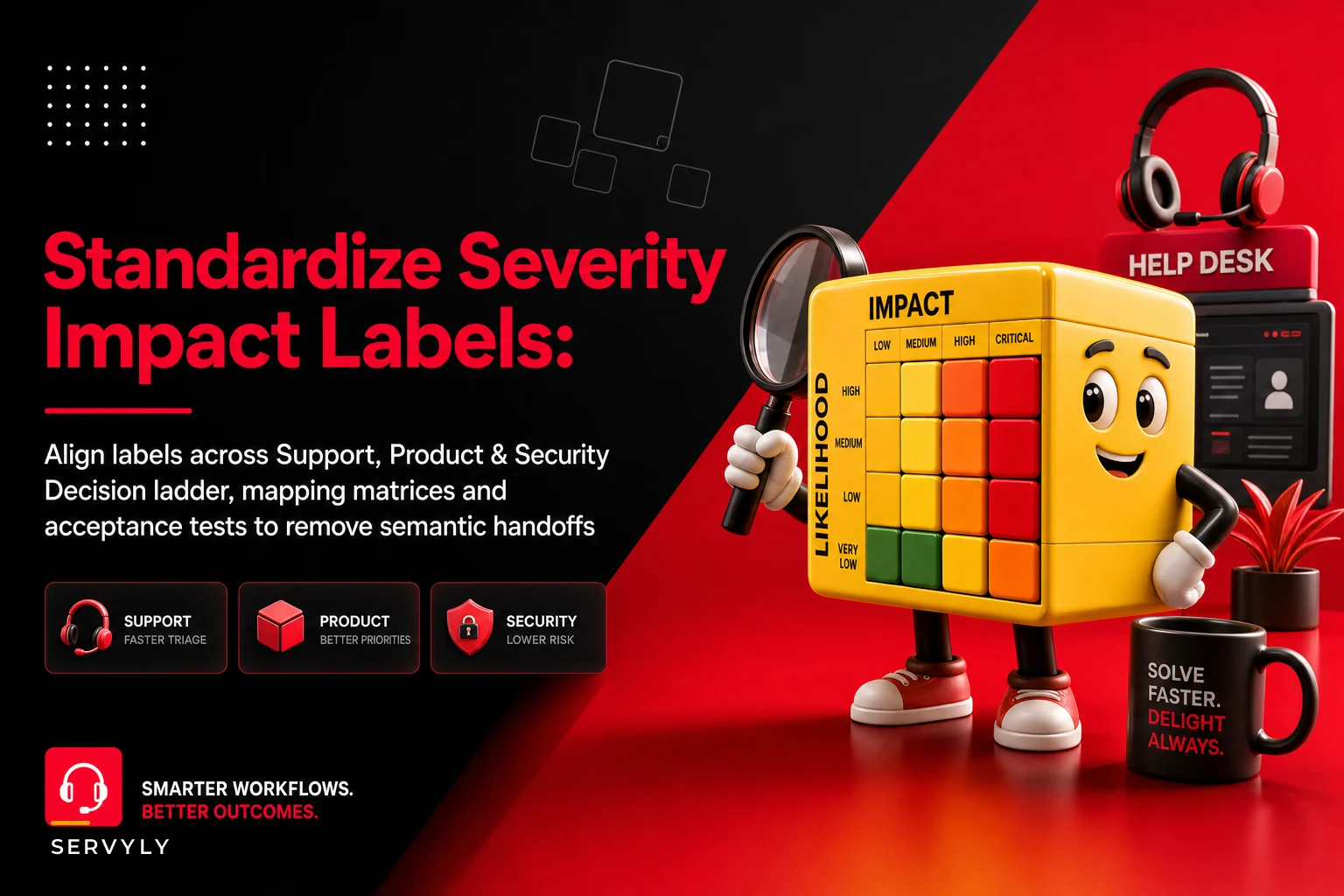
Teams that get this right use a two-dimensional grid. Severity on one axis, impact on the other. The priority that comes out — the thing that drives SLAs and paging — is a function of both, computed the same way for everyone.
| Severity (technical state) | Low Impact | Medium Impact | High Impact |
|---|---|---|---|
| S1 — Broken / unusable | P2 | P1 | P1 |
| S2 — Degraded / partial | P3 | P2 | P1 |
| S3 — Minor defect | P4 | P3 | P2 |
| S4 — Cosmetic / annoyance | P4 | P4 | P3 |
The value here isn't the specific cells — adjust those to your business. The value is that priority becomes derived, not declared. Nobody "assigns a P1" anymore. They assess severity, they assess impact, and the matrix produces the priority. That removes the most common argument: "I think it's a P1," "well I think it's a P2." Now you argue about the inputs, which are far more concrete and checkable.
Security adds a third consideration that doesn't fit cleanly on either axis: exposure. A defect that leaks data or opens an attack path can override the matrix entirely and escalate regardless of severity or user count. That's the one hard rule worth hardcoding — more on that below.
The decision ladder: how a ticket gets classified
A matrix only works if people can consistently place a ticket on it. That's what the decision ladder does. It's a short, ordered set of questions that anyone — support agent, PM, security analyst — walks through to land on severity and impact without needing tribal knowledge.
-
Is anyone's data exposed to someone who shouldn't see it? If yes → security gate triggers immediately, skip the rest, treat as minimum P1 and loop security in. This question comes first on purpose, because it's the one support teams are least equipped to catch and the one that causes the worst damage when missed.
-
Can the affected users complete their core task? No = S1. Only with a painful workaround = S2. Yes, but with a visible defect = S3. Yes, barely noticeable = S4.
-
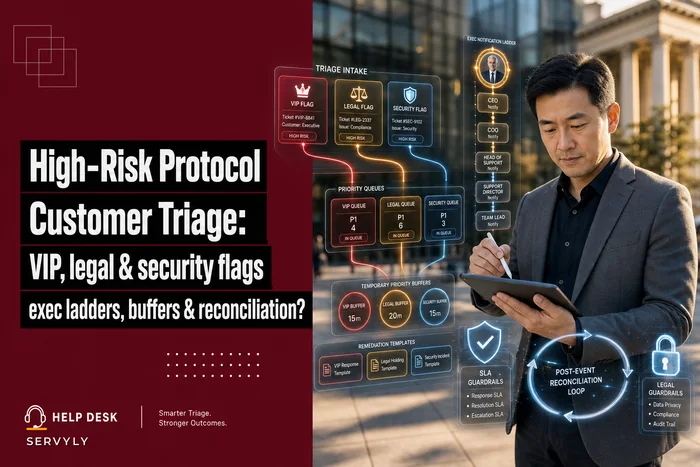
How many users / which accounts are affected? A single standard user = Low. A segment, a workflow, or a named enterprise account = Medium. Broad base, all accounts, or a high-risk customer = High. (Your protocols for enterprise and high-risk accounts should feed this directly — see the high-risk customer triage protocol for how VIP, legal, and security flags change the impact rating.)
-
Is there revenue, legal, or contractual exposure attached? If yes, bump impact up one level. A broken checkout for 12 users is still High impact because it's touching money.
-
Read the priority off the matrix. Severity × Impact → Priority. Done.
The ordering matters more than the content. Putting the exposure question first forces the one check each team is most likely to skip. Making impact a separate step from severity stops people from inflating severity just to get attention — a very common behavior when "P1" is the only lever an agent has to make engineering care.
A quick visual of the ladder helps people apply it consistently.
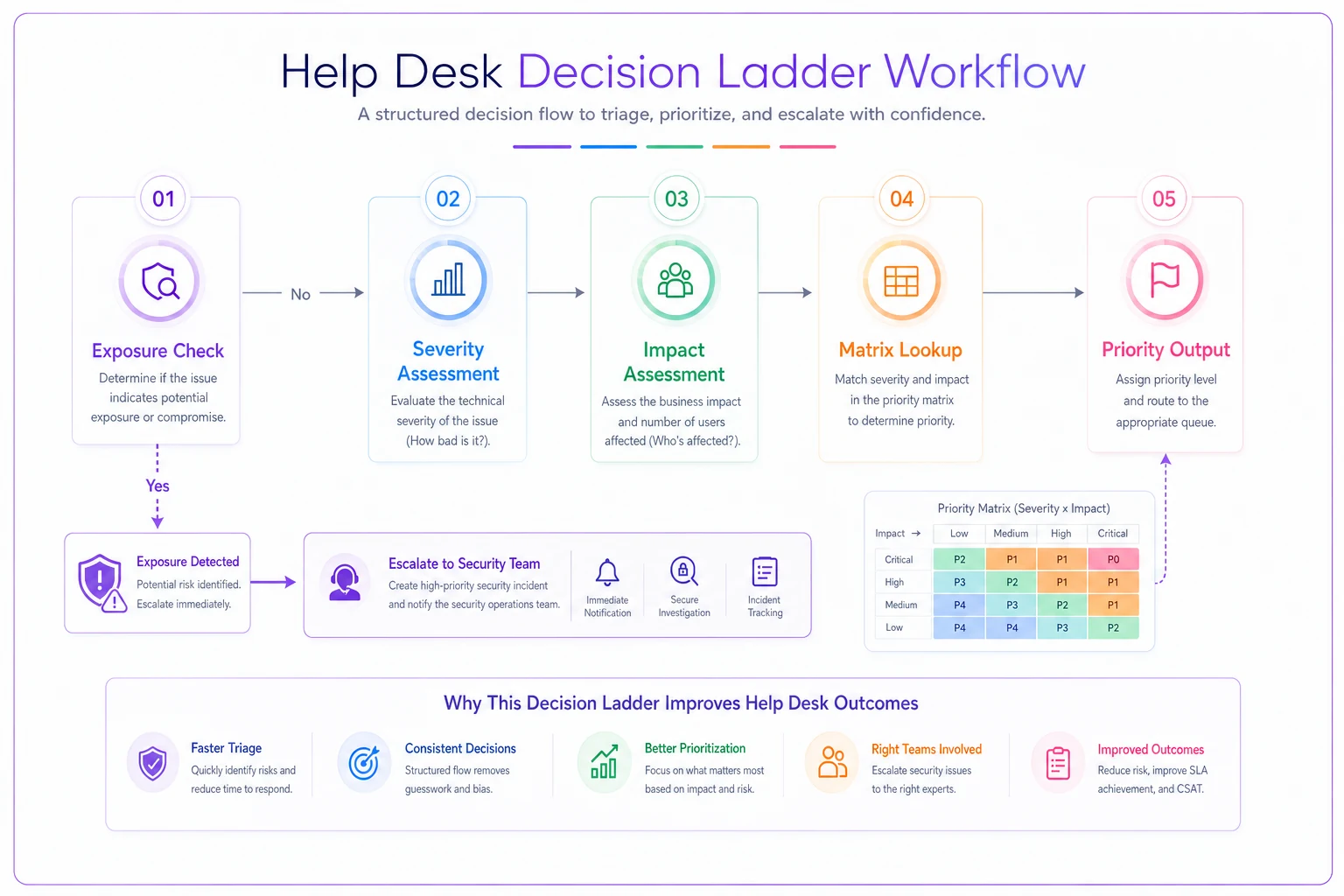
This visual highlights where to stop and ask each question, and where escalation happens.
One pattern worth naming: support agents chronically over-rate severity and under-rate impact, because they're staring at one angry customer. Product does the reverse — they see the aggregate roadmap but discount the individual. The ladder corrects both by making each dimension an explicit, separate judgment.
The ladder's ordering and separation of inputs make cross-team agreement far easier in practice.
The mapping matrix: translating between native scales
You will not get three teams to abandon their existing labels, and you shouldn't try. Security has regulatory frameworks baked into their severity language. Engineering's labels are wired into their alerting. What you need is a crosswalk — a table that says exactly what each team's label maps to in the shared scale, in both directions.
| Shared | Support says | Product/Eng says | Security says |
|---|---|---|---|
| P1 | "Critical — customer blocked" | "Sev1 — service/data broken" | "High — active exposure or exploit" |
| P2 | "High — major feature broken" | "Sev2 — significant degradation" | "Medium — exploitable, not active" |
| P3 | "Normal — workaround exists" | "Sev3 — minor defect" | "Low — hardening / theoretical" |
| P4 | "Low — cosmetic" | "Sev4 — backlog" | "Info — no action required" |
The mistake people make here is treating the crosswalk as approximate. "Roughly, support P1 is like engineering Sev1." That approximation is exactly the gap tickets fall through. The crosswalk has to be exact and enforced at the handoff: when a ticket moves from support to engineering, the system translates the label and shows both — "Support P1 → Eng Sev1" — so the receiving engineer sees the shared-scale value, not just their own interpretation.
The hardest rows are the mismatches. A support P3 ("workaround exists, not urgent") can be a security Medium ("exploitable") at the same time. Those aren't contradictions — they're two different axes describing the same ticket. The crosswalk has to allow a ticket to carry both a priority and a security classification simultaneously, and the higher of the two governs the response. When you're building the actual escalation payload that moves between teams, the reproducible escalation packet approach is where this translated label needs to live so nothing gets re-interpreted downstream.
Acceptance tests: proving the taxonomy actually works
A taxonomy nobody tests is a wiki page nobody reads. The way you keep it honest is with operational acceptance tests — a set of real, pre-classified scenarios that every team runs through to confirm they land on the same answer.
Think of these as regression tests for your definitions. You write up 15–20 realistic tickets, have the "correct" classification agreed on by all three teams, then periodically have fresh people classify them cold. If support, product, and security all independently land on the same priority for the same scenario, your taxonomy is calibrated. When they diverge, you've found a definition that's ambiguous — and that divergence is a real signal, not a personnel problem.
> Scenario 7: A customer on an enterprise plan reports that two-factor authentication SMS codes are arriving 4–6 minutes late. Login eventually succeeds. About 30 enterprise accounts have reported it in two days. > > Expected classification: S2 (degraded — task completable with painful delay) × High impact (enterprise accounts, auth-related, contractual) → P1. Security secondary flag: Medium (auth reliability, no exposure). Governs: P1.
Run that scenario and you'll immediately see who treats "login still works" as low severity versus who correctly weights the enterprise-auth impact. Those disagreements are the entire point — they surface before a real incident instead of during one.
-
Cover at least one scenario per cell of the matrix, including the awkward corners.
-
Include at least three cross-boundary cases where the security axis disagrees with the priority axis.
-
Include a few trap scenarios — some that look scarier than they are (noisy but harmless) and some that look trivial but aren't (quiet data leaks).
-
Pull real tickets from your own history. Invented scenarios are too clean and don't expose real ambiguity.
-
Re-run the suite whenever you change a definition, and when onboarding anyone who classifies tickets.
-
Track the disagreement rate over time. A healthy, mature taxonomy drifts toward a low, stable disagreement rate; a spike means a definition rotted or a new product area outgrew the labels.
Pull real tickets from your own history.
A practical checklist for building your acceptance test suite is above; use it to reduce ambiguity before incidents happen.
Governance: keeping the taxonomy from rotting
Definitions decay. New products ship, new compliance requirements land, and six months later the mapping matrix quietly stops matching reality. Without an owner, the taxonomy becomes another stale document everyone ignores and teams drift back to private scales.
-
One owner per axis. A support lead owns the impact definitions, an engineering lead owns severity, a security lead owns the exposure gate. No committee owns the whole thing — committees don't make decisions, they defer them.
-
A standing reconciliation review, maybe 30 minutes every two weeks, where the three owners look at tickets where teams disagreed on classification. Not to assign blame — to decide whether the definition needs tightening.
-
A change log for the taxonomy itself. When a definition changes, it's versioned and dated. "As of the March revision, auth-related defects are minimum Medium impact." That history is what lets you re-run acceptance tests and know which version you're testing against.
-
A single source of truth that both the humans and the tooling read from. The crosswalk can't live in one team's Notion and another's spreadsheet. It has to be one authoritative definition that your ticketing system references at the handoff.
This is where tooling earns its keep, quietly. The translation step — showing "Support P1 → Eng Sev1 → Security: Medium flag" at every boundary — is exactly the kind of deterministic, rule-based enforcement that's tedious and error-prone for humans and trivial to encode. An operational platform that stores the mapping matrix as live rules and applies them automatically at each handoff means the receiving team never has to re-interpret a label from memory. Lightweight AI-assisted triage can also pre-fill the decision ladder — flagging a probable data-exposure case the moment certain keywords or patterns appear in a ticket — so the security gate question isn't dependent on a tired agent remembering to ask it. The goal isn't to automate the judgment; it's to make sure the translation and the gating checks never get skipped under pressure.
When this is worth doing — and when it isn't
A full severity taxonomy with crosswalks and acceptance tests is real work. It's not always the right investment.
It makes sense when you have genuinely separate teams with their own severity scales, tickets routinely cross between support, product, and security, and you've already been burned by a mislabeled incident. The signal is simple: if you can name two or three incidents in the last quarter where severity got lost in handoff, you need this.
It's overkill when you're a small team where the same handful of people see every ticket. If support, engineering, and security are four people in one Slack channel, a shared vocabulary lives in their heads and a formal crosswalk is bureaucracy. Build the one-page matrix, skip the governance ritual.
Who should not do this: teams that haven't yet agreed severity and impact are separate axes. If you're still collapsing everything into one P1–P4 number, fix that first. Layering a crosswalk on top of a broken single-axis scale just translates the confusion more efficiently.
A short real scenario
A B2B SaaS company with a support team of around nine people, a product org, and a two-person security function kept hitting the same wall: customer-reported bugs that turned out to be security issues sat in the engineering backlog for days because the support label never carried a security dimension. Over roughly a quarter they counted three incidents where a data-handling bug was triaged as a routine P3 and only escalated after a customer pushed back — one of which triggered a disclosure review that could have started a week earlier.
They built exactly what's described here: the two-axis matrix, a decision ladder with the exposure question first, a crosswalk between the three teams' labels, and about 18 acceptance-test scenarios pulled from their own ticket history. The first time they ran the acceptance tests cold, the three teams agreed on roughly half the classifications — which told them precisely which definitions were broken.
After tightening those definitions and wiring the crosswalk into their handoff step, the disagreement rate on new cross-boundary tickets dropped to a low, stable level over the following couple of months. More importantly, the "quiet data leak misread as a minor bug" pattern stopped recurring, because the ladder's first question now forced the check every single time, regardless of how busy the agent was.
The takeaway
Severity labels fail at team boundaries not because people are careless but because the same word carries a different payload for each team. You fix it by separating severity from impact, deriving priority from a shared matrix instead of declaring it, mapping each team's native scale through an exact crosswalk, and proving the whole thing works with acceptance tests built from your own real tickets. Put one owner on each axis, review the disagreements, and version your definitions so they don't rot.
Do that, and "P1" finally means the same thing in every queue it touches — which is the entire point of having the label at all.
Severity labels fail at team boundaries not because people are careless but because the same word carries a different payload for each team. You fix it by separating severity from impact, deriving priority from a shared matrix instead of declaring it, mapping each team's native scale through an exact crosswalk, and proving the whole thing works with acceptance tests built from your own real tickets. Put one owner on each axis, review the disagreements, and version your definitions so they don't rot.
Do that, and "P1" finally means the same thing in every queue it touches — which is the entire point of having the label at all.
Ready to transform your support operations?
Join 500+ support teams using Servyly to reduce resolution times, improve customer satisfaction, and boost team productivity.