

Most teams that add sentiment detection to their help desk make the same quiet mistake: they wire the signal directly to an action. Negative sentiment detected → escalate to tier 2. Angry tone → ping the account manager. It feels responsive. Then two weeks later your tier 2 queue is clogged with customers who typed "ugh this is frustrating" about a password reset, and your senior agents are spending their mornings triaging noise.
The problem isn't that sentiment analysis doesn't work. It's that sentiment alone is a terrible routing key. A frustrated enterprise customer on a renewal timeline and a mildly annoyed free-tier user both register as "negative," but they need completely different responses. Route on tone without context and you've built a very expensive random number generator.
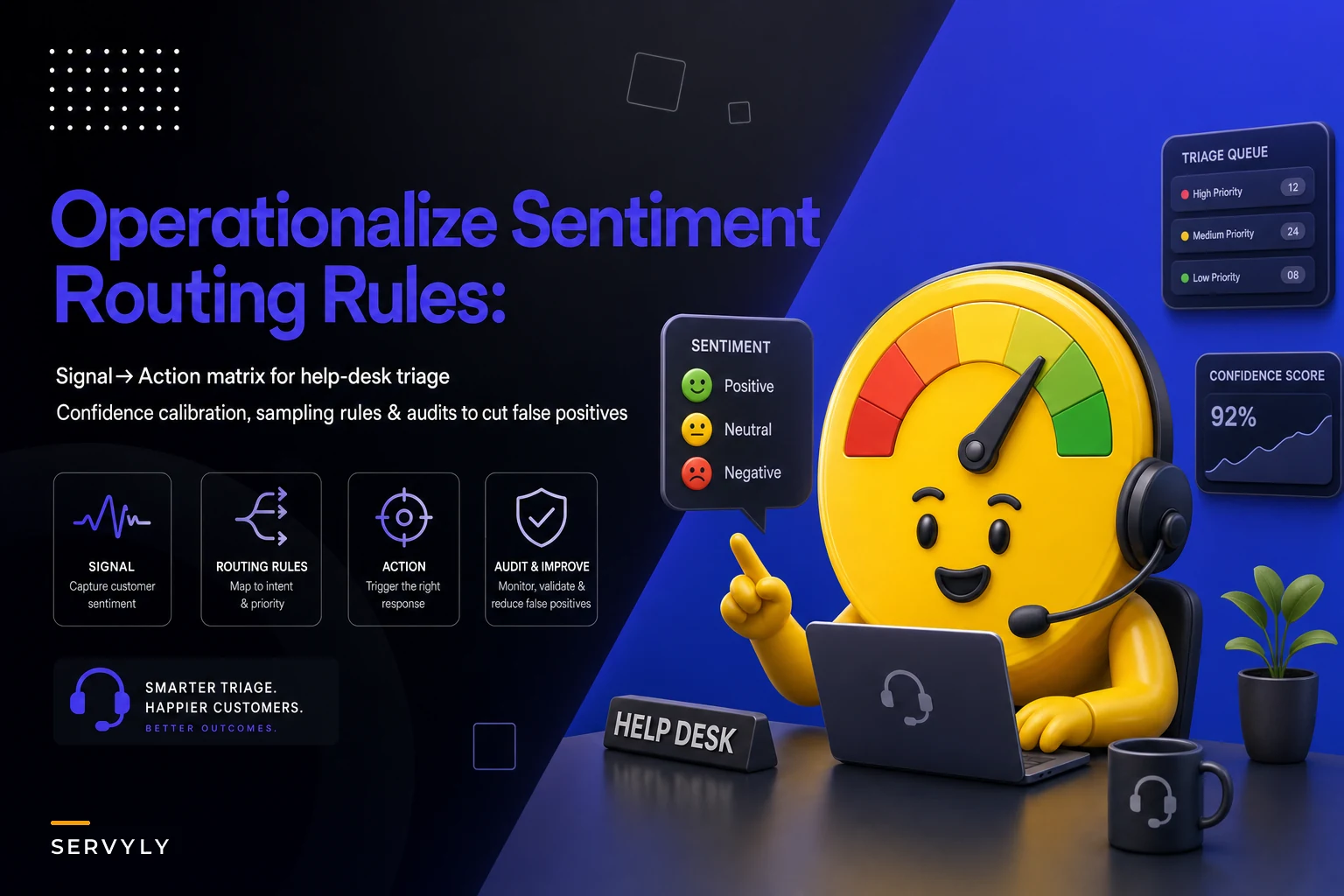
What actually works is treating sentiment as one input in a matrix—combined with customer tier and issue type—then gating it behind confidence thresholds and sampling rules so you can catch when the model is wrong before it costs you anything. That's what sentiment routing rules support teams actually need: not a tone detector, but a decision framework that knows when to trust itself.
Why raw sentiment routing falls apart
A team turns on sentiment scoring, sets a threshold ("if negativity > 0.7, escalate"), and watches escalations spike. They assume the spike means they were missing a lot of unhappy customers before. Sometimes that's true. Usually it's not.
Sentiment models are noisy on short, transactional support text. "This isn't working" scores strongly negative. So does "I'm so frustrated, I've tried everything." But one is a factual status report and the other is an emotional one—and they often need the same five-minute fix. The model can't distinguish between frustration at the product and frustration expressed while describing a routine problem.
A typical example: a mid-market SaaS support team turned on auto-escalation for negative sentiment and saw tier 2 volume jump by roughly 40% in the first week. When they sampled the escalated tickets, close to 60% were things a tier 1 agent could have closed in one reply. The model wasn't broken. The routing logic was—it had no sense of who was upset or what about.
The fix isn't a better model. It's refusing to let a single signal make a decision on its own.
The signal→action matrix
The core artifact here is a matrix that maps three inputs to one routing action:
Never lose track of a customer request again.
Servyly helps you track, assign, and resolve every ticket quickly and efficiently.
- Centralized ticket management
- Automated response workflows
- Team collaboration tools
No credit card required
-
Sentiment (positive / neutral / negative / severe-negative)
-
Customer tier (free / paid / strategic account)
-
Issue type (how-to / bug / billing / outage-adjacent / account risk)
The intersection tells you what to do, not just how the customer feels. Here's a condensed version of what one looks like in practice:
| Sentiment | Tier | Issue type | Routing action |
|---|---|---|---|
| Negative | Free | How-to | Standard queue, no flag |
| Negative | Paid | How-to | Standard queue, priority sort |
| Negative | Strategic | How-to | Tier 1, add watch flag |
| Severe-negative | Paid | Billing | Tier 2, 2-hour SLA |
| Severe-negative | Strategic | Billing | Tier 2 + account manager notify |
| Negative | Strategic | Bug | Tier 1, link to known-issue check |
| Severe-negative | Strategic | Account risk | Immediate escalation + manager page |
| Positive | Any | Any | Standard, tag for QA sampling |
Notice what this does. A negative free-tier how-to ticket—the single most common false-alarm category—gets no special action at all. The emotional signal is still captured, but it doesn't trigger anything expensive until it combines with a tier or issue type that justifies the cost.
The matrix also forces a conversation your team probably hasn't had explicitly: which combinations actually warrant interrupting a senior person? Most teams discover they only have four or five intersections that genuinely merit escalation. Everything else is informational.
One mistake people make here is building the matrix too granular—twelve sentiment levels, eight tiers, twenty issue types. You end up with a massive spreadsheet nobody maintains. Keep it coarse. Four sentiment bands, three tiers, five or six issue types. If a cell is ambiguous, default to the less disruptive action.
Below is a simplified view of how these signals flow into a routing decision:
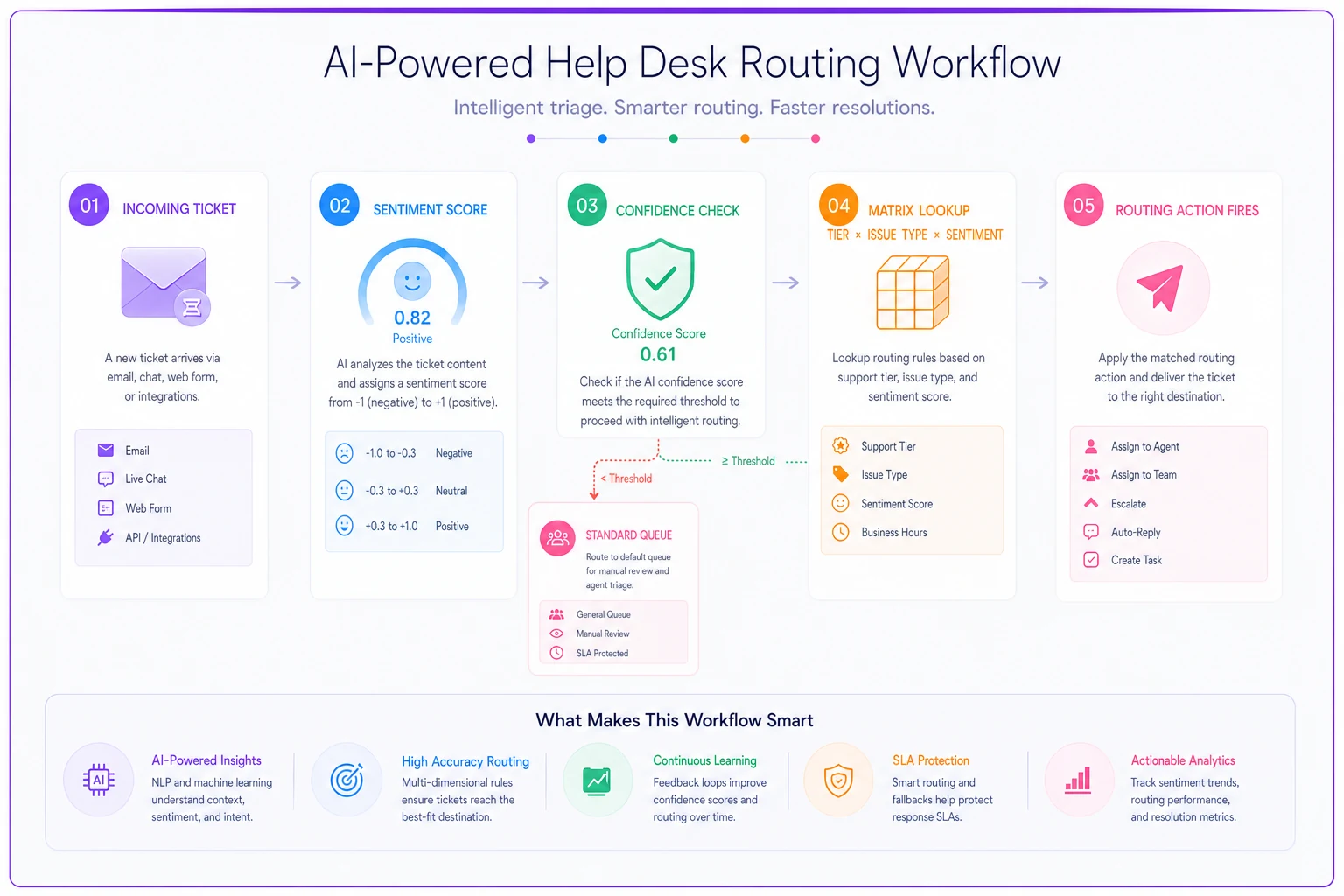
This flow matters because skipping the confidence check—jumping straight from sentiment score to routing action—is exactly where most implementations break down.
Confidence calibration: the part everyone skips
A sentiment score of "negative, 0.73" is meaningless until you know whether 0.73 is actually reliable. Most teams treat the model's confidence number as truth. It isn't—it's the model's opinion of itself, and those opinions are often badly calibrated on real support text.
Calibration means answering one question with data: when the model says 0.73 negative, how often is it actually negative? If you check a few hundred tickets and find that "0.73" is correct only 55% of the time, then 0.73 is not a usable threshold for any action that costs you money.
-
Pull a sample of a few hundred recent tickets across all sentiment bands.
-
Have two humans label each one for true sentiment, blind to the model's score.
-
Bucket the model's scores into ranges (0.5–0.6, 0.6–0.7, 0.7–0.8, etc.).
-
For each bucket, calculate what percentage the humans agreed were actually negative.
-
Set your action thresholds based on the bucket where accuracy crosses your tolerance—often around 80% for anything that interrupts a human.
What you'll usually find is a confidence cliff. The model might be 85% accurate above 0.82 but drop to coin-flip territory between 0.65 and 0.80. That cliff is your real threshold—not the round number someone picked in a planning meeting.
The insight most teams miss: you need different confidence thresholds for different actions. Routing a strategic-account outage ticket to tier 2 is cheap insurance even if you're only 70% sure. Paging an account manager at 11pm needs 90%+. The cost of being wrong scales with the action, so the confidence bar should too. A single global threshold guarantees you're either too trigger-happy on cheap actions or too cautious on expensive ones.
Paging an account manager at 11pm needs 90%+.
A single global threshold guarantees you're either too trigger-happy on cheap actions or too cautious on expensive ones.
Sampling rules to catch drift before it hurts
Calibration isn't a one-time event. Sentiment models drift as your product changes, as customer language shifts, as new issue types appear. A model calibrated in January can be meaningfully off by April, and you won't notice unless you're sampling.
The practical approach is a lightweight ongoing audit:
-
Sample every escalation triggered by sentiment. If the matrix escalated it on tone, a human spot-checks whether the tone was real. This is your false-positive tripwire.
-
Sample a small slice of non-escalated negative tickets. These are your false negatives—genuinely upset customers the matrix let through. Easy to forget because nothing broke loudly.
-
Sample all positive-sentiment tickets flagged for QA. Sometimes "thanks, that's perfect" is sarcasm, and sometimes a happy-sounding ticket hides a churn risk the customer is being polite about.
A reasonable cadence for a small-to-mid team is auditing somewhere around 20–30 sentiment-triggered tickets a week. That's maybe an hour of a lead's time, and it's enough to catch a drifting model before it quietly doubles your escalation noise. If your false-positive rate on sampled escalations climbs past a threshold you set—say, above 25%—that's your signal to recalibrate.
This kind of leading-indicator monitoring is the same discipline that makes predictive support analytics actually trustworthy: you're watching the quality of the signal, not just the volume it generates.
An audit example worth copying
For each sampled escalation, record:
-
The ticket's original text (first customer message)
-
The model's sentiment score and band
-
The matrix action that fired
-
A human's blind judgment
was the action warranted? (yes / no / borderline)
-
A one-line reason
After a couple of weeks you'll have a log that tells you exactly where the matrix misfires. The pattern is almost always concentrated. You won't find false positives evenly spread—you'll find that, say, 70% of your bad escalations come from two specific cells: negative-sentiment billing tickets from paid users, and anything containing the word "cancel" (which models love to read as severe-negative even when it's "can I cancel my old plan and switch to the new one").
Once you see the concentration, the fix is targeted. Add a keyword guardrail. Lower the action for that one cell. Raise the confidence threshold for billing issues specifically. You're not retraining anything—you're adjusting the matrix based on evidence.
A real scenario
A support team at a B2B scheduling software company—roughly 9 agents, two tier-2 specialists—had turned on sentiment escalation and was drowning. Their tier-2 pair was fielding something like 50–60 sentiment-flagged tickets a week, and the specialists kept complaining that most of them were routine.
They ran the calibration exercise over a weekend: about 300 tickets, two labelers. Two things surfaced. First, their escalation threshold of 0.70 was sitting right in the model's unreliable zone—accuracy in that band was around 58%. Second, nearly half their false positives came from a single cell: paid-tier how-to questions where customers used frustrated phrasing about themselves ("I'm hopeless at this, sorry").
They made three changes. Raised the action threshold to 0.82 for everything except strategic-account and outage-adjacent tickets. Changed the paid/how-to/negative cell from "escalate" to "priority sort, no escalation." Started sampling 25 escalations a week.
Over the following month, sentiment-triggered tier-2 volume dropped by a bit more than half—down to roughly 25 a week—and the specialists reported that the ones coming through were almost always worth it. Resolution time on genuine angry-customer tickets actually improved, because tier 2 wasn't buried in noise anymore. The customers who were really at risk got attention faster, not slower.
That last part matters. Reducing false positives isn't just about saving your senior people's time. It's about making sure the real signals don't get drowned out. A matrix that cries wolf trains your team to ignore the alerts.
When this makes sense—and when it doesn't
Worth building when you have clear customer tiers, a reasonable issue taxonomy already in place, and enough volume that manual triage of emotional signals isn't scaling. If strategic accounts and free users flow into the same queue and get the same treatment, the matrix will pay for itself quickly.
A bad idea when your tagging and tiering are a mess. Sentiment routing sits on top of your existing structure—if your issue types are inconsistent or your customer tiers aren't reliably attached to tickets, the matrix inherits all that chaos and amplifies it. Fix the foundation first.
Probably not worth it if you're a very small team with one shared queue where everyone sees every ticket anyway. The whole value of this system is directing attention when you can't look at everything. If you can, a lightweight tone flag is plenty and the matrix is overhead you don't need.
One more honest caveat: sentiment routing works best as a supplement to good closure discipline, not a replacement for it. If tickets are reopening because the first fix was shallow, no amount of emotional routing addresses that—you handle it with tighter closure checklists and QA triggers. Sentiment tells you who's upset now. Good closure keeps them from being upset again next week.
Quick build checklist
Before you turn any of this on:
-
[ ] Coarse matrix defined (4 sentiment bands max, 3 tiers, ~5 issue types)
-
[ ] Every ambiguous cell defaults to the less disruptive action
-
[ ] Calibration run on 200–300 labeled tickets, two labelers
-
[ ] Action thresholds set per the model's actual accuracy cliff, not round numbers
-
[ ] Separate confidence bars for cheap vs. expensive actions
-
[ ] Weekly sampling of 20–30 sentiment-triggered escalations
-
[ ] A false-positive rate ceiling defined that triggers recalibration
-
[ ] At least one keyword guardrail for the predictable traps ("cancel," apology phrasing)
Before you turn any of this on:
The real point
Sentiment detection doesn't fail because the technology is bad. It fails because teams treat an emotional reading as a routing command instead of what it actually is—a probabilistic hint that only means something when you combine it with who the customer is, what they're asking about, and how much you trust the signal in that specific context.
Build the matrix, calibrate the confidence, sample relentlessly, and let the evidence tell you which cells to tune. Do that, and sentiment becomes a genuine triage asset instead of a noise machine. Skip it, and you've just hired your most expensive agents to chase typos that happened to sound angry.
Build the matrix, calibrate the confidence, sample relentlessly, and let the evidence tell you which cells to tune. Do that, and sentiment becomes a genuine triage asset instead of a noise machine. Skip it, and you've just hired your most expensive agents to chase typos that happened to sound angry.
Ready to transform your support operations?
Join 500+ support teams using Servyly to reduce resolution times, improve customer satisfaction, and boost team productivity.