

Support teams handling multiple languages usually end up with the same mess: tickets in popular languages get answered fast while less common ones sit for days. Your team scrambles to find whoever speaks Polish when a ticket comes in. Machine translations make customers angrier than the original problem did. And nobody really knows if your translated responses actually make sense until someone complains.
The real operational challenge isn't just translating words—it's building workflows that handle different languages at different volumes without blowing your SLAs or burning out the one person who happens to speak Italian.
Why Language Detection Breaks Down in Real Support Queues
Most support platforms claim they detect languages automatically. What typically happens: a customer writes in broken English mixed with their native language, the system guesses wrong, routes it to the English queue, and three hours later someone realizes it should've gone to the Portuguese team.
The detection problem gets worse with regional variations. Brazilian Portuguese tickets end up in the European Portuguese queue. Simplified Chinese goes to Traditional. Quebec French lands with the Paris team who can't understand half the slang.
Then there's the volume mismatch. You get 400 English tickets daily, maybe 80 Spanish, 15 French, and one random Finnish ticket every two weeks. Traditional round-robin routing means that Finnish ticket sits untouched because nobody's checking that queue constantly. Meanwhile, your Spanish-speaking agents are drowning while English agents have downtime.
Small teams compound these problems. You probably have two people who speak Spanish—one fluent, one conversational. Three who "know some French" from high school. Someone who claims they speak German but really just uses Google Translate. When tickets come in, you're routing based on who's available, not who's actually qualified.
The Tiered Language Framework That Actually Works
After watching dozens of support teams struggle with this, one thing consistently holds: stop treating all languages equally. Build tiers based on volume and capability.
Never lose track of a customer request again.
Servyly helps you track, assign, and resolve every ticket quickly and efficiently.
- Centralized ticket management
- Automated response workflows
- Team collaboration tools
No credit card required
Tier 1: High-volume languages (>50 tickets/week) These get dedicated coverage. If you're getting 300+ Spanish tickets weekly, you need at least two fluent speakers with overlapping shifts. Set up primary assignments, backup coverage, and escalation paths. Track response times separately from your main SLA because these directly impact a significant chunk of your customer base.
Tier 2: Medium-volume languages (10–50 tickets/week) These need structured flex coverage. Maybe you have one fluent French speaker and two who can handle basic queries with some translation help. Build workflows where simple questions go to the semi-fluent agents with translation templates and quality checks, while complex issues wait for the fluent speaker. Accept slightly longer response times but set clear thresholds—nothing sits more than 24 hours.
Tier 3: Low-volume languages (<10 tickets/week) These get translation workflows with human verification. Use machine translation for initial understanding, draft responses in English, translate them, then have someone (even semi-fluent) review before sending. Yes, it's slower. But one ticket every few days doesn't justify dedicated staffing.
Tier 4: Rare languages (sporadic tickets) Set expectations upfront. Auto-respond acknowledging receipt and explaining you're working on translation. Give realistic timelines—48–72 hours is reasonable for languages you rarely encounter. Better to set proper expectations than pretend you can handle everything instantly.
Building Auto-Detection That Doesn't Constantly Fail
Don't rely solely on automated language detection. Build a multi-signal system instead.
The four signals below work best in sequence—each one narrows the guess before you ever run content analysis:
-
Customer's account language preference. If they set their profile to German, start there.
-
Browser/app language settings. This catches most users accurately.
-
Previous ticket history. If they've written in Portuguese before, they probably will again.
-
Actual content analysis. Only now do you run detection on the message itself.
When signals conflict—account says English but the message is clearly Spanish—flag it for human review rather than guessing. A 30-second manual check beats routing to the wrong queue for three hours.
Prioritize account and browser signals before running content analysis to reduce false positives.
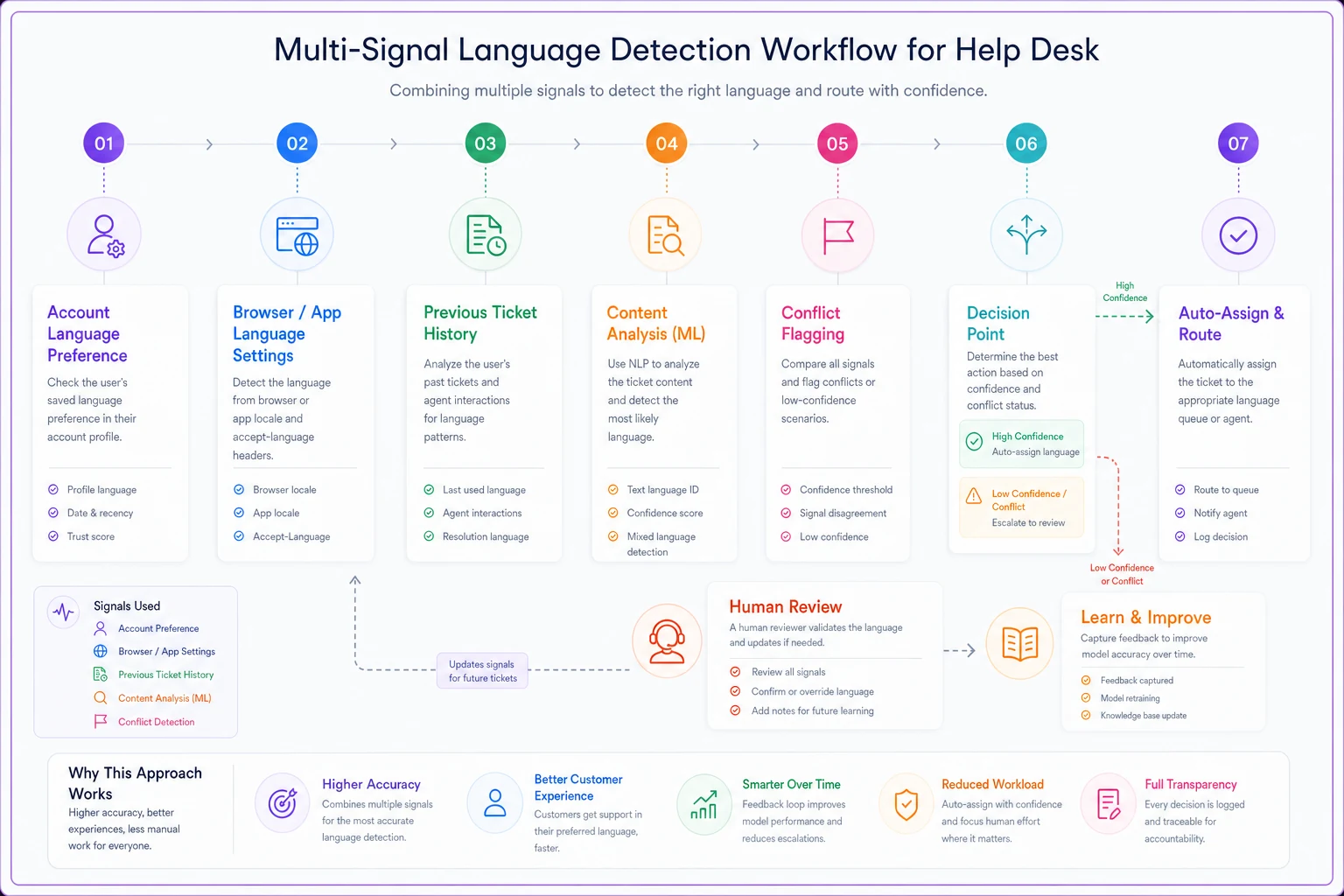
For mixed-language tickets, which are more common than most teams expect, detect the primary language but tag secondary ones. A ticket that starts in English and switches to Korean halfway through needs someone who can handle both, or at least understand what's actually happening.
Prioritized Routing Rules Based on Reality
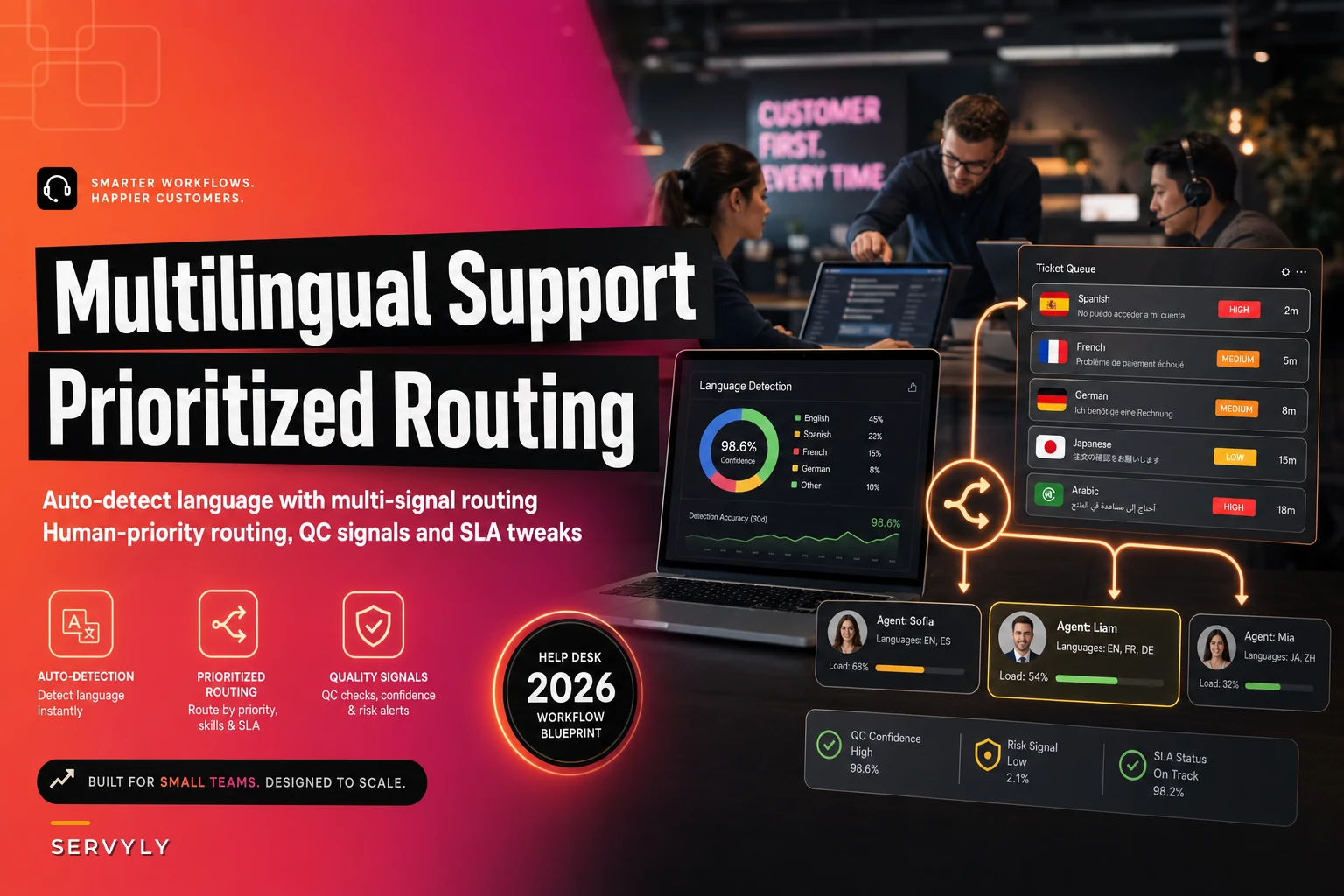
Traditional routing sends tickets to whoever's free. That's how your one Italian speaker ends up answering English tickets while Italian messages pile up. You need smarter routing logic.
Primary assignment rules:
-
Native speakers get first priority for their language
-
Fluent speakers get second priority
-
Conversational speakers only get simple, tagged inquiries (password resets, billing questions)
-
Never auto-assign complex technical issues to non-fluent agents
Overflow handling: When Spanish tickets spike but your Spanish speakers are swamped, don't just dump them on anyone available. Route overflow to agents with translation tools and templates, but flag these for quality review. Slower and correct beats faster and garbled.
Time-based escalation: If a Tier 1 language ticket sits for 2 hours, escalate. Tier 2 gets 8 hours. Tier 3 gets 24. Build these thresholds into your routing, not just your monitoring. The system should actively move tickets, not just send alerts nobody acts on.
Skills-based backup: Map your team's actual language capabilities. Not just "speaks Spanish" but something like "Spanish: billing/accounts (fluent), technical issues (conversational), legal/compliance (needs translation)." Route based on both language and topic complexity.
Quality Checks Without Grinding Everything to a Halt
Machine translation creates real liability. One mistranslated refund policy or warranty term could cost thousands. But you can't have native speakers review every response. Build proportional quality controls instead.
High-risk responses always get human review:
-
Anything involving refunds, legal terms, or account changes
-
Responses to escalated or previously frustrated customers
-
First response to a new customer
-
Anything with specific numbers, dates, or commitments
Sampling matters for the routine stuff. Review 10–15% of translated template responses weekly and look for patterns—maybe your French translations consistently mishandle conditional statements. Fix the templates, not individual responses.
When satisfaction scores dip on translated interactions, automatically flag those agents' next few translations for review. Don't wait for a pattern to become a problem.
Your Spanish speakers reviewing each other's complex responses once daily takes maybe five minutes but catches cultural tone issues machine translation misses entirely—the "technically correct but sounds rude in Mexican Spanish" kind of stuff.
SLA Adjustments That Keep Customers Happy
Stop pretending you can maintain the same SLA across all languages. Set realistic expectations.
| Language Tier | First Response SLA | Resolution SLA | Customer Expectation Setting |
|---|---|---|---|
| Tier 1 (High volume) | 2–4 hours | 24 hours | Standard automated confirmations |
| Tier 2 (Medium volume) | 8–12 hours | 48 hours | Language-specific explanation of timing |
| Tier 3 (Low volume) | 24 hours | 72 hours | Detailed explanation with translation note |
| Tier 4 (Rare) | 48 hours | 5 business days | Upfront explanation of translation process |
The key is communicating these differences. That auto-response to Finnish tickets should explain, in Finnish, that responses take longer due to translation requirements. Customers generally understand if you're transparent about it.
Translation Workflow Starter Templates
For teams just getting started, keep it simple. Build three core templates and use them consistently before you try anything fancier.
The Acknowledgment: "We've received your message and are translating it to ensure accurate assistance. Expected response time: [X hours based on tier]. For urgent issues, please note that in your reply."
The Clarification: "We want to make sure we understand correctly. Are you asking about [summarized understanding]? Please confirm so we can assist accurately."
The Resolution Confirmation: "We believe we've resolved your issue. If this translation hasn't fully addressed your concern, please reply with 'NO' and we'll escalate to a native speaker."
These buy time, set expectations, and create checkpoints before problems compound. Simple as that.
Real Scenario: How a 50-Person Support Team Fixed Their Language Chaos
An online marketplace with around 50 support agents was drowning. They supposedly supported 12 languages but anything besides English and Spanish was a disaster. Portuguese tickets sat for days. German customers complained about nonsensical responses. The one Mandarin speaker was burning out.
They implemented tiered coverage based on actual volume. English and Spanish got full Tier 1 treatment. Portuguese, French, and German became Tier 2 with hybrid human-translation workflows. Everything else moved to Tier 3 with adjusted SLAs.
The critical shift was stopping the pretense that all languages were equal. Portuguese tickets went from an impossible 2-hour SLA to a realistic 12-hour one. German technical issues got routed to English-speaking technical specialists using translation tools, with quality checks from their conversational German speakers.
Three months later, overall satisfaction had climbed from around 68% to 81%. Not because they hired more multilingual agents, but because they built honest workflows around their actual capabilities. Portuguese customers were happier with reliable 12-hour responses than broken promises of 2-hour responses that never materialized.
When This System Makes Sense vs. When It Doesn't
This tiered approach works when you have genuine language diversity—dozens of weekly tickets across four or more languages with occasional surprises. It's overkill if you're mostly English with rare Spanish inquiries. And it's not enough if you're handling hundreds of tickets in five or more languages daily—at that scale you need dedicated multilingual teams, not workflows.
Don't implement this if your team is smaller than ten people. The overhead of managing tiers and quality checks will overwhelm your actual support work. Pick two or three languages and use simple translation tools for everything else.
Skip it entirely if you're B2B with high-touch enterprise accounts. Those customers deserve native speakers or professional interpreters, not translation workflows. The risk of miscommunication costs far more than proper language support.
The Hidden Costs Nobody Calculates
Teams focus on response times but ignore the real costs of bad multilingual support. Every mistranslated response that escalates costs roughly three to four times more to resolve than getting it right initially. Your Spanish-speaking agents spending 20% of their time fixing bad translations aren't actually available for Spanish tickets.
There's also reputation damage in specific markets. Consistently mess up German support and word spreads in German forums that your company doesn't care about German customers. Those market-specific hits are hard to recover from.
The burnout factor is real too. That one Korean speaker handling every Korean ticket while also managing English support will quit. Then you have zero Korean coverage and start the expensive process of hiring someone multilingual in a tight labor market.
Building Competency Tracking That Reflects Reality
Stop marking agents as "speaks Spanish" or "doesn't speak Spanish." Build actual capability matrices.
-
Reading comprehension (can understand customer issues)
-
Writing ability (can compose clear responses)
-
Technical vocabulary (can explain product features accurately)
-
Cultural fluency (understands regional expressions and expectations)
-
Phone/chat comfort (some agents read and write well but struggle verbally)
Track these separately. Someone might read German perfectly but write at a third-grade level. They can understand and route tickets but shouldn't be drafting responses. This kind of granular tracking lets you use partial skills effectively instead of leaving them on the table.
Making AI-Powered Translation Actually Useful
Modern operational software can automatically detect languages, suggest routing, and pre-translate tickets for initial triage. The real value, though, comes from building translation memory—when your system learns that "facture" always means "invoice" in your specific context, not just "bill" or "receipt."
AI automation helps most with quality signals. Instead of manually reviewing every translation, the system flags responses that use unusual phrasing, have sentiment mismatches (original sounds frustrated but translation reads cheerful), or contain terms that previously caused confusion. Reviewers focus on genuinely risky translations rather than random sampling.
The practical benefit isn't replacing human language skills—it's extending them. Your conversational French speaker becomes far more effective with AI-assisted drafting and review tools. Your native Spanish speakers can handle more volume when routine inquiries come with high-quality automated translations they verify and send.
Multilingual support workflows aren't about perfect translation or native fluency in every language. They're about building operational systems that honestly match your capabilities to customer needs.
Stop pretending you can support every language equally. Build tiers, set realistic SLAs, and use translation tools strategically rather than desperately.
The teams that actually succeed with multilingual support accept their limitations and build smart workflows around them. They know a reliable 24-hour response in decent Portuguese beats a promised 2-hour response that never arrives. They understand that one overworked Italian speaker is worse than a solid translation workflow with quality checks.
Your customers don't expect perfection in every language. They expect consistency, honesty about your capabilities, and evidence that you're genuinely trying to help despite the language barrier. Build your workflows around that reality and you'll handle international tickets better than teams twice your size who are busy pretending to be something they're not.
Ready to transform your support operations?
Join 500+ support teams using Servyly to reduce resolution times, improve customer satisfaction, and boost team productivity.