


The worst version of an incident brief isn't the one that's late. It's the one that's three paragraphs of hedging, two Slack screenshots, and a sentence that says "we're looking into it" — sent to a VP who then forwards it to the board with their own guesses attached. By the time it reaches the top, the story has mutated into something you didn't say and can't walk back.
That's the real risk with executive communication during an incident. Not that leadership doesn't trust you — it's that in the absence of a clean, structured update, they fill the gap themselves. And their version is almost always worse than reality.
This post is about one artifact: the one-page executive incident brief. Not the war-room doc. Not the customer-facing status page. The internal brief support leadership sends upward while an incident is still unfolding. Get this right and you buy yourself room to actually fix the problem. Get it wrong and you spend the incident managing executives instead of the outage.
Why the exec brief falls apart (and it's usually not the writing)
The failure almost never happens because the support lead can't write. It happens because the brief is being authored reactively, mid-fire, by someone who's also running triage.
A typical sequence: an incident kicks off around 9:40am. The support manager is coordinating agents, watching ticket volume spike, and pinging engineering. At 10:15 a director messages: "What's going on? I'm getting asked." The manager drops everything, writes a hurried paragraph, sends it. At 10:40 another exec asks the same question in a different channel. Now there are two versions floating around, slightly inconsistent, and someone upstairs has noticed they don't match.
The inconsistency is what destroys trust — not the incident itself. Executives expect things to break. What they don't forgive is feeling like they're getting different stories depending on who they ask.
What you see across a lot of support orgs is that the brief gets treated as a message instead of a living document. A message is written once and sent. A document has a canonical location, a version, and a timestamp. The moment you switch from "I'll reply when asked" to "there's one brief, here's the link, it updates every 30 minutes," the chaos drops considerably.
The one-page structure that actually works
The format matters more than the prose. An exec reading this is scanning, not studying. They want five things, in this order, and they want them in the same place every single time so they can find them without reading the whole thing.
Never lose track of a customer request again.
Servyly helps you track, assign, and resolve every ticket quickly and efficiently.
- Centralized ticket management
- Automated response workflows
- Team collaboration tools
No credit card required
Here's the skeleton:
| Section | What it answers | Length target |
|---|---|---|
| Status line | Is this getting better or worse right now? | 1 line |
| Timeline | When did it start, what have we done, what's next? | 3–5 bullets |
| Impact | Who/how many customers, which segments, revenue exposure? | 2–4 bullets |
| Mitigations in flight | What's being done right now and by whom? | 2–3 bullets |
| Residual risk | What could still go wrong even after we fix it? | 1–2 lines |
The status line is the single most important thing on the page and the one most people skip. Executives want to know the trajectory before the detail. "Stable, mitigations holding, no new customer reports in 20 min" tells a VP everything they need to decide whether to interrupt their day. Burying that under a timeline forces them to reconstruct it, and reconstruction is where panic creeps in.
A quick note on residual risk, because it's the section people are most scared to write. There's a temptation to leave it blank or put "none expected" so the brief looks clean. Don't. Naming residual risk is what makes the rest of the brief credible. When you say "we've restored service but there's a chance the backlog reprocessing triggers duplicate notifications over the next two hours," you sound like someone in control. When you say everything's fine and then duplicate notifications go out, you've torched your credibility for the next incident too.
The brief follows a simple flow from status through to risk. Here's roughly how those five sections sequence during an active incident:
[ Status Line ] ↓ [ Timeline of events ] ↓ [ Impact (who, how many, which segments) ] ↓ [ Mitigations in flight ] ↓ [ Residual risk ]
Each section feeds the next. The status line gives trajectory; the timeline gives context; the impact section sizes the problem; mitigations show what's being done; residual risk is what keeps the brief honest.
Visual workflow of the brief:
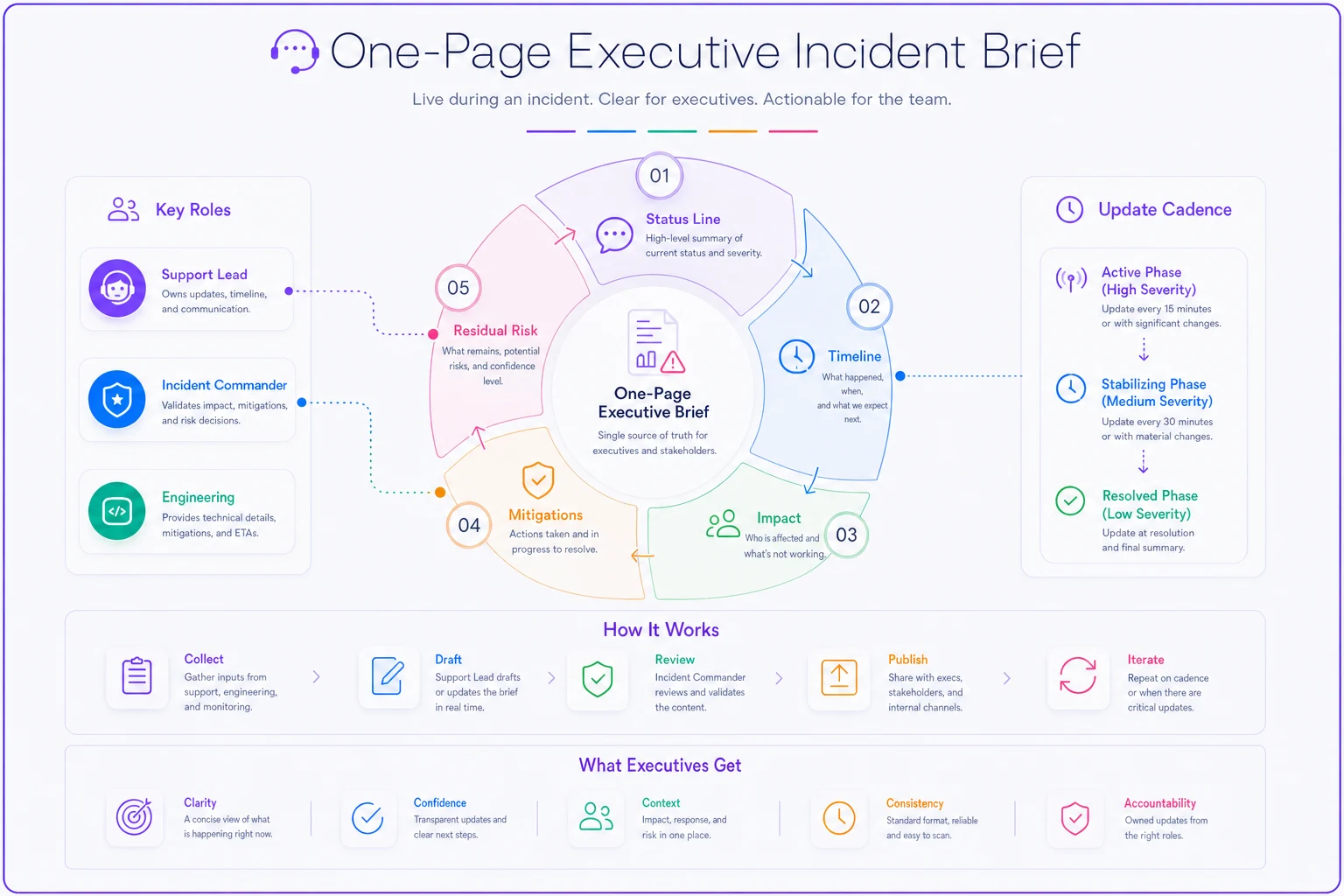
This diagram shows the sequence of sections and the roles responsible for updates.
Writing for the board without saying "board"
There's a specific flavor of language that survives being forwarded upward. The brief you write for a director will often get copy-pasted into a board update or an all-hands with zero edits. So write every brief as if the CEO might read it unedited — because they might.
That changes a few things:
-
No internal jargon. "P1" and "the Kafka consumer lag" mean nothing to a board member. "A high-severity outage affecting login for enterprise customers" does.
-
No blame, no names of individuals. Teams, not people. "The payments team is deploying a fix" is board-safe. "Dave pushed a bad config" is a lawsuit waiting to happen and makes support look petty.
-
Numbers with context, not raw counts. "1,200 affected tickets" means nothing. "Roughly 1,200 affected customers, about 8% of our active enterprise base" lets someone actually size the problem.
-
Commitments you can keep. Never write "resolved by noon" unless engineering has confirmed noon. Write "next update by 11:00" instead. You control the update cadence; you don't always control the fix.
The board-readiness test is simple: if this exact sentence appeared in a board deck next week, would it make you look careful or careless? If careless, rewrite it.
A worked example
Here's what a real brief looks like at the 45-minute mark of an incident. A mid-size B2B SaaS company, login outage hitting their SSO integration.
> *INCIDENT BRIEF — Login failures, enterprise SSO> > Status as of 10:25am ET — Update #2. Next update: 11:00am.* > > Status: Partially mitigated. New failure reports have slowed significantly in the last 15 minutes. Not yet fully resolved. > > Timeline: > - 9:38am — First reports of SSO login failures from enterprise accounts > - 9:52am — Confirmed outage, root cause isolated to an identity-provider config change > - 10:10am — Rollback initiated > - 10:22am — Rollback completing; login success rate climbing > > Impact: > - Affects enterprise SSO logins only. Standard email/password login unaffected. > - Roughly 40 enterprise accounts, ~15% of enterprise base. No data loss. > - Three of our top-20 accounts are among those affected; account teams notified. > > Mitigations in flight: > - Engineering completing rollback of the config change (ETA ~10 min). > - Support holding a canned, approved response for inbound tickets; no speculation on cause. > > Residual risk: > - Some users may need to clear cached sessions after fix; we expect a small second wave of tickets even after service restores. Monitoring for that.
Notice what that brief does. It never over-promises a resolution time. It names the three big accounts because leadership will ask about them, and getting ahead of that question is worth more than the thirty seconds it took to add the line.
Before this company standardized the format, incident updates were taking somewhere around 35–40 minutes to produce and going out inconsistently. After, the first brief was out inside 15 minutes and updates were basically fill-in-the-blank. The incidents didn't get shorter — but the "where are we at?" interruptions dropped sharply, which gave the support lead their focus back.
Escalation triggers: deciding *when* to send upward
Half the stress around exec briefs is the decision of whether to send one at all. Send too early and you look jumpy. Send too late and you look negligent. So remove the judgment call entirely by pre-defining triggers.
These should be agreed with leadership before any incident, written down, and treated as automatic. A reasonable starter set:
-
Any incident affecting a top-tier or named strategic account — brief goes out immediately, regardless of size.
-
Customer-facing impact lasting more than 30 minutes — brief goes out, even if the fix seems close.
-
Anything touching data integrity, billing, or security — brief goes out immediately, no matter how small the apparent blast radius.
-
Any incident where support volume is spiking faster than the team can triage — because that's a capacity signal leadership needs regardless of root cause.
-
Any public visibility — a customer tweets, it hits a status page, press asks. Brief goes out.
The point of pre-agreed triggers is that nobody has to defend the decision to escalate in the moment. "It hit the trigger, so I sent it" is a complete answer. That protects the support lead and means executives aren't surprised by a brief appearing — they already know the rules.
When you should NOT send a full exec brief
Not everything deserves the one-pager. Sending executive briefs for routine degradation trains leadership to ignore them, and an ignored brief is worse than no brief. Skip it when:
-
The issue resolves before it crosses any trigger threshold.
-
It affects a small, non-strategic slice of users with an obvious workaround.
-
It's a known, already-communicated maintenance window behaving as expected.
If you're sending exec briefs weekly for things that resolve themselves, the triggers are miscalibrated. The brief should feel meaningful when it lands.
The cadence rule that prevents the real damage
Most trust erosion during long incidents doesn't come from bad news. It comes from silence. An exec who got a brief at 10:00 and hears nothing by 11:30 assumes the worst — that it's spiraling and you're too underwater to surface.
So the brief commits to its own next update time, and you hit that time even if nothing changed. "No change since last update, mitigations still holding, next update at 12:00" is a perfectly good brief. It tells leadership you're on it. The discipline of hitting your own stated cadence does more for trust than any single piece of good news.
Assign brief-writing to someone who is not the incident commander. The commander runs the fix; a designated communicator owns the brief and the clock. On small teams where the same person wears both hats, the move is to set a hard timer and treat the update like any other mandatory step.
Most of the pre-work — the template, the trigger list, the approved customer-response language — should already be sitting in your incident runbook so you're filling blanks, not writing from scratch under pressure. If you've built out a gate-based release readiness system, the exec brief template belongs right next to your launch-day protocols, since launches are exactly when you'll need it most.
Tying it into your broader incident posture
The exec brief is one layer. It works best when it sits on top of an incident process that already produces clean inputs — so you're not scrambling to figure out impact numbers while also trying to communicate them. If your vendor failure and SLA recovery process already tracks blast radius and affected segments, the brief practically writes itself from data you're already capturing.
That's the real unlock. A good brief isn't a writing exercise performed in isolation. It's a thin presentation layer over information your incident process should already be surfacing. When the underlying tracking is solid, filling the one-pager takes a few minutes. When it isn't, you'll feel the brief as pure overhead — which is usually a sign your incident process, not your writing, needs work.
Think about what that means structurally. If every incident requires you to manually piece together ticket counts, affected segments, and a timeline of actions before you can even start writing, your ops setup is the bottleneck. The brief is just exposing it.
Where tooling quietly helps
The part worth automating isn't the writing — it's the assembly. Pulling the affected ticket count, the segment breakdown, and the timeline of actions into one place is tedious and error-prone when done by hand mid-incident. Operational platforms with AI-assisted summarization can draft the impact and timeline sections from your ticketing and incident data, so the support lead is editing and approving rather than composing from scratch. The human still owns the status line, the residual-risk judgment, and the board-safe phrasing — those require context no system has. But shaving the mechanical assembly off the front of the process is often the difference between a brief that goes out in 15 minutes and one that goes out in 40.
Keep the human in the loop on anything that implies a commitment or a risk assessment. A drafted timeline is helpful. An auto-sent "resolved" message that turns out to be wrong is a trust disaster. The tooling should get you to a first draft faster, not send on your behalf.
The short version
An executive incident brief earns its keep in the moments when everyone's anxious and attention is scarce. The format should be boring and identical every time — so execs can read it in ten seconds and so you can fill it fast under pressure. Commit to a cadence and hit it even with no news. Name your residual risk honestly. Write every line as if it'll end up in front of the board, because it might.
Do that consistently and something shifts over time: leadership stops interrupting your incidents to ask what's happening, because they already know a clean brief is coming. That earned silence — the trust that you've got it handled — is the whole point.
An executive incident brief earns its keep in the moments when everyone's anxious and attention is scarce. The format should be boring and identical every time — so execs can read it in ten seconds and so you can fill it fast under pressure. Commit to a cadence and hit it even with no news. Name your residual risk honestly. Write every line as if it'll end up in front of the board, because it might.
Do that consistently and something shifts over time: leadership stops interrupting your incidents to ask what's happening, because they already know a clean brief is coming. That earned silence — the trust that you've got it handled — is the whole point.
Ready to transform your support operations?
Join 500+ support teams using Servyly to reduce resolution times, improve customer satisfaction, and boost team productivity.