

Most enterprise support contracts fall apart in the exact same place: the gap between what the legal document promises and what the support floor can actually execute on a Tuesday afternoon. The MSA says "99.5% first-response within 1 hour for Priority-1." The renewal deck says "24/7 named engineer coverage." And then a P1 hits at 2am in APAC, the runbook is three versions out of date, and nobody can find the person who's supposedly on the hook.
The problem isn't the numbers in the contract. It's that the operational side was never written. What most teams sign is a legal artifact with SLA percentages bolted on. What they need is an operational contract — commitments mapped to runnable processes, with acceptance tests that prove the process exists before anyone signs.
This is about the operational half of enterprise support contract design: the pieces that make the promises real. Not indemnification clauses. Not limitation of liability. The runbooks, the escrow, the acceptance tests, and the KPIs that a support manager actually has to deliver against.
The failure mode nobody puts in the contract
Here's the pattern that shows up over and over in real support operations.
A vendor wins a big enterprise account. Sales negotiates aggressive SLAs to close the deal — 15-minute P1 response, root-cause within 48 hours, dedicated Slack channel. The contract gets signed. Legal is happy. The AE gets their commission.
Then the account transitions to the support team, who was never in the room. They inherit SLA numbers with no attached process. Nobody defined what "root-cause within 48 hours" actually means operationally — is that a written RCA document? A verbal readout? Who owns it? What happens when the root cause is in a third-party dependency the support team doesn't even control?
Six weeks later the customer's CTO is escalating because a P1 dragged for nine hours and the "15-minute response" was an automated bot acknowledgment. Technically the SLA was met. Operationally, the relationship is on fire.
The core issue: the contract committed to outcomes without committing to processes. And outcomes without runnable processes behind them are just aspirations with a penalty clause attached.
What an operational contract component actually looks like
A real operational commitment has four moving parts that a normal support contract usually skips entirely. Each one matters, so let me break them down.
Never lose track of a customer request again.
Servyly helps you track, assign, and resolve every ticket quickly and efficiently.
- Centralized ticket management
- Automated response workflows
- Team collaboration tools
No credit card required
1. Playbook escrow
Playbook escrow is the practice of committing your operational runbooks — the actual step-by-step response procedures — as a versioned, referenceable part of the contract relationship. Not the contract text itself, but a linked, maintained set of playbooks both sides can point to.
Why does this matter? Because "we'll respond to P1s within 15 minutes" means nothing if the how changes silently. When a vendor reorganizes their on-call rotation, swaps tooling, or loses the two engineers who actually knew how to handle the customer's edge cases, the SLA number stays the same but the delivery quietly degrades.
In practice, playbook escrow looks like this: the vendor maintains a set of named runbooks (P1 triage, data-loss incident, auth outage, escalation-to-engineering), each versioned with a last-reviewed date. The customer gets read access — or at minimum, a quarterly attestation that the runbooks exist and were actually tested. When the vendor changes a critical procedure, that's a tracked event, not something discovered mid-incident.
The mistake most teams make is treating runbooks as internal-only documents that never surface in the commercial relationship. If your customer is paying for guaranteed response, the mechanism of that response is part of what they bought. Escrowing it keeps both sides honest.
2. Runbook SLAs (not just response SLAs)
Most contracts commit to response and resolution SLAs. Almost none commit to runbook SLAs — meaning, commitments about the operational machinery itself.
A runbook SLA is a promise about the process, not just the outcome. Examples:
-
Every P1 runbook is reviewed and re-tested at least once per quarter
-
Any runbook referenced during a live incident is updated within 5 business days if it was found to be inaccurate
-
On-call rotation for named accounts never drops below two qualified engineers per shift
-
Every new critical failure mode gets a runbook within 10 business days of first occurrence
These sound boring. They're also the difference between an SLA that holds up over 18 months and one that decays the moment the original team turns over. If you've dealt with organizational breakdowns as teams scale, you already know the process quietly rots long before the metrics show it. Runbook SLAs are how you catch the rot before the customer does.
Tie runbook review dates to on-call rotations so reviewers have recent hands-on context during updates.
3. Acceptance tests
This is the piece almost every support contract is missing, and probably the most valuable one.
An acceptance test is a runnable proof that the operational commitment works before it's needed in anger. In software procurement, acceptance testing is completely normal — you don't accept delivery until the thing passes tests. In support contracts, it's almost unheard of, which is strange when you think about it, because support is entirely operational.
A typical acceptance test for a support SLA looks like a scheduled fire drill:
-
The customer (or a neutral party) triggers a synthetic P1 through the real intake channel
-
The clock starts
-
The vendor's on-call has to acknowledge, triage, follow the escrowed runbook, and produce the artifacts the contract promises (RCA doc, status updates at committed cadence, resolution)
-
Everything is timed and logged against the contracted SLA
Run this at signing, then quarterly. The first one almost always fails in some embarrassing way — the pager didn't route correctly, the runbook pointed to a deprecated tool, the "dedicated channel" wasn't monitored on weekends. That's the point. You want to find the gap in a drill, not during the customer's actual outage.
4. Operational KPIs mapped to runnable processes
Contracts love KPIs. The trap is committing to KPIs that aren't attached to any process that can actually move them.
"Maintain CSAT above 90%" is a wish, not a commitment, unless there's a defined process producing and defending that number. A properly mapped KPI looks like this instead:
| Contracted KPI | Runnable process behind it | Owner | How it's measured |
|---|---|---|---|
| P1 ack ≤ 15 min | Auto-paging + primary/secondary on-call runbook | On-call lead | Timestamp from intake to human ack |
| RCA within 48h | Post-incident RCA template + review gate | Incident owner | RCA doc timestamp vs. incident close |
| Runbook freshness ≥ quarterly | Scheduled runbook review cycle | Support ops manager | Last-reviewed date per runbook |
| Reopen rate < 8% on P1 | Closure checklist + QA trigger | QA reviewer | Reopens / total P1 closures |
Every row has a process, an owner, and a measurement source. If any of those three is blank, you don't have a commitment — you have a number you'll be arguing about during the QBR.
A worked example: what "guaranteed" should actually mean
Consider a mid-market infrastructure vendor — roughly $30M ARR — with about a dozen enterprise accounts on premium support tiers. Each carried a contract promising 15-minute P1 response and 24/7 coverage.
Before they fixed the operational side, here's what their reality looked like across two quarters:
-
P1 acknowledgment median was fine, around 11 minutes, but the 90th percentile sat closer to 40 minutes — meaning the worst cases, which are exactly the ones that trigger executive escalations, blew the SLA regularly
-
Three of their named-account runbooks hadn't been touched in over a year
-
No acceptance testing existed; SLA compliance was self-reported and nobody was checking the tail
They added four things: escrowed runbooks per premium account, a runbook-freshness SLA, quarterly synthetic-P1 acceptance drills, and a mapped KPI table like the one above.
The first acceptance drill failed. Secondary on-call wasn't configured to page after hours, so the "24/7" promise had a real gap somewhere between 1am and 6am local time. That gap had existed silently for months and would've surfaced during a customer's actual middle-of-the-night outage.
After two quarters of running drills and enforcing runbook freshness, the 90th-percentile P1 ack came down into the high teens of minutes. More importantly, the executive escalations tied to "you missed your SLA" basically stopped — not because the median improved much, but because the tail got fixed and the process behind the number became real.
The contract number was never the problem. The unmeasured, untested process behind it was.
Writing the operational half: a process you can follow
If you're a support manager inheriting contracts that sales already negotiated, here's how to retrofit operational commitments without renegotiating the whole MSA.
-
Inventory every SLA number across your enterprise contracts. List them plainly: what's promised, to whom, at what severity.
-
For each number, find the process. If there's a runbook, link it. If there isn't, that number is unbacked — flag it.
-
Assign an owner to every commitment. Not a team. A named role. "Support ops manager" is fine; "the support team" is not.
-
Define the measurement source. Where does the timestamp come from? Can you pull the 90th percentile, or only the median? If you can only see the median, you're blind to exactly the cases that breach.
-
Write runbook SLAs for the critical playbooks. Freshness cadence, update-after-incident windows, minimum on-call depth.
-
Schedule the first acceptance drill. Synthetic P1, real channel, real clock. Expect it to fail. Log what broke.
-
Set the escrow cadence. Quarterly attestation that runbooks exist, were reviewed, and passed their last drill.
No lawyer in that list. It's operational plumbing, and it's entirely within a support manager's control to build even after the ink is dry.
Below is a simple workflow diagram you can use to align teams and artifacts before running your first drill.
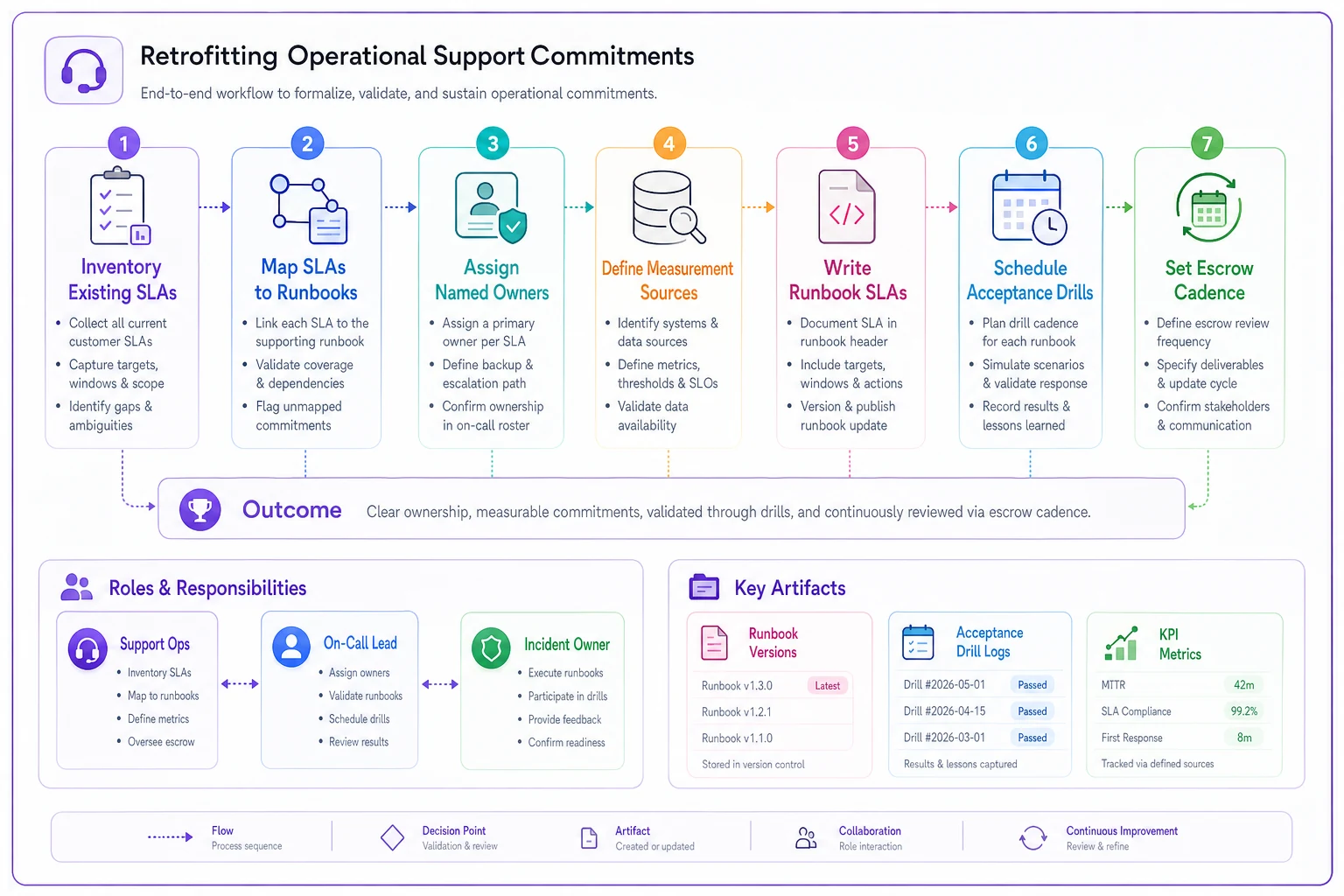
Use this process as a pragmatic sequence: inventory → map → assign → measure → test → escrow.
A checklist for whether your contract is operationally real
Run your current enterprise contracts against this. If you can't check the box, you have exposure.
-
[ ] Every SLA number maps to a specific, documented runbook
-
[ ] Each commitment has a single named owner role
-
[ ] You can measure the tail (P90/P95), not just the median
-
[ ] Critical runbooks have a defined freshness/review cadence
-
[ ] On-call depth for named accounts is contractually floored (never one-deep)
-
[ ] A synthetic incident drill has been run in the last quarter
-
[ ] The last drill's failures were logged and remediated
-
[ ] "24/7" coverage has been tested during the actual overnight window
-
[ ] RCA commitments specify format, owner, and deadline — not just "we'll investigate"
-
[ ] Reopen and QA processes back any quality-related KPI
Most teams check three or four of these on their first pass. That's normal. The value is in the gaps you find.
When this level of rigor makes sense — and when it doesn't
This is real work. It isn't worth doing for every contract.
When it makes sense: Named enterprise accounts with negotiated SLAs, penalty clauses, or revenue significant enough that a churn event genuinely hurts. Anything where an executive on the customer side will personally escalate. Anything where "24/7" or sub-30-minute response is promised, because those are the commitments most likely to have silent gaps.
When it's overkill: Standard-tier support with published, generic SLAs that apply to everyone. If you're committing to a 1-business-day response for a self-serve customer base, you don't need escrowed playbooks and quarterly acceptance drills. You need good segment-based SLAs and automated breach signals, and that's a different, lighter apparatus.
Who should not do this: Teams that haven't yet defined their runbooks at all. If you don't have documented incident procedures, don't start by writing them into contracts — that just locks in commitments you can't run. Build the operational baseline first, then commit to it externally. Signing operational SLAs before you can execute them is how you turn an internal gap into a breach-of-contract problem.
The point most teams miss
Enterprise support contracts fail operationally because they're written by people who don't run the operation, and run by people who never saw the contract. The commercial and operational halves live in separate documents, separate departments, separate heads.
Closing that gap doesn't require better lawyers. It requires treating operational commitments as first-class, testable, owned things — playbooks you can point to, runbooks with their own SLAs, acceptance tests that fail loudly in drills instead of quietly in production, and KPIs wired to processes that can actually move them.
Get that right and the SLA percentages in the contract stop being a liability you hope you never have to defend, and start being a description of something your team can genuinely do. Which is the only kind of guarantee worth signing.
Enterprise support contracts fail operationally because they're written by people who don't run the operation, and run by people who never saw the contract. The commercial and operational halves live in separate documents, separate departments, separate heads.
Closing that gap doesn't require better lawyers. It requires treating operational commitments as first-class, testable, owned things — playbooks you can point to, runbooks with their own SLAs, acceptance tests that fail loudly in drills instead of quietly in production, and KPIs wired to processes that can actually move them.
Get that right and the SLA percentages in the contract stop being a liability you hope you never have to defend, and start being a description of something your team can genuinely do. Which is the only kind of guarantee worth signing.
Ready to transform your support operations?
Join 500+ support teams using Servyly to reduce resolution times, improve customer satisfaction, and boost team productivity.