

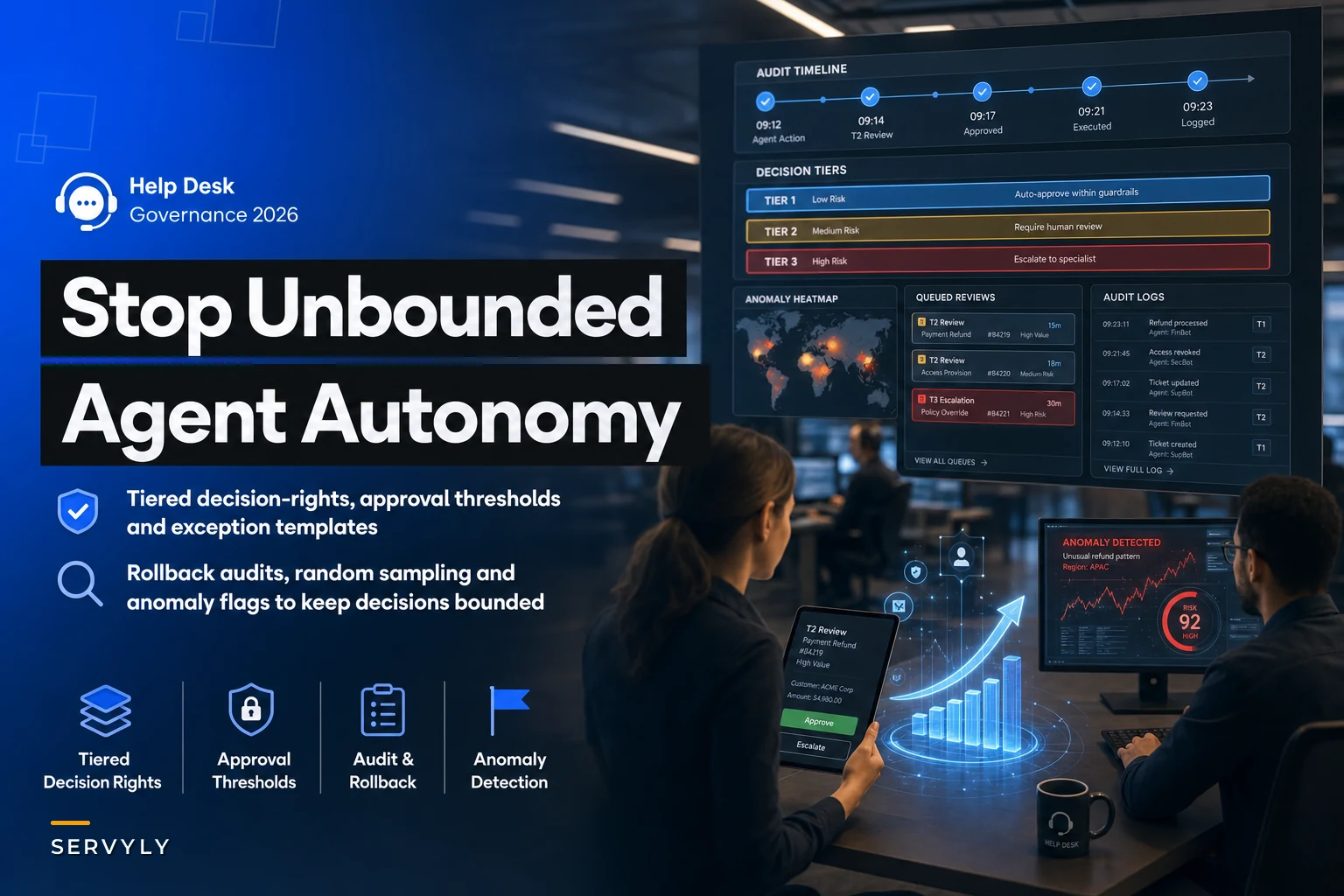

There's a specific failure mode that happens when support leaders decide to "empower" their teams. It usually starts with a good instinct — stop making agents ask permission for every $12 refund — and ends three months later with a finance team asking why credit issuance jumped 40% and nobody can explain which decisions were justified.
The problem isn't empowerment. It's empowerment without boundaries. What most teams call an agent empowerment playbook is really just a Slack message that says "use your judgment," which is neither a playbook nor empowerment. It's abdication with extra steps.
The fix is boring on purpose: bounded decision-rights, tiered autonomy, and rollback audits that make decentralization safe instead of scary.
Why "use your judgment" quietly destroys consistency
Judgment isn't a policy. Two agents with identical training will resolve the same edge case differently — one refunds fully, one offers a 20% credit, one escalates. None of them are exactly wrong, but the variance is the problem. Customers talk. When a churned customer gets a full refund and a loyal one gets a partial credit for the same issue, you've created a fairness problem you'll mostly never hear about directly.
Unbounded discretion doesn't produce reckless agents — it produces anxious ones. When there's no clear line, agents over-escalate to protect themselves. So you get the worst of both worlds: inconsistent outcomes on the low-risk stuff and clogged escalation queues because nobody's sure what they're allowed to handle alone.
A support lead at a mid-size SaaS company described their pre-framework state well: every refund over $50 pinged a manager. That manager approved 96% of them without changes. The approval step wasn't controlling risk — it was adding a 4-hour delay to decisions that were going to be yes anyway. That's not governance. That's a bottleneck cosplaying as governance.
The core idea: decision-rights as tiers, not permissions
Stop thinking about who is allowed to do things and start thinking about which decisions carry which risk, then attach autonomy to the risk level — not seniority.
Never lose track of a customer request again.
Servyly helps you track, assign, and resolve every ticket quickly and efficiently.
- Centralized ticket management
- Automated response workflows
- Team collaboration tools
No credit card required
-
What's the maximum impact of this decision if it's wrong?
-
Who can make it without asking?
-
What evidence gets logged so we can review it later?
When you frame it that way, most support decisions collapse into three or four tiers. The vast majority — password resets, shipping reissues, small goodwill credits — are genuinely low-risk and should never touch a manager's queue.
| Tier | Decision type | Example | Autonomy level | Audit requirement |
|---|---|---|---|---|
| T0 | No financial impact | Resend receipt, reset password, update address | Any agent, no approval | Logged, no review |
| T1 | Low-value goodwill | Refund/credit up to ~$50, expedite shipping | Any agent, no approval | Logged, sampled weekly |
| T2 | Moderate impact | Refund up to ~$250, partial contract credit | Agent + reason code required | 100% reviewed within 7 days |
| T3 | High impact / precedent-setting | Full refund on annual plan, policy exception | Senior agent or lead approval | Reviewed + logged as precedent |
| T4 | Legal / contractual / brand risk | Chargebacks, data deletion, media-adjacent | Manager + cross-functional | Full review, mandatory |
The thresholds are illustrative — a company with a $9/mo product should set T2 far lower than one selling $40k contracts. The structure is what transfers. T0 and T1 combined usually cover somewhere around 70–80% of daily decisions. That's the whole point: get routine stuff out of the approval pipeline entirely, and save human review for the tiers where it actually earns its cost.
Approval thresholds: where teams set the line wrong
The most common mistake is setting thresholds based on fear instead of data. Someone once got burned by a $400 refund, so now everything over $100 needs sign-off. That one incident is now taxing thousands of legitimate decisions.
Pull your last 90 days of refunds and credits and look at the actual distribution. In most teams it's heavily skewed — a big cluster of small amounts and a thin tail of large ones. Your T1 ceiling should sit right at the top of that dense cluster. If 78% of your refunds are under $50, then $50 is a natural, defensible T1 line. You're auto-approving what you were already approving anyway.
A quick sanity check on any threshold: if your approval rate on a given tier is above 90%, the approval step is theater. Either lower the tier so agents own it outright, or figure out what reviewers are actually catching in that remaining 10% and encode that as a rule.
Every unnecessary approval hop has a real dollar value in delayed resolution and manager time — worth modeling before you set any threshold. If you haven't put numbers to it, Quantify the Cost of Escalations: A Simple Routing ROI Model, Decision Thresholds and Worked Examples gives you a way to price the bottleneck you're trying to remove.
Sample exception and refund templates
Bounded autonomy only works if the reason travels with the decision. An unexplained refund is useless in an audit. A refund with a reason code and one line of context is something you can actually learn from.
Keep templates short. If logging a decision takes more than 15 seconds, agents will route around it. Here's the format that sticks:
T1 goodwill credit (no approval):
> Reason code: SHIPDELAYGOODWILL
> Amount: $25
> Context: Order arrived 6 days late, first-time issue for this customer.
> Rollback flag: N
T2 refund (reason code + logged):
> Reason code: BILLINGERRORCONFIRMED
> Amount: $180
> Context: Double-charged on renewal, confirmed in billing log. Refunded duplicate charge.
> Rollback flag: N
T3 exception (approved, precedent-setting):
> Reason code: POLICYEXCEPTIONRETENTION
> Amount: $890 (annual plan, pro-rated)
> Context: Customer cited undocumented downtime. Approved by lead. Flagging as precedent — if this recurs, we need a policy.
> Rollback flag: Y — revisit if churn signal persists.
That last line — the precedent flag — is what most teams miss. A T3 decision that keeps recurring isn't an exception anymore. It's a policy gap. Your reason codes are the early warning system telling you which "exceptions" have quietly become the norm.
Rollback audits: the part that makes decentralization safe
You don't need to prevent every mistake if you can catch and reverse them fast. Rollback audits are what let you loosen the front end without losing control of outcomes.
A rollback audit isn't a witch hunt. It's a scheduled, sampled review of low-tier decisions and a full review of high-tier ones, with the ability to reverse a decision or — more importantly — patch the rule that produced it.
The workflow in practice:
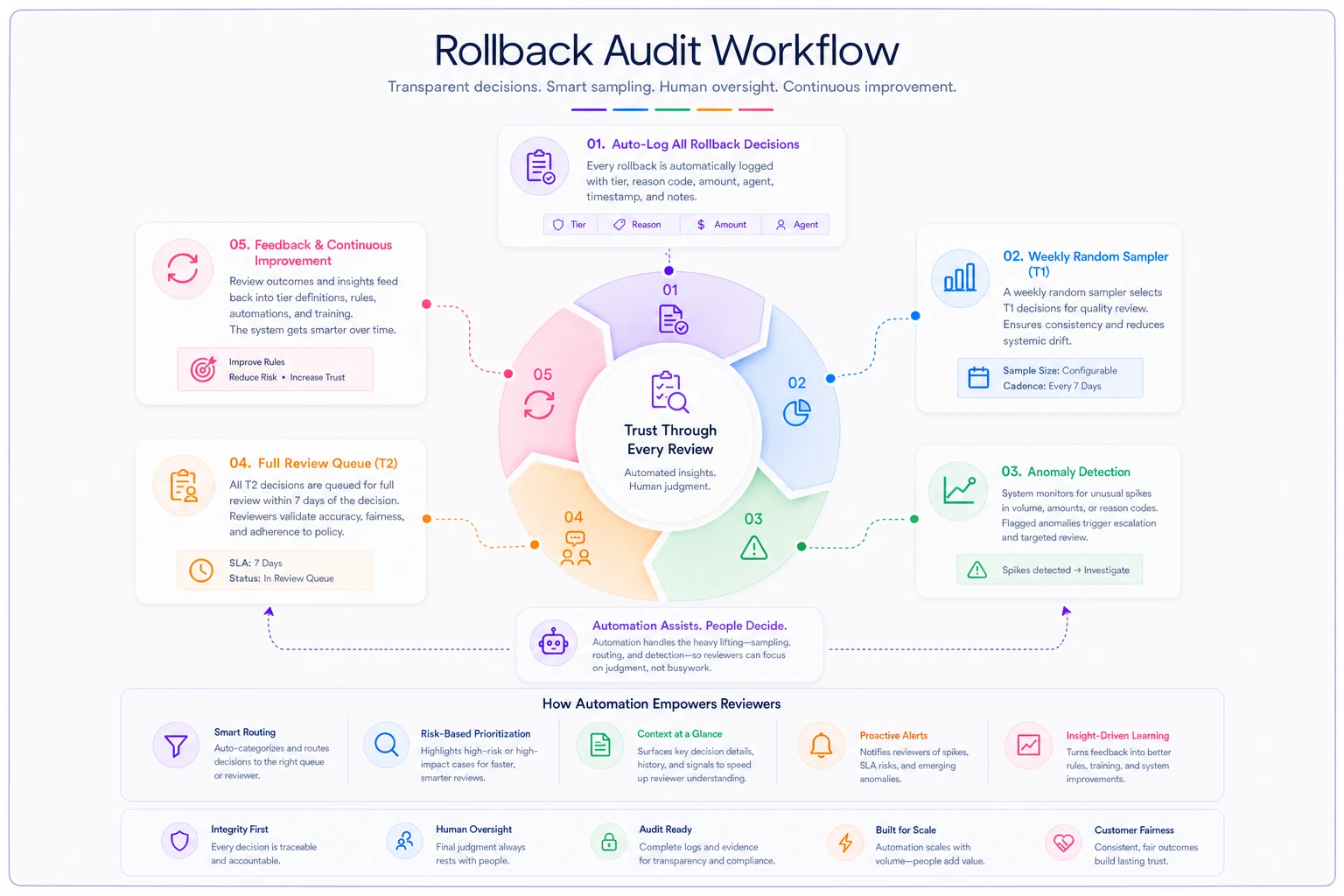
Here's a simple visualization of that audit workflow.
-
Every decision logs automatically with tier, reason code, amount, and agent.
-
T1 decisions get sampled weekly — pull around 10% at random and check whether the reason code matched the action.
-
T2 decisions get reviewed in full within a week, batched so a lead spends maybe 30 minutes on the whole set rather than interrupting live work.
-
Flag anomalies, not individuals. If one reason code spikes, that's a training or policy signal, not a performance problem for one person.
-
Feed corrections back into the tiers. A pattern of misapplied T2 codes might mean the threshold is wrong or the definition is fuzzy.
The goal of the audit is to shrink itself over time. If your weekly sample keeps coming back clean, widen the tier and reduce sampling frequency. If it keeps surfacing the same confusion, tighten the definition. The audit is a feedback loop, not a permanent tax.
Modern help desk and workflow platforms can carry most of the mechanical weight here — auto-logging every refund with its reason code, sampling a random slice for review, flagging when a reason code spikes past its normal range. That's the right use of automation in this context: not deciding for the agent, but making the audit trail cheap enough that decentralization stays honest. When the logging and anomaly-flagging run in the background, reviewers spend their time on actual judgment calls instead of assembling spreadsheets.
Automate logging and sampling early so audits stay lightweight and scalable.
When the logging and anomaly-flagging run in the background, reviewers spend their time on actual judgment calls instead of assembling spreadsheets.
When this framework actually makes sense
Tiered autonomy pays off when you have enough decision volume that approval bottlenecks are visibly slowing resolution — usually once you're past a handful of agents and a few hundred tickets a week. Below that, building tiers might cost more effort than the friction you'd remove.
It also makes sense when your decisions are repeatable. Refunds, credits, shipping fixes, standard exceptions — these fit tiers well because they come up constantly. The framework earns its keep on volume of similar decisions.
When this is a bad idea
If nearly every support decision is genuinely novel — bespoke enterprise contracts, one-off legal negotiations — tiers add ceremony without payoff. You can't pre-classify decisions that never look alike.
It's also premature if your reason-code discipline doesn't exist yet. Tiers depend on clean, consistent logging. Get agents comfortable dropping a reason code on every action first, then layer tiers on top. Skip that order and your audits will be reviewing garbage.
Who should NOT roll this out yet
There are a few organizational signs this isn't ready for you yet.
-
Teams with no reliable way to log a decision and its reason in one place. Tiers without an audit trail are just vibes with extra paperwork.
-
Orgs where managers can't resist overriding agent decisions on the low tiers. If leaders keep reaching into T1, agents learn the tiers are fake and revert to asking permission for everything.
-
Teams that haven't defined what "wrong" looks like for each tier. If you can't articulate the failure mode you're worried about, you can't set a sensible threshold or audit rule.
If any of those describe your org, fix the foundation first: logging, discipline, and clear failure definitions.
A real scenario
A subscription e-commerce company — around 11 support agents, roughly 2,400 tickets a month — was routing every refund and credit through a two-person lead team. Approval turnaround averaged close to 5 hours during busy stretches, and the leads were spending somewhere around 12–15 hours a week just approving small refunds that they almost never changed.
They mapped their last quarter of refunds and found about 74% sat under $40. So they set T1 at $40 with no approval, T2 at $200 with a reason code and weekly batch review, and kept everything above that with lead sign-off. Reason codes were mandatory on every action from day one.
Over the next two months: refund turnaround on the low tier dropped from hours to essentially immediate. Lead time spent on approvals fell to roughly 3–4 hours a week, now concentrated on batch reviews and genuine T3 exceptions. And the part they didn't expect — total refund dollars went down slightly, not up. Because agents had to log a reason code, the reflexive "just refund it to make them go away" decisions dropped. The friction of naming a reason turned out to be a mild governance mechanism on its own.
The one thing the audit caught early: a spike in a LATE_DELIVERY credit code that traced back to a single carrier's regional delays. Not an agent issue at all — an operations signal that only surfaced because every decision carried a reason.
Tying autonomy to quality, not just risk
Tiered autonomy assumes your agents can be trusted at the tiers you assign them — and that trust should be earned and measured, not granted by tenure alone. The reason codes and audit results become natural inputs into how you evaluate and promote people. An agent whose T2 decisions consistently pass review is demonstrating exactly the judgment that justifies wider autonomy.
If you're building the evaluation side of this, the rubrics and promotion criteria in the Operational Agent Quality Program: Rubrics, Calibration Artifacts and HR‑Friendly Promotion Criteria pair cleanly with the tier structure here — one defines what agents are allowed to decide, the other defines how they earn wider latitude.
The takeaway
Empowerment without boundaries isn't generosity — it's a slow-motion consistency and cost problem that surfaces in a finance review months later. Bounded decision-rights fix that by matching autonomy to risk, encoding reasoning in lightweight templates, and using rollback audits as a feedback loop that catches mistakes cheaply instead of preventing them expensively.
Start narrow. Pull your refund distribution, set one honest T1 threshold at the top of the dense cluster, make reason codes mandatory, and sample the results weekly. You'll remove the bottleneck on the 70% of decisions that never needed a manager — and finally get real visibility into the 30% that do.
Ready to transform your support operations?
Join 500+ support teams using Servyly to reduce resolution times, improve customer satisfaction, and boost team productivity.