



The Fed's decision to hold rates steady while signaling at least one more hike later this year just shifted the calculus for support operations. If you're running a support team right now, you're probably staring at your Q3 budget trying to figure out how to make the numbers work.
What's actually happening is pretty straightforward: companies are freezing headcount, cutting tool budgets, and still expecting the same SLA performance. Support managers are stuck between CFOs demanding lower costs and customers expecting faster resolution. The math doesn't add up, and everyone in the room knows it.
Back in 2022, when rates started climbing, support teams that adapted their operations made it through. The ones that just pushed harder with fewer people burned out their best agents within six months. This time the pressure is worse, because customer expectations have only gone up since then.
The Real Cost Structure Nobody Talks About
Most support managers assume salaries are their biggest expense. Run the actual numbers and you'll usually find something different.
A typical 20-person support team handling around 8,000 tickets a month looks roughly like this:
| Cost Category | Monthly Amount | % of Total | What Actually Drives It |
|---|---|---|---|
| Base Salaries | $85,000–$95,000 | 62% | Market rates, not performance |
| Tools & Software | $18,000–$22,000 | 14% | Per-seat pricing models |
| Overtime & Coverage | $12,000–$15,000 | 10% | Unpredictable ticket spikes |
| Training & Ramp Time | $8,000–$11,000 | 7% | Agent turnover rate |
| Quality & Management | $9,000–$12,000 | 7% | Manual review processes |
The kicker is what happens when you cut. Companies tend to trim the visible costs first — headcount and tools. But overtime and training costs actually increase when you run lean. A team that drops from 20 to 16 agents doesn't save 20%. It saves maybe 12% while response times crater and your best agents start updating their LinkedIn profiles.
Why Traditional Staffing Models Break in This Environment
Support staffing has always been a guessing game. You forecast ticket volume, add a buffer, and hope nothing weird happens. Except weird things happen constantly.
Never lose track of a customer request again.
Servyly helps you track, assign, and resolve every ticket quickly and efficiently.
- Centralized ticket management
- Automated response workflows
- Team collaboration tools
No credit card required
A B2B software company staffed for 350 tickets per day based on historical averages. Then their biggest competitor had an outage, sending 200 panicked prospects their way in 48 hours. Response time went from 2 hours to 14. By the time they recovered, they'd lost around eight trial conversions — roughly $180k in potential ARR.
The traditional model assumes predictable volume, stable staffing, and consistent complexity. None of those hold when economic pressure hits. Customers get anxious and generate more tickets. Your best agents get recruited away by companies still hiring. Simple issues become complex because customers are trying to squeeze more value out of existing tools instead of buying new ones.
This creates a cycle most support leaders recognize pretty fast:
-
Budget cuts force headcount reduction
-
Remaining agents handle more tickets
-
Quality drops, creating repeat contacts
-
Good agents burn out and leave
-
Hiring and training costs spike
-
Performance metrics tank
-
More budget pressure follows
This creates a cycle most support leaders recognize pretty fast:
Building Elastic Support Operations
The answer isn't hiring more people — that's not happening in this environment. It's building support operations that expand and contract based on actual demand.
Start with ticket deflection, but not the way most teams approach it. Everyone throws up a knowledge base and calls it done. Real deflection happens when you identify the 20% of issues driving 80% of your volume and systematically keep them from reaching agents at all.
Real deflection happens when you identify the 20% of issues driving 80% of your volume and systematically keep them from reaching agents at all.
One consumer app company tracked every ticket for two months and found 31% were password resets, 18% were billing questions about the same three scenarios, and 14% were basic "how do I" questions about features that already existed. They didn't just write help articles — they rebuilt the password reset flow, added inline billing explanations, and created interactive feature tours. Ticket volume dropped 42% in ten weeks.
Next, segment your ticket flow by actual complexity, not just priority. Most teams treat every ticket like it needs the same level of skill. That's like having senior engineers handle IT password resets.
A cleaner model:
-
Level 0
Fully Automated
- Password resets - Order status checks - Account balance inquiries - Business hours questions - Shipping estimates -
Level 1
Template + Light Personalization
- Standard troubleshooting (first 3 steps) - Policy explanations - Feature availability questions - Basic billing adjustments - Account access issues -
Level 2
Agent Problem-Solving
- Complex troubleshooting - Escalated complaints - Custom billing situations - Technical integrations - Bug reports requiring investigation -
Level 3
Specialist Territory
- Engineering escalations - Enterprise account issues - Legal/compliance matters - Product partnerships - Executive escalations
The real value is accurate routing. Level 0 and Level 1 tickets shouldn't touch your experienced agents at all. AI-powered operational software handles the predictable volume, which frees your best people for actual problem-solving.
The workflow below shows how tickets move through Levels 0–3.
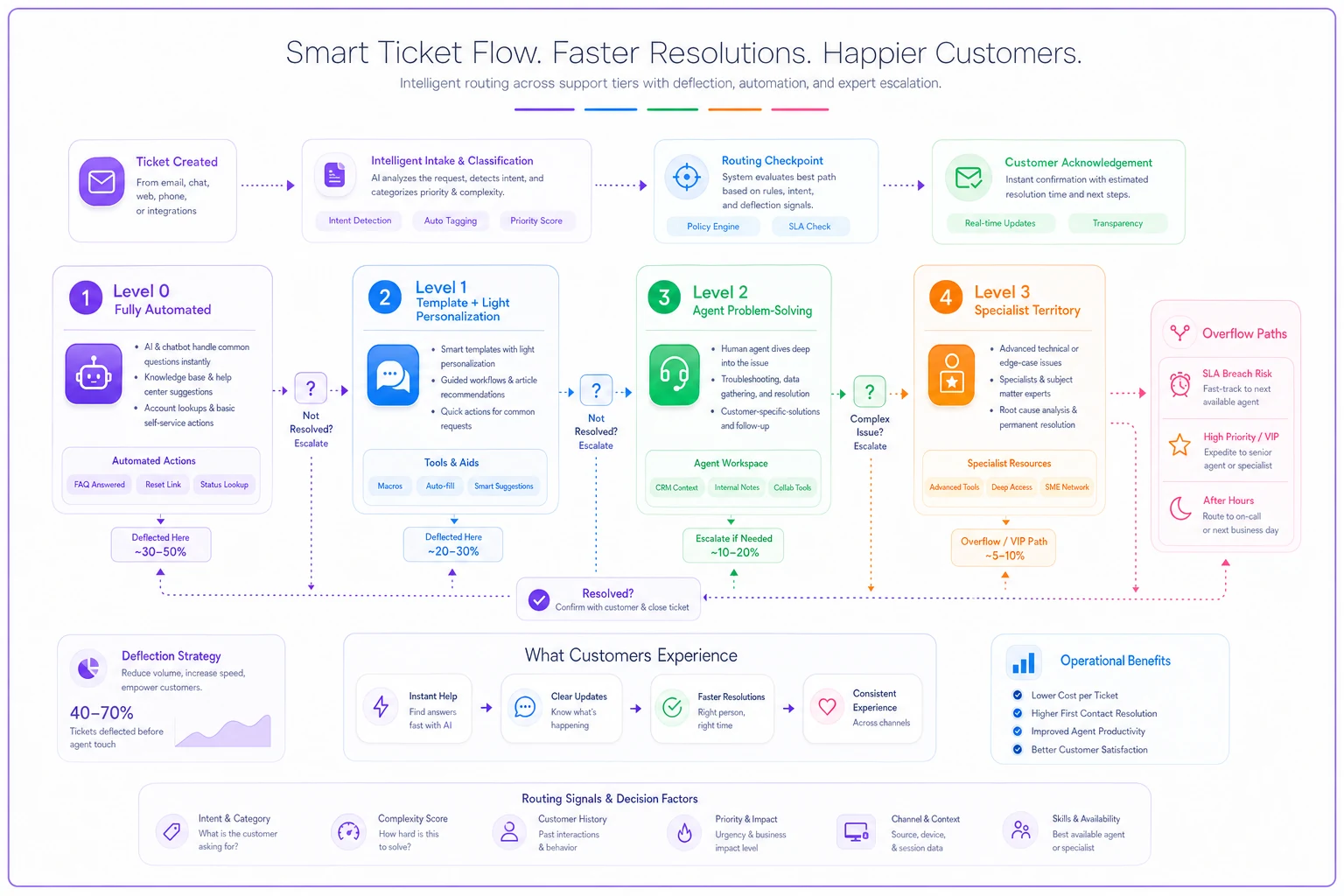
This visualization emphasizes deflection at Level 0, routing accuracy at Level 1, and escalation paths to Levels 2 and 3.
Protecting SLAs When Everything's on Fire
SLAs get political during budget cuts. Miss them and executives question why support exists. Hit them with half the team and next year's budget gets cut further because "clearly you didn't need those resources."
Teams that survive this cycle focus on SLA efficiency, not just achievement. They measure cost-per-SLA-point and optimize from there.
A retail support team handling 12,000 monthly tickets restructured around SLA protection using pods:
-
Speed Pod (30% of team) - Target
Sub-30-minute first response - Handles: Quick questions, routing, initial responses - Metric: Response time only
-
Resolution Pod (50% of team) - Target
One-touch resolution - Handles: Standard issues with clear solutions - Metric: Resolution rate and CSAT
-
Complex Pod (20% of team) - Target
Thorough investigation - Handles: Multi-step problems, escalations - Metric: Repeat contact rate
This structure isn't complicated, but most teams avoid it because it means admitting not all tickets deserve the same attention. Budget pressure has a way of making that admission easier.
The Turnover Trap That's Coming
Rising rates create a strange dynamic on support teams. As companies freeze hiring, your agents become more attractive to competitors still growing. The good ones know it — they're getting recruiter messages right now, and when someone offers 20% more with remote flexibility, they're gone.
Retention bonuses don't work well under budget pressure. You need to fix the job itself.
Most agents quit because they're drowning in repetitive tickets, dealing with angry customers over issues they can't actually fix, or watching their metrics tank from factors outside their control. An online education platform cut agent turnover from 35% to around 18% annually by changing how work gets allocated. Instead of round-robin ticket assignment, they let agents specialize in areas they genuinely preferred. Some liked technical troubleshooting. Others preferred billing conversations. A few were actually good at handling escalations.
They built an AI-assisted operational platform that routed tickets based on agent strengths and preferences, not just availability. Agents handled fewer tickets but resolved them faster because they weren't constantly context-switching between completely different problem types. That's a harder outcome to replicate than any retention bonus.
Surge Capacity Without Surge Hiring
The recent Reuters coverage of the Fed's decision makes it clear that hiring freezes aren't going anywhere soon. You need surge capacity that doesn't require headcount.
Elastic tier support. Partner with an overflow provider, but flip the typical model. Instead of sending them your hardest tickets when you're swamped, send them your easiest ones. A subscription box company documented their 50 most common tickets with exact resolution steps. During surge periods, their overflow partner handles only those 50 types. Cost per ticket runs about $2.40 versus $8.50 internally.
Community-powered support. Not a forum where customers vaguely help each other — that rarely works. Identify your power users and give them real incentives. A project management software company gives their top 100 users early feature access, direct product team contact, and conference passes in exchange for handling roughly 10 community questions monthly. Those users cover about 15% of total support volume.
Proactive surge prevention. Most ticket surges are predictable if you're watching the right signals. Marketing launching a campaign? Prepare responses for confused customers. Product shipping a major update? Pre-write troubleshooting guides for likely issues. Payment processor having problems? Notify customers before they notice and contact you.
When AI Automation Actually Helps (And When It Doesn't)
Everyone's pushing AI for support right now, and a lot of those implementations are making things worse. Chatbots that can't answer basic questions, suggested responses that sound robotic, sentiment analysis flagging happy customers as angry.
AI automation in support works when it handles discrete, measurable tasks — not when it pretends to be human.
Good automation targets:
-
Ticket categorization and routing
-
Suggested macros based on ticket content
-
Auto-population of customer context
-
Duplicate ticket detection
-
SLA warning systems
-
Quality assurance sampling
A fintech support team implemented AI-powered operational software that reads every incoming ticket and adds three pieces of context before an agent sees it: the customer's account status, their last three interactions, and similar resolved tickets. Agents save about 90 seconds per ticket just by not asking for basic information. The AI never responds to customers directly — it just makes agents meaningfully faster.
The bad implementations create more problems than they solve. A travel booking platform tried to automate their entire Level 1 support with conversational AI. Six months later, CSAT had dropped 20 points and escalation rate doubled. Customers learned to type "human" immediately to bypass the bot, which defeated the whole point.
Budget Reality Check
Actual numbers for a 15-person support team handling 6,000 monthly tickets:
Current State Budget (Monthly)
-
Salaries
$64,000
-
Tools
$8,500
-
Management overhead
$12,000
-
Training/quality
$4,500
-
Total
$89,000
-
Cost per ticket
$14.83
Optimized Operations Budget (Monthly)
-
Salaries (12 people)
$51,000
-
Enhanced tools/automation
$11,000
-
Management overhead
$10,000
-
Training/quality
$3,500
-
Overflow capacity
$6,000
-
Total
$81,500
-
Cost per ticket
$13.58
The optimized model handles the same volume with fewer people by investing in better operational systems. What most budget models miss: the optimized version can absorb 8,000 tickets without adding headcount, while the traditional model starts breaking around 7,000. That buffer matters more than the cost-per-ticket difference.
Making the Transition Without Breaking Everything
You can't rebuild support operations overnight, especially when everyone's watching metrics daily. The teams that get through this make incremental changes that compound over time.
Start with ticket deflection for your highest volume issues. Pick the top three ticket types and fix them specifically. Password resets eating 500 tickets monthly? Fix the password reset flow. Billing confusion creating 400 tickets? Clarify the billing page. Feature questions generating 300 contacts? Build an interactive tour.
Then implement intelligent routing. This doesn't require sophisticated AI — just clear rules about which tickets go where. Senior agents shouldn't see password resets. New agents shouldn't handle executive escalations. Basic routing rules alone can cut resolution time by 25–30% without anything else changing.
-
Month 1 Identified and fixed top 5 ticket generators — volume down 22%
-
Month 2 Implemented skills-based routing — resolution time down 18%
-
Month 3 Added internal automation tools — capacity up 15%
-
Month 4 Launched overflow partnership — surge coverage achieved
They reduced headcount by 20% while improving every performance metric. Agent satisfaction went up because they weren't buried in repetitive work anymore. That's not a coincidence — it's what happens when you fix the actual problems instead of just pushing people harder.
What's Actually Coming
Interest rates aren't the real problem. They're exposing how fragile most support operations already were. Teams have been throwing bodies at volume problems for years because hiring was easier than fixing processes. That era is over.
The next 12–18 months will split support teams pretty clearly: those who adapt their operations, and those who burn out trying to work harder with less. You can't sustain quality support by just asking fewer people to handle more tickets indefinitely. Human psychology doesn't work that way, and the burnout cycle is expensive when you finally have to backfill.
What tends to happen, though, is that budget pressure forces improvements that should've happened years ago. The password reset flow generating 500 tickets monthly was always broken. The routing system sending complex tickets to new agents never made sense. The manual processes eating 40% of capacity should've been automated a long time ago. Tight budgets just make these problems impossible to keep ignoring.
The teams that thrive don't just survive the cuts — they build better support operations that scale more efficiently than their old models ever did. Your CFO wants 15% cost reduction with the same SLAs. Traditional staffing math says that's impossible. Operational transformation makes it workable.
The Fed is signaling more pressure ahead. If you're still trying to solve 2026's problems with 2019's playbook, the teams moving faster are already pulling ahead.
The Fed is signaling more pressure ahead. If you're still trying to solve 2026's problems with 2019's playbook, the teams moving faster are already pulling ahead.
Ready to transform your support operations?
Join 500+ support teams using Servyly to reduce resolution times, improve customer satisfaction, and boost team productivity.