

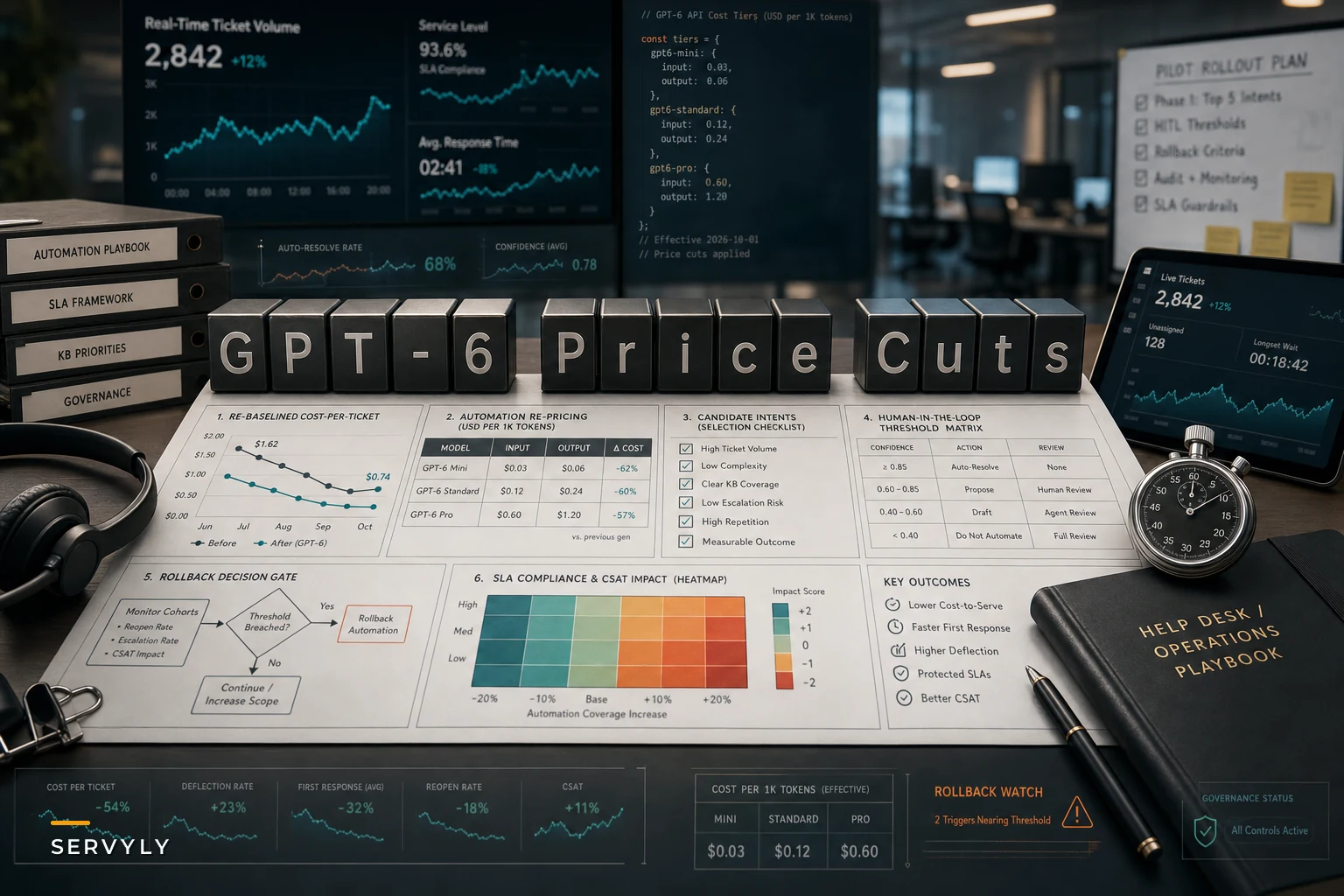

When OpenAI rolled out GPT‑6 Sol and GPT‑6 Luna on September 22, with API prices on those tiers cut by roughly half, the first reaction in a lot of support orgs was predictable: "Great, let's automate more." The second reaction, usually a week or two later, is the one that causes problems: "Wait, why did our reopen rate just climb?"
Both Reuters and CNBC framed the move as part of a broader round of cheaper model releases across the industry. For support leaders, the headline isn't really the model names — it's that the unit economics of automation just shifted underneath you, and most cost‑to‑serve models built even six months ago are now quietly wrong.
This post isn't about the announcement. It's about what to actually do with your budget, your automation footprint, and your SLAs now that a meaningful chunk of per‑ticket AI cost just evaporated.
The real change isn't "AI got cheaper." It's that your break‑even points moved.
Most teams miss this. A 50% price cut doesn't just make everything you're already doing cheaper — it unlocks workflows that were previously just barely not worth automating. That's where both the money and the risk live.
Think about where your per‑ticket AI spend used to sit. If running a summarization‑plus‑draft‑reply flow on a complex ticket cost somewhere around 9–14 cents in model calls, that was defensible for your top ticket drivers but hard to justify on the long tail. You'd automate the top 20 intents and leave the rest to humans because the math didn't work below a certain volume threshold.
Cut that cost roughly in half and suddenly intents you see 40 times a month become worth automating. The marginal ticket that wasn't worth a model call now is. That's the actual operational shift here — not "AI is cheaper," but "the line between automate and don't‑automate just moved, and nobody redrew it on purpose."
The mistake most teams make is treating the price cut as a reason to expand the depth of existing automation — more autonomy, longer chains, less review — when the smarter move is usually to expand breadth instead: more intents, more languages, more draft‑assist, while keeping human review exactly where it already was.
Rebuilding your cost‑to‑serve math (without pretending it's precise)
Most cost‑to‑serve models in support are built on blended labor cost per ticket. AI used to be a rounding error inside that number, so people ignored it. Now it's big enough to matter but small enough that it's easy to model badly.
Never lose track of a customer request again.
Servyly helps you track, assign, and resolve every ticket quickly and efficiently.
- Centralized ticket management
- Automated response workflows
- Team collaboration tools
No credit card required
A cleaner approach: break your per‑ticket cost into three buckets and think about how the price cut hits each one differently.
| Cost component | Before price cut (illustrative) | After ~50% model cut | What actually changed |
|---|---|---|---|
| Human handle time | $4.20–$6.00 | $4.20–$6.00 | Unchanged — labor is still labor |
| AI draft/summarize/route | $0.10–$0.15 | $0.05–$0.08 | Roughly halved |
| Rework from bad automation | Variable, often hidden | Can increase if you over‑expand | The dangerous one |
The trap is row three. Teams model the first two, see the savings, and never price in the cost of reopens, misroutes, and escalations that come from pushing automation into places it isn't ready for. A deflected ticket that comes back angry two days later often costs more than the human handle you "saved."
So before you expand anything, pull your current numbers on average handle time, reopen rate by intent, and escalation rate on AI‑assisted tickets versus human‑only. If you don't have that split yet, that's the first project — not the expansion.
When expanding automation actually makes sense
-
The intent has a stable, documented resolution path that hasn't changed in the last quarter
-
Your reopen rate on that intent is already low with humans — you're automating a solved problem, not a messy one
-
There's a clean rollback — you can turn it off in minutes without a release cycle
-
You have retrieval content good enough that the model isn't guessing
When it's a bad idea
-
The intent touches billing disputes, security, cancellations, or anything legally sensitive
-
Resolution depends on customer‑specific context your knowledge base doesn't hold
-
You're under‑instrumented and can't actually see quality degradation in near real time
-
You're expanding to hit a cost target finance set, not because the workflow is actually ready
That last one is worth sitting with. Cheaper tokens create pressure to show savings, and that pressure is exactly how teams talk themselves into automating things they shouldn't.
The underlying problem the price cut exposes
Price cuts are good at revealing which teams had real automation governance and which teams had "it was too expensive to go overboard, so we never had to set limits."
For a lot of help desks, cost was functioning as an accidental guardrail. You weren't automating the risky long‑tail intents because they weren't worth the spend — not because you'd made a deliberate call about quality thresholds. Remove the cost barrier and that accidental discipline disappears pretty fast.
This is where the actual work is. The governance structure that was optional when AI was a small line item is now the thing standing between you and a wave of plausible‑sounding wrong answers at scale. The failure modes worth revisiting — bad retrieval, no rollback path, weak human‑in‑the‑loop thresholds — are the same ones covered in the phased approach to avoiding costly AI mistakes in support. Cheaper models make that phasing more important, not less, because the temptation to skip phases goes up with every price cut.
A staged response that won't blow up your SLAs
There's a sequence that works better than "turn on more automation and watch the dashboard." The key is treating this as a deliberate planning exercise rather than a reaction to a pricing announcement — because the teams that just flip switches usually regret it within a month or two.
-
Re‑baseline before you change anything. Lock your current per‑intent quality and cost numbers for two to three weeks. You need a clean "before" or you'll never prove the expansion helped or hurt.
-
Re‑price your existing automation. Update the cost‑to‑serve model with the new token economics. This alone usually frees up budget you can redirect deliberately instead of accidentally.
-
Pick 3–5 new candidate intents, not 30. Choose from the "solved but previously not worth it" bucket. Resist the urge to scale everything at once just because it's suddenly affordable.
-
Keep human review where it is. Expand breadth, hold your autonomy and HITL thresholds constant for now. Change one variable at a time.
-
Watch reopen and escalation rates by cohort. Compare newly automated intents against their human‑only baseline weekly. If reopens climb, pull that intent — don't "tune it later."
-
Only then consider deeper autonomy on intents that have been clean for a month or more.
The whole point is sequencing. The price cut gives you room to move — it doesn't tell you how fast. Those are separate decisions, and treating them as the same thing is how SLAs quietly erode.
A quick visual can make the sequence easier to run through with your ops and SRE teams.
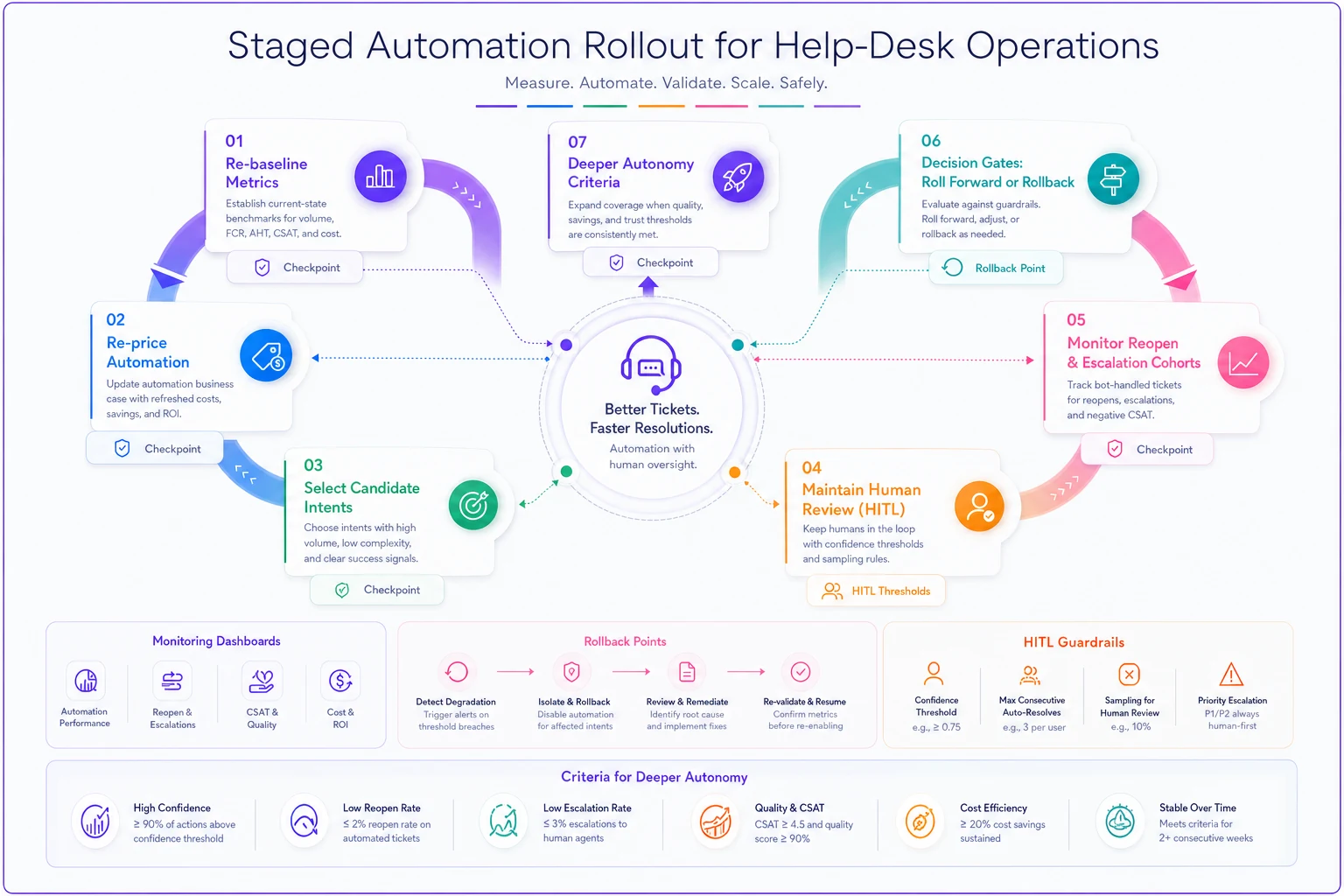
Use the graphic as a one-page guide when you brief stakeholders.
A checklist before you expand anything
Run through this before touching your automation footprint.
-
[ ] Updated cost‑to‑serve model reflects the new (~50% lower) token pricing
-
[ ] Per‑intent reopen and escalation baselines captured for human‑only tickets
-
[ ] Rollback path tested — you've actually turned an automation off and confirmed it stopped
-
[ ] Audit trail logs which responses were AI‑drafted vs. AI‑sent vs. human‑sent
-
[ ] HITL thresholds documented and unchanged during the expansion window
-
[ ] A named owner for each new automated intent (not "the team")
-
[ ] A kill criterion written down in advance ("if reopen rate on this intent exceeds X for two weeks, we disable it")
It's not exhaustive, but if you can't check the rollback and audit‑trail boxes, you're not ready to expand regardless of how cheap the tokens got.
A realistic scenario
A mid‑size B2B SaaS help desk — around 11 agents, roughly 6,500 tickets a month — had automated draft replies on their top 15 intents and left everything else to humans. The long tail, maybe 60 lower‑frequency intents, had sat untouched because the model spend wasn't worth it.
After re‑pricing against the new tiers, they didn't just flip everything on. They picked 4 long‑tail intents that were well‑documented and already had low human reopen rates. Draft‑assist only, human still clicking send. Over about six weeks, those four intents saw handle time drop somewhere in the 20–25% range, and because review stayed human, reopens barely moved. The quieter win was budget: re‑pricing the existing automation freed up a few hundred dollars a month that had been baked into their cost‑to‑serve assumptions. They redirected it toward translation‑assist for their non‑English queue instead of chasing a flashier deflection number.
One of the four candidate intents got pulled in week three — reopens ticked up because the underlying KB article was stale. That's the system working as intended. Cheap tokens don't fix bad content, and no price cut ever will.
What not to walk away with
Don't read this as "automation is now basically free, so automate everything." Token cost was never the real constraint.
The real constraints are whether your knowledge is solid, your rollback is genuine, and your quality signals are fast enough to catch problems before customers do.
The price cut is a budget event and a planning opportunity — a genuinely good one. But the teams that come out ahead in six months won't be the ones who automated the most the fastest. They'll be the ones who re‑priced carefully, expanded breadth deliberately, kept humans on the risky stuff, and treated cheaper models as a reason to be more disciplined about governance, not less. Redraw your cost‑to‑serve math this week. Just don't let the savings talk you into skipping the parts that protect your SLAs.
Ready to transform your support operations?
Join 500+ support teams using Servyly to reduce resolution times, improve customer satisfaction, and boost team productivity.