

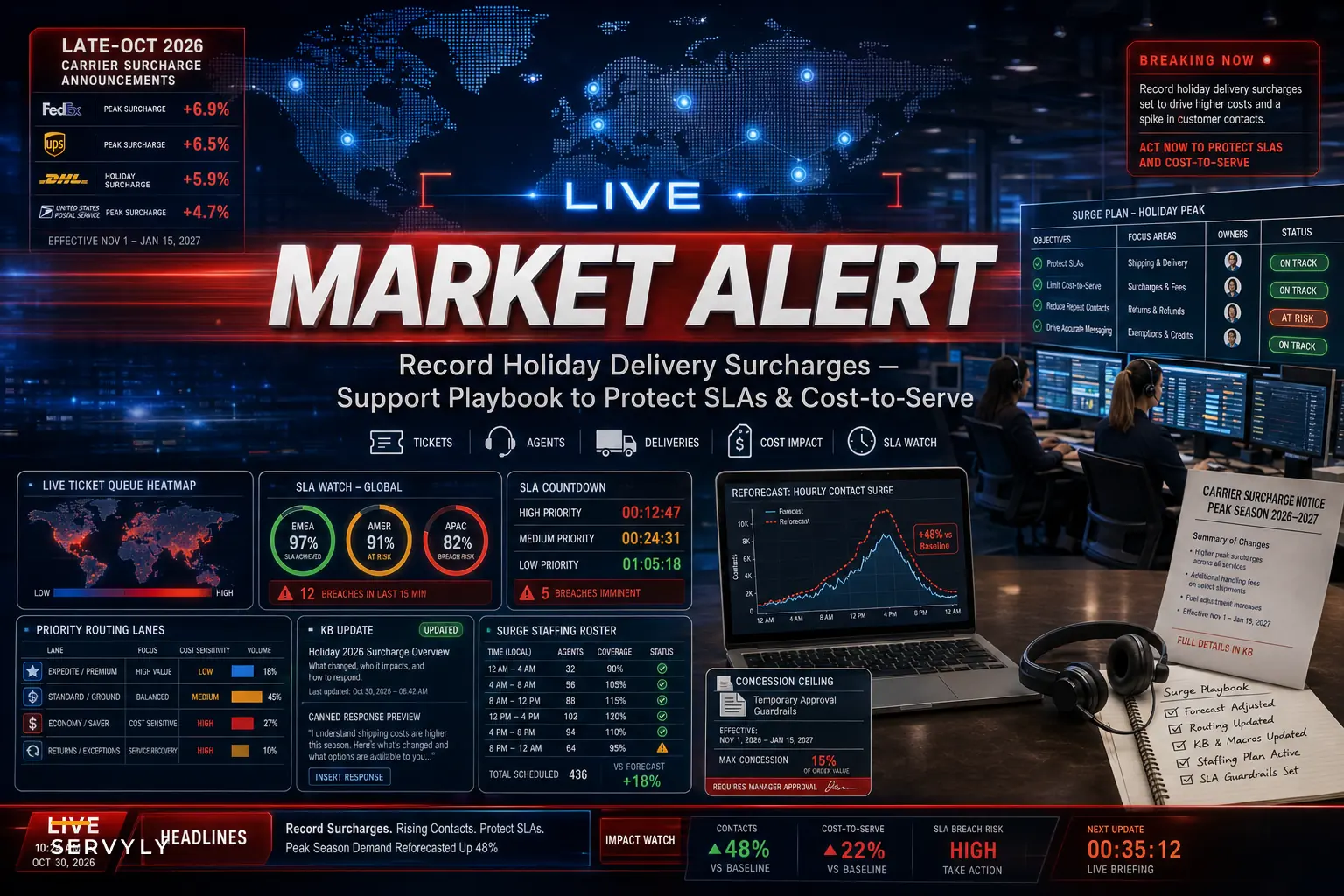

Carriers didn't wait for December this year. Reuters reported in late October that U.S. retailers are staring down record holiday delivery prices as peak surcharges climb alongside pricier diesel. On the carrier side, UPS signaled fatter holiday profits from higher-paying shipments — a polite way of saying everyone downstream pays more to move a box.
Most support leaders read that as a logistics problem. It isn't. It's a queue problem wearing a logistics costume. When shipping costs rise and delivery promises get shakier, the first team that hears about it isn't fulfillment — it's you. And those tickets aren't clean "where's my order" questions. They're emotionally charged, cost-sensitive, and far more likely to end in a cancellation or dispute than a standard WISMO contact.
This isn't really about diesel. It's about what happens to your SLA board, your staffing math, and your cost-to-serve when every shipping change the business makes lands in your inbox two weeks before your busiest stretch of the year.
The ticket mix shifts before the volume does
Teams prepare for holiday volume — more tickets, longer hours, surge staffing. What they don't prepare for is the composition change, which usually hits first and does more damage per ticket.
-
Price-dispute tickets — "Why is shipping $14 now?" These aren't resolved with a tracking link. They require a judgment call, sometimes a concession, sometimes an escalation.
-
Delivery-promise complaints — guaranteed dates slip when carriers deprioritize surcharge-sensitive lanes, and the customer blames you, not FedEx.
-
Return and refund disputes — higher shipping costs make customers angrier about paying return postage, so refund negotiations drag on longer.
-
Retention saves — the "I'll just cancel" conversations that need your most experienced people, not your seasonal temps.
A normal WISMO ticket might take 2–3 minutes. A surcharge dispute that turns into a partial-refund decision and a retention attempt can eat 11–14 minutes and pull in a lead for approval. So even if your raw ticket count only climbs 20%, your handle-time-weighted workload can jump far more. Teams that staff to ticket count instead of weighted minutes get blindsided every single peak season.
The underlying problem: support absorbs pricing decisions it didn't make
This is the deeper issue the surcharge news exposes. Pricing, shipping policy, and promo thresholds get decided by merchandising or finance. The consequences — confused, annoyed, price-sensitive customers — get routed to support with zero lead time and often zero briefing.
Never lose track of a customer request again.
Servyly helps you track, assign, and resolve every ticket quickly and efficiently.
- Centralized ticket management
- Automated response workflows
- Team collaboration tools
No credit card required
The failure pattern is pretty predictable. Finance approves a surcharge pass-through or threshold change around Nov 3. It goes live Nov 10. Support finds out when the tickets start arriving Nov 11. Agents improvise answers because the KB still says "free shipping over $35." Then three agents give three different concession amounts, and now you have inconsistent precedents customers screenshot and compare.
That gap between policy change and support readiness is where SLAs quietly break. Not from volume — from scrambling.
A fast-moving carrier labor angle worth watching
There's a second-order effect buried in the carrier news. Reuters also noted that FedEx margins slipped partly because it's paying more to hire truckers. Carrier labor pressure usually translates into tighter capacity on the exact days you need reliability most — more "it says delivered but I don't have it" tickets, more missed-guarantee complaints clustered around peak cutoff dates. Plan your toughest staffing around carrier cutoff weeks, not just the calendar's general "busy" assumptions.
Build your surcharge response before the first ticket
The goal is to compress the time between a shipping change and your team being ready to handle it. Treat it like a mini launch readiness drill, not a reaction.
Most teams skip straight to "how do we handle the volume" without asking whether the volume was even predictable. A lot of it is. You know the surcharge is coming. You know customers will notice. The preparation work is just deciding to do it in advance instead of in the middle of a spike.
-
Get written confirmation of every shipping-cost or threshold change and its go-live date — from the team that owns it.
-
Pre-draft macros for the top five surcharge scenarios
new threshold, guarantee slip, return-postage complaint, duty/fee confusion, price-match request.
-
Set a concession ceiling so agents know the max refund or credit they can offer without escalating — write it down, don't leave it to instinct.
-
Update the KB and the help-center search synonyms ("why did shipping go up," "shipping more expensive," "no more free shipping").
-
Tag a dedicated
peak-shipping-surchargeticket category so you can actually measure this after the fact. -
Brief seasonal hires specifically on these five scenarios — they will see them constantly.
-
Define a retention-save routing rule so cancellation-intent tickets skip the temp pool.
Here's a quick visual of that readiness drill workflow.
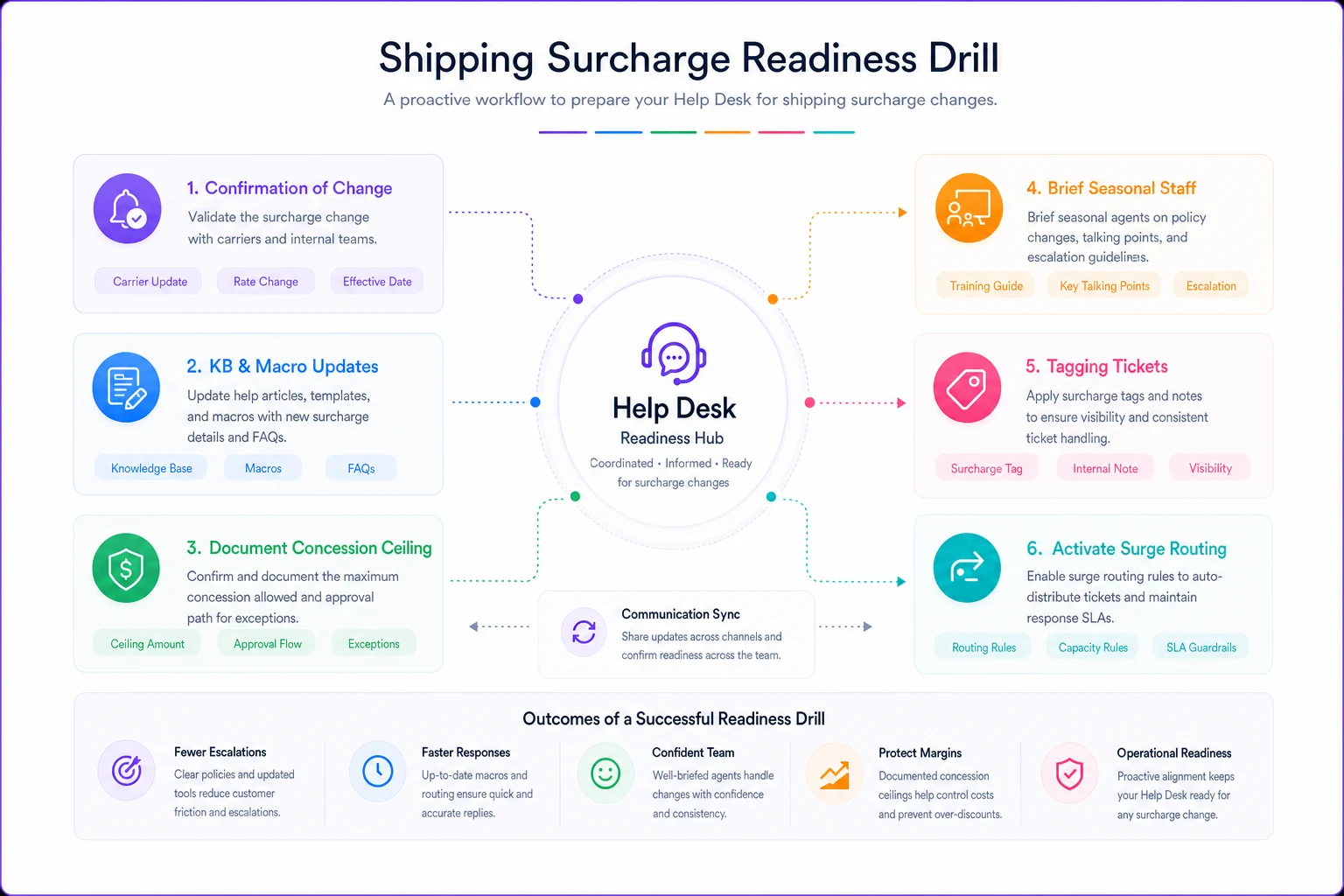
[Policy change confirmed] ↓ [KB + macros updated] ↓ [Concession ceiling documented] ↓ [Seasonal staff briefed on top 5 scenarios] ↓ [Ticket tag live before go-live date] ↓ [Surge routing rules activated]
The concession ceiling is the one teams consistently underestimate. Without it, your cost-to-serve on these tickets becomes invisible and uncontrolled. One agent hands out $20 credits freely, another refuses everything and generates reopens and escalations. Both outcomes are expensive, just in different ways.
A quick comparison: reactive vs. prepared teams
The gap between a reactive and a prepared desk isn't really about how hard people work — it's about when the work gets done. Teams that front-load the readiness work before the surge tend to hold SLAs. Teams that catch up during the surge don't.
| Dimension | Reactive team | Prepared team |
|---|---|---|
| Finds out about surcharge | From inbound tickets | From a documented change notice |
| KB accuracy on day one | Stale, says "free over $35" | Updated same day as go-live |
| Concession consistency | 3 agents, 3 answers | Documented ceiling + approval path |
| Handle time on disputes | 11–14 min, lots of escalation | 6–8 min with pre-built macros |
| SLA during cutoff week | Breaches cluster | Guardrails hold, surge routing kicks in |
| Post-peak learning | No tag, no data | Tagged, measurable, feeds next year |
The difference is sequencing. Prepared teams move the work before the surge instead of inside it.
A real scenario: mid-size apparel retailer, ~90 tickets/day baseline
A specialty apparel brand running a small in-house desk — six agents — raised its free-shipping threshold from $50 to $75 and started passing a peak surcharge on expedited orders in early November. No support briefing went out.
In the first four days, shipping-related contacts went from roughly a quarter of the queue to just over half. Average handle time crept up because agents kept pinging the lead for refund approval. First-response SLA on their standard tier slipped from the low 90s to around 78% — not a full collapse, but enough to trigger complaints and a handful of public reviews.
They stopped and did three things: pre-wrote five macros, set a hard $12 concession ceiling for agents (anything above required a lead), and updated the help-center article plus search synonyms. Within about a week, handle time on surcharge tickets dropped by roughly a third and first-response recovered into the high 80s. Nothing exotic. They just closed the readiness gap the policy change had opened.
The interesting part: their volume barely changed after the fix. What changed was how long each ticket took and how many bounced to a lead. That's the hidden cost of an unprepared surcharge season — it hides inside handle time and escalation rates, not the ticket counter.
When to staff up vs. when to re-route
Not every surcharge spike justifies hiring. Throwing bodies at a composition problem is a classic overcorrection, and it's expensive.
Add staff when your weighted workload — handle time multiplied by volume — is genuinely climbing across all tiers and the surge lasts more than a week or two. Seasonal apparel, electronics, and gift-heavy categories usually qualify.
Re-route instead when the spike is concentrated in one ticket type — say, threshold confusion — that a solid macro and an updated KB article can deflect. Hiring for a problem a synonym fix solves is just expensive.
Don't do either yet when you haven't tagged the tickets. If you can't see which contacts are surcharge-driven, you're staffing on guesswork. Tag first, decide second.
This is exactly where a lightweight forecasting approach pays off. Instead of reacting to the queue, you model expected demand by ticket type and map it against your actual shift supply. If you don't already have a repeatable way to do this, the approach in our workforce forecasting guide for small help desks walks through building a demand model and surge routing plan that handles exactly these composition shifts — not just raw volume.
Where AI automation genuinely helps here (and where it doesn't)
A quick, honest take — because peak season tempts people into over-automating.
Surcharge tickets split into two buckets. The informational ones — "why did shipping go up," "what's the new free-shipping minimum," "when's the cutoff for Christmas delivery" — are solid candidates for AI-assisted deflection and auto-drafted replies pulled from an updated KB. If your help center and macros are current, an AI automation layer can handle or draft a meaningful share of these before a human touches them, which protects your SLA during the hours it's most at risk.
The judgment ones — refund negotiations, retention saves, angry missed-guarantee escalations — shouldn't be fully automated. These need the concession ceiling, a human read on the customer's history and value, and a tone that a seasonal script won't get right. The smarter move is AI-assisted routing and drafting: let automation triage intent, surface the customer's order history and prior concessions, and suggest a response, while a human makes the actual call. That keeps cost-to-serve controlled without turning a retention moment into a robotic brush-off.
The mistake teams make under peak pressure is flipping everything to auto-resolve just to survive the volume. That works for tracking links. It backfires on price-sensitive customers who are already one bad experience away from canceling.
The post-peak step almost everyone skips
Tag the tickets now so January-you has data. After the season, pull the peak-shipping-surcharge cohort and answer three questions:
-
Which surcharge scenario drove the most volume and the longest handle times?
-
How much did we give away in concessions, and was it consistent?
-
Which KB gaps caused repeat contacts?
That review is what turns this year's scramble into next year's playbook. Most teams fight the same surcharge fire every November because nobody wrote down what happened the last time. The data is sitting there — it just never gets pulled.
Bringing it together
The record surcharge news is a logistics headline, but the operational reality lands squarely on support. The teams that come through peak season clean aren't the ones with the most agents — they're the ones that closed the gap between a pricing decision and their desk being ready for it. Pre-written macros, a written concession ceiling, updated search synonyms, a dedicated tag, and forecasting built around weighted workload instead of raw ticket count.
None of that is glamorous. But when carrier capacity tightens and every shipping change routes straight to your queue, boring readiness is exactly what keeps your SLAs standing while everyone else is improvising answers in real time.
None of that is glamorous. But when carrier capacity tightens and every shipping change routes straight to your queue, boring readiness is exactly what keeps your SLAs standing while everyone else is improvising answers in real time.
Ready to transform your support operations?
Join 500+ support teams using Servyly to reduce resolution times, improve customer satisfaction, and boost team productivity.