

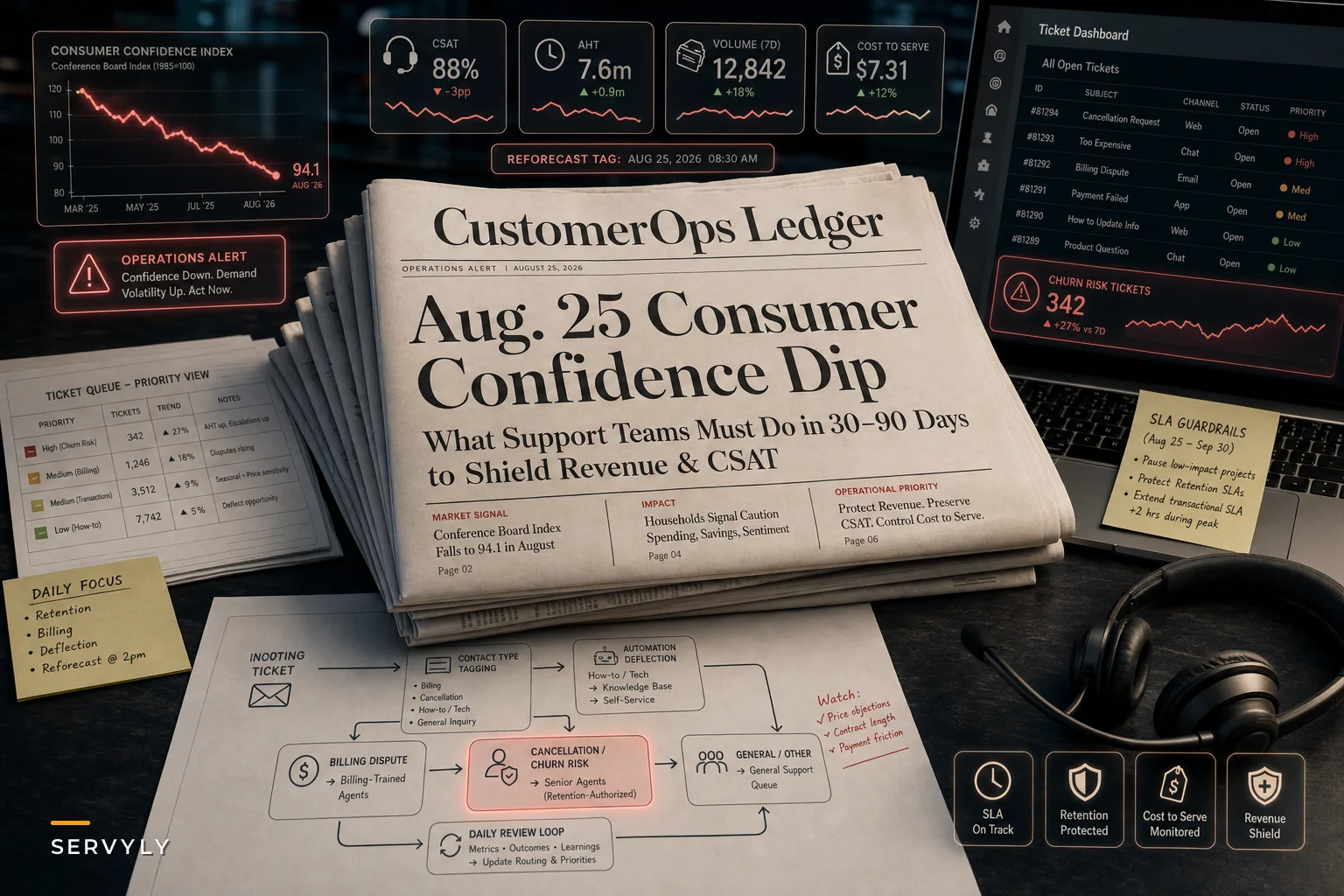

The Conference Board's August reading landed at 89.4, down from 90.2 in July. Small drop on paper. What makes it worth paying attention to is where the softness showed up: short-term expectations sagged even while people felt okay about their current situation. People feel fine right now but are bracing for the next few months.
Support teams tend to read a number like that and think, "okay, maybe fewer tickets if people are spending less." That's the wrong instinct. When confidence dips on the expectations side, your volume doesn't necessarily drop — it shifts toward the expensive, emotionally loaded contacts. Cancellations. Downgrade requests. "Why did my card get charged again." Refund disputes on purchases people now regret. As Reuters noted in its coverage, the pullback is being driven by how people feel about what's coming, not what's already happened. That forward-looking anxiety is exactly what generates retention-critical tickets.
So the real question isn't "will my volume go up or down." It's "is my routing and staffing built for a queue that's getting harder even if it's not getting bigger."
The queue shift most teams miss
In a normal month, a mid-size SaaS support desk might see something like 60% how-to and troubleshooting tickets, 25% account/billing, and 15% cancellation or churn-risk contacts. When confidence softens, that mix tilts. The how-to volume stays roughly flat, but billing climbs and the cancellation slice can grow by a third or more.
That matters because those ticket types have wildly different economics. A password reset closes in two minutes with a macro. A cancellation contact where the customer is on the fence can run 15–20 minutes, needs your most experienced people, and if it goes well, you saved an account worth real ARR. If it goes badly, you lost the account and generated a bad CSAT score on the way out.
The mistake teams make is treating this like a volume problem — throwing more agents at the queue, or leaning harder on automation to deflect. Both backfire here. You can't deflect a retention conversation with a help article. And adding junior headcount to a queue full of billing disputes just means more escalations landing on the same two senior people you already had.
The underlying issue: most staffing and routing models are built around volume forecasting, not contact-type forecasting. They tell you how many tickets are coming. They don't tell you how many of those tickets need your best judgment, your retention playbook, or your billing-savviest agent.
What actually changes operationally
The specific pressures a confidence dip puts on a support org aren't obvious until you're in it:
Never lose track of a customer request again.
Servyly helps you track, assign, and resolve every ticket quickly and efficiently.
- Centralized ticket management
- Automated response workflows
- Team collaboration tools
No credit card required
-
Billing tickets spike, and they're stickier. Price-sensitive customers scrutinize invoices harder. A charge that nobody questioned six months ago now generates a ticket. These often require account access, sometimes a refund decision, and they carry frustration.
-
Cancellation contacts become retention opportunities — or missed ones. Every "how do I cancel" is a fork. Handled by someone with the right offer authority and tone, some percentage stays. Routed to a rushed junior agent, they're gone.
-
Downgrade requests replace some churn. Good news, sort of. But downgrades still need handling, and they need someone who won't accidentally talk the customer into a full cancel.
-
CSAT gets more fragile. Anxious customers are less forgiving. The same response that scored a 4 last quarter might score a 3 now because the person on the other end is already stressed about money.
-
Budget pressure hits at the exact wrong moment. Finance sees soft demand and asks you to trim cost-to-serve — right when your queue is getting harder to serve well.
That last one is the trap. You're being asked to lower cost per ticket while your ticket mix is getting more expensive to handle. Squeeze the wrong lever and you'll protect your budget this quarter and lose accounts that cost you far more next quarter.
Re-routing for a harder queue
The fix isn't more people or more automation. It's matching the right contacts to the right people faster, and being deliberate about what you protect versus what you streamline.
| Contact type | Priority shift | Who handles it | What to protect |
|---|---|---|---|
| How-to / basic troubleshooting | Streamline hard | Automation + junior tier | Speed, self-service deflection |
| Billing / invoice disputes | Elevate | Billing-trained agents | Accuracy, refund policy consistency |
| Cancellation / churn-risk | Top priority | Senior + retention-authorized | CSAT, save rate, tone |
| Downgrade requests | Elevate | Mid-tier with offer scripts | Preventing over-cancellation |
| Feature complaints | Watch | Standard tier | Trend tracking for product |
The point of the table isn't the exact rows — your business will differ. It's the principle: you free up capacity on the cheap contacts specifically so you can over-invest in the expensive ones. Automation earns its keep here not by deflecting cancellations, but by clearing enough routine volume that your senior people aren't buried when a save-able account walks in.
A practical re-prioritization sequence
-
Tag your current queue by contact type for two weeks. You need a real baseline of your mix before you can tell whether it's shifting. Most teams are guessing.
-
Identify your "protect list" — the contact types where a bad interaction costs you revenue, not just a CSAT point. Usually cancellations, billing disputes, and downgrades.
-
Aggressively deflect and automate the streamline list. How-to, status checks, basic troubleshooting. This is where you claw back capacity.
-
Route protect-list contacts to a named, trained subset of agents — not just "whoever's free." Skill-based routing matters more now than at any other time.
-
Set a tighter SLA on retention contacts specifically. A churn-risk customer waiting 40 minutes is a churn-risk customer who's already made up their mind.
-
Review daily, not weekly. When the mix is shifting under you, a weekly staffing review is too slow.
Here's a visual of the routing and priority workflow.
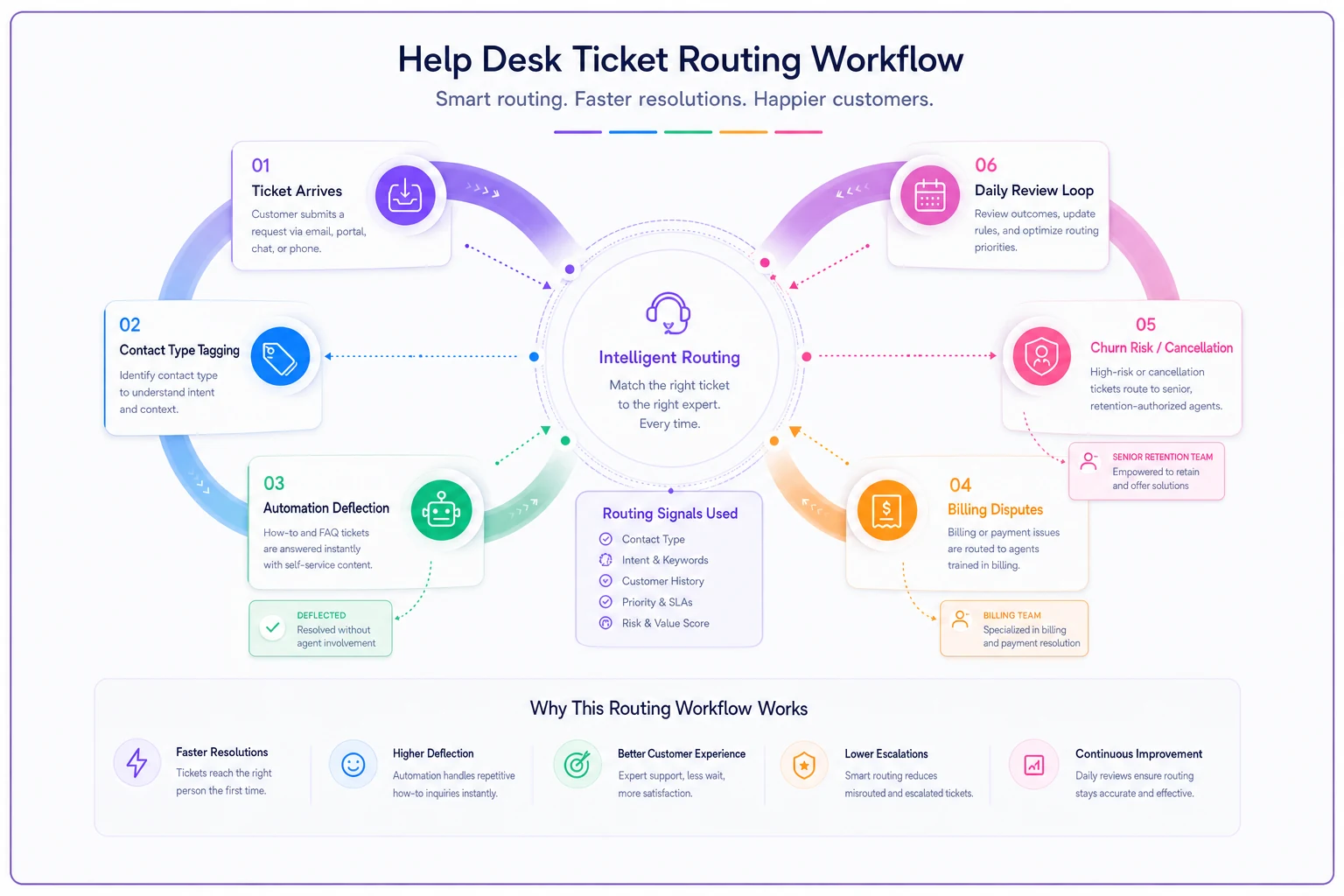
When the mix is shifting under you, a weekly staffing review is too slow.
The forecasting problem underneath all of this
Everything above depends on one capability most small help desks don't have dialed in: forecasting not just how many contacts are coming, but what kind, and mapping that against who's actually available on a given shift.
Volume forecasting is common. Mix-aware forecasting — where you're modeling "we expect billing contacts to run 30% above baseline for the next six weeks, and our billing-competent agents are concentrated on Tuesday–Thursday shifts" — is rare. And it's exactly what you need when consumer sentiment is telling you the queue's character is about to change.
If you don't already have a lightweight demand model that ties expected contact types to your actual shift supply, that's the thing to build before this trend deepens. We walked through a practical version of this in our guide on workforce forecasting for small help desks — the shift-supply map and surge routing pieces in particular are what let you respond to a mix shift without just throwing bodies at it or blowing your budget.
The teams that handle a confidence-driven queue shift well aren't the ones with the most headcount. They're the ones who saw the mix change coming and had their best people pointed at the right contacts before the wave hit.
A realistic scenario
A B2B subscription tool — around 4,000 paying accounts, support team of nine — noticed billing and cancellation tickets creeping up over about six weeks. Nothing dramatic day to day, maybe a few extra per day. But monthly churn ticked from roughly 2.1% to 2.8%, and their save rate on cancellation contacts had quietly dropped because those tickets were landing in the general queue and getting handled by whoever grabbed them first.
They did two things. They pulled cancellation and downgrade contacts into a dedicated route staffed by their three most experienced agents, with authority to offer a short pause or a downgrade path instead of a full cancel. Then they pushed harder on automating status and how-to contacts to free those senior agents up.
Over the next two months, save rate on churn-risk contacts recovered — they were retaining a meaningfully larger share of accounts that reached out to cancel. Churn settled back toward 2.3%. Cost per ticket actually ticked down slightly, because the routine stuff was getting deflected. Nothing miraculous. Just the right contacts reaching the right people faster.
When this playbook doesn't apply
Not every team should rip up their routing over a 0.8-point confidence dip.
This makes sense when: your revenue is subscription-based, cancellations are recoverable through retention offers, and you're already seeing your billing or cancellation mix creep up. That's when mix-aware routing pays for itself fast.
This is overkill when: you're running a small transactional support team where contacts are mostly one-and-done, there's no retention conversation to have, and churn isn't sensitive to how a support interaction goes. Reshuffling routing for you is just extra process with no payoff.
Be careful if you're tempted to solve budget pressure by cutting senior headcount. In a softening-confidence environment, your senior agents are the ones saving the accounts that keep the lights on. Trimming them to hit a cost target is the kind of move that looks smart on a spreadsheet and shows up as churn two quarters later.
The takeaway
A dip in consumer confidence isn't a signal to brace for fewer tickets. It's a signal that the tickets you get are about to matter more — more money on the line per contact, more fragile customers, more conversations where the difference between a good agent and a rushed one is a retained account versus a lost one.
The teams that come through this well treat it as a routing and forecasting challenge, not a headcount one. Know your mix. Protect the contacts that carry revenue. Streamline the ones that don't. And get your forecasting sharp enough to see the shift before it's already cost you.
A dip in consumer confidence isn't a signal to brace for fewer tickets. It's a signal that the tickets you get are about to matter more — more money on the line per contact, more fragile customers, more conversations where the difference between a good agent and a rushed one is a retained account versus a lost one.
The teams that come through this well treat it as a routing and forecasting challenge, not a headcount one. Know your mix. Protect the contacts that carry revenue. Streamline the ones that don't. And get your forecasting sharp enough to see the shift before it's already cost you.
Ready to transform your support operations?
Join 500+ support teams using Servyly to reduce resolution times, improve customer satisfaction, and boost team productivity.